



Reading time: approximately 5 minutes
The first thing most people do with a sandalwood bead bracelet is hold it up to their nose. Sometimes there’s a soft, dry woody scent. Sometimes there’s almost nothing. Both are normal – and the reason has to do with what “sandalwood” actually means in the bead trade.
This guide explains the difference between green and yellow sandalwood beads, what to expect from the scent, how the wood changes as you wear it, and how to keep it looking good next to stone.
Table of Contents
What “Sandalwood” Means on a Bracelet
True sandalwood comes from trees of the Santalum genus – most famously Indian sandalwood (Santalum album) and Australian sandalwood. Its heartwood is fragrant, slow-growing and expensive, and much of it goes to perfumery and incense.
In bead bracelets, “sandalwood” is used more loosely. Green and yellow sandalwood beads are usually named for their color and their fragrant, sandalwood-like character rather than their botany. That isn’t a trick; it’s how wood beads have been traded for decades. But it explains why the scent varies, and why two “sandalwood” bracelets can look and smell quite different.
Green Sandalwood
Look: an olive to deep green-brown, with fine, tight grain. The green is subtle – more forest floor than bright green.
What it is: beads sold as green sandalwood are commonly made from a dense, naturally aromatic South American hardwood rather than Santalum.
How it ages: the color tends to deepen and darken with light and handling over time, moving toward a darker green-brown. The polish softens into a satin sheen.
Best for: green and blue stones, and anyone who wants the wood to blend in rather than contrast. It’s the wood in our ruby zoisite and green sandalwood bracelet and the unakite with green sandalwood.
Yellow Sandalwood
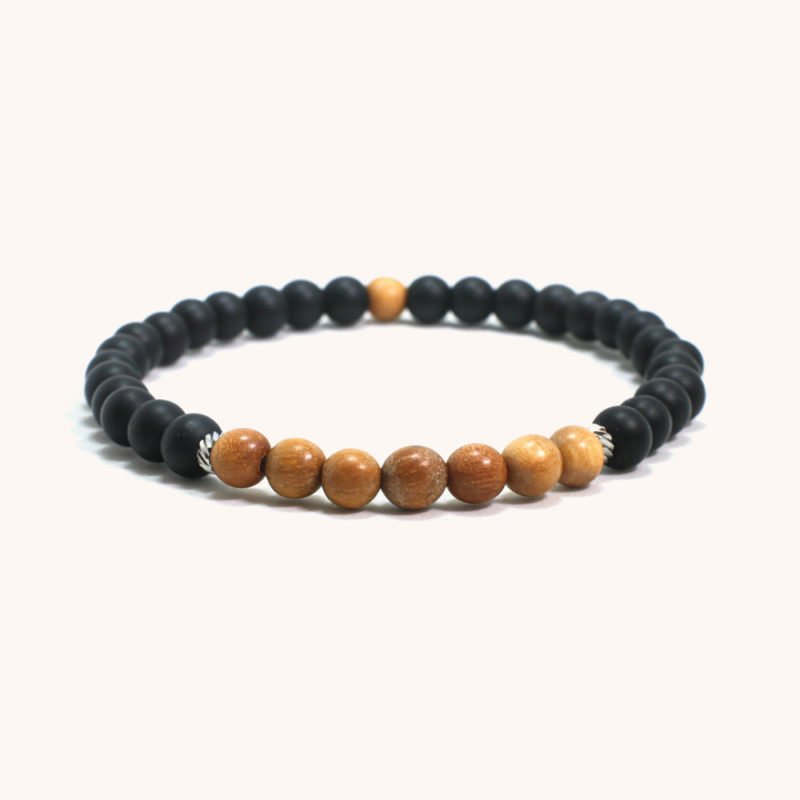
Look: honey to golden-tan, with visible grain lines. Lighter and warmer than green sandalwood.
What it is: a light, warm-toned wood sold under the sandalwood name; the exact species varies by supplier.
How it ages: it warms slightly toward amber with wear, and the grain becomes more visible.
Best for: contrast. Against black stones it looks bright and modern; against blue stones it reads like sand next to water; with earthy stones it makes the whole bracelet glow. See how it works with three very different stones:
- With black onyx – the black onyx and yellow sandalwood bracelet
- With blue dumortierite – the dumortierite and yellow sandalwood bracelet
- With unakite – the unakite and yellow sandalwood bracelet
Does a Sandalwood Bracelet Smell?
Usually a little, especially when new. Expect:
- A light, dry, woody scent close to the skin, not something people across the room will notice.
- Stronger scent when warm – body heat and a little friction bring it out.
- Fading over weeks or months, as the surface oxidises and picks up skin oils.
You can sometimes bring a little of it back by gently rubbing a bead between your palms. Avoid adding perfume or essential oils directly to wood beads: oils can stain the wood, weaken the elastic cord and transfer onto stone beads. If you want a bracelet designed to hold scent, porous lava stone is the better choice – see our lava bead bracelet guide.
Which Stones Pair With Each Wood
| Stone | Green sandalwood | Yellow sandalwood |
|---|---|---|
| Black onyx | Quiet, dark | High contrast, modern |
| Jade and green stones | Tonal, natural | Warm, earthy |
| Blue stones (lapis, dumortierite) | Cool, deep | Bright, coastal |
| Unakite | Leans green | Leans pink and gold |
| Ruby zoisite | Tonal, rich | Busy – not our first choice |
For more on how different wood species look and wear, see our wood bead species guide.
How to Care for Sandalwood Beads
- Keep it dry. Take the bracelet off before showering, swimming or washing dishes. Water raises the grain and can dull the finish.
- Avoid sweat-heavy sessions. Workouts in a wood bracelet speed up darkening and wear on the cord – our post on beaded bracelets and summer sweat has more detail.
- Wipe with a dry cloth. If the wood looks dry, a tiny amount of unscented beeswax on a cloth, buffed off, restores the sheen. Keep it off the stone beads.
- Store flat, away from sunlight. Long exposure to direct sun fades and dries wood.
The full routine for mixed stone-and-wood bracelets is in our bracelet care guide. Or browse every combination in the bracelet collection.
FAQ
Is green sandalwood real sandalwood?
Usually not in the botanical sense. True sandalwood belongs to the Santalum genus. Beads sold as green sandalwood are commonly made from a dense, aromatic South American hardwood with a green-brown color. It’s a genuine natural wood with a light scent – the name describes its look and character rather than its species.
How long does the scent of a sandalwood bracelet last?
The scent is usually strongest in the first weeks and gradually fades over a few months as the wood’s surface oxidises and absorbs skin oils. Body warmth and gently rubbing the beads can bring some of it back. It is meant to be subtle and close to the skin.
Can I get a sandalwood bracelet wet?
Try not to. Occasional splashes are fine, but soaking the bracelet in water – showering, swimming, washing dishes – raises the grain, dulls the finish and weakens the elastic cord over time. Take it off first, and if it gets wet, pat it dry and let it air-dry flat.
Why is my green sandalwood bracelet getting darker?
Green sandalwood naturally deepens in color with exposure to light, air and skin contact. Over months it moves from olive toward a darker green-brown. This is a normal change in the wood, not damage, and it’s one reason worn wood bracelets develop a character new ones don’t have.
What is the difference between green and yellow sandalwood beads?
Green sandalwood is darker, olive to green-brown, with fine grain, and blends with green and blue stones. Yellow sandalwood is honey to golden-tan with visible grain, and creates contrast with black, blue and earthy stones. Both have a light woody scent and need the same care.
Mr. Woodini was founded in 2018. We design eco-accessories built from materials with a story – natural stone beads, real wood and handcrafted construction. Our bracelets are handmade in Israel, and our guides are written from direct experience: sourcing stones, testing daily wear, and building pieces by hand. Learn more about us.