


Reading time: approximately 5 minutes
Howlite is the stone you’ve probably worn without knowing its name. In its natural state it’s chalk-white with fine grey or black veins, like a piece of marble shrunk down to a bead. But because it’s porous and takes color easily, a lot of howlite on the market has been dyed – most often blue-green, and sold as turquoise.
A natural white howlite bracelet is one of the most versatile pieces you can own: it brightens dark stones, cools down warm ones, and goes with almost any color you wear. This guide covers what howlite is, how to tell natural from dyed, how fragile it really is, and how to wear it.
Table of Contents
What Is Howlite?
Howlite is a calcium borosilicate mineral. It was identified in 1868 near Windsor, Nova Scotia, and named after Henry How, the Canadian chemist and mineralogist who described it. Much of the howlite used in jewelry today comes from deposits in California.
In its natural form it’s:
- White to cream with a slightly chalky, matte-to-satin polish
- Veined with grey, brown or black lines in a web-like pattern
- Opaque – light doesn’t pass through it
No two beads have the same veining, which is how you can tell natural howlite from white glass or plastic. The pattern is irregular, sometimes heavy, sometimes almost absent.
Howlite and Dyed “Turquoise”
Howlite is porous, so dye soaks into it evenly and settles into the veins. That makes it the most common turquoise imitation in the bead world – dyed blue-green with dark veins, it looks a lot like turquoise matrix at a glance.
Dyed howlite isn’t a bad stone, but it should be sold as dyed howlite. Signs you’re looking at dyed rather than natural turquoise:
- Very uniform, saturated color across every bead
- Dye pooling darker around the drill hole and inside the veins
- Color transferring to a cotton swab dipped in a little acetone
- A price that’s far too low for turquoise
You’ll also see white howlite sold as “white turquoise” or “white buffalo.” It’s a trade name rather than a real turquoise variety. Our guide on how to tell if a gemstone bracelet is real walks through these checks in more detail.
Is Howlite Durable Enough for a Bracelet?
Yes, with some care. Howlite is soft – around 3.5 on the Mohs scale, softer than glass. In practice:
- It can scratch if knocked against stone counters, metal or harder beads. Light scratches show less on veined howlite than on plain white.
- It absorbs – lotions, perfume and oils can discolor it over time. Put the bracelet on after skincare, not before.
- It doesn’t love water. A rinse won’t hurt, but soaking and chlorine should be avoided. See whether you can shower with a stone bracelet.
Store it apart from harder stones like onyx and tiger eye, and clean with a soft dry or barely damp cloth.
What Howlite Pairs Best With
Because it’s white, howlite works as the “light” in a bracelet – it gives darker or more colorful stones room to breathe.
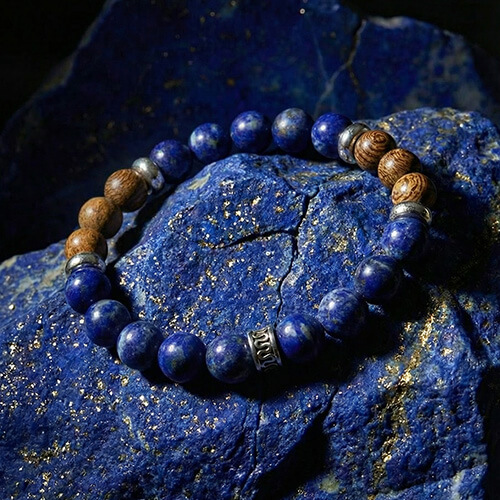
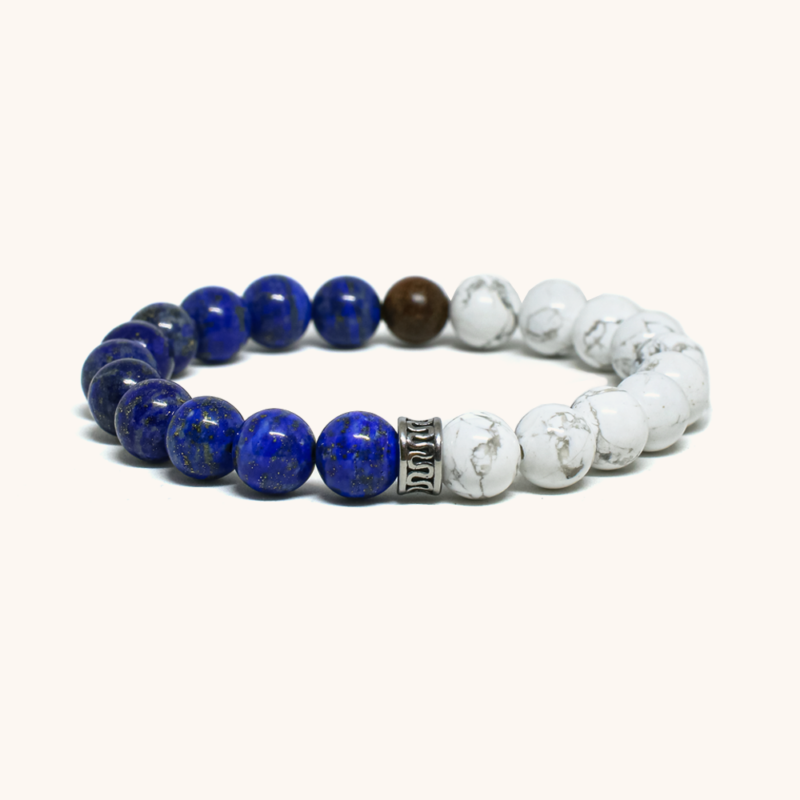
With blue: howlite and lapis lazuli is a classic, crisp combination – like the blue and white lapis lazuli bracelet with howlite and walnut. The white makes the blue look deeper.
With black: high contrast, graphic and modern. The black skull and white howlite bracelet is the bolder version of this.
With red and blue: howlite is the white in our USA red, white and blue bracelet, alongside red jasper and lapis lazuli.
With symbols: it’s part of the Mediterranean blue-and-white palette in the Greek evil eye bracelet. If you’re curious about that symbol, see the history of the evil eye.
How to Wear a Howlite Bracelet
Summer: white stones look best against a tan and with light linen, white tees and denim. A howlite-and-blue bracelet is about as summery as jewelry gets.
Year-round: paired with black stones or dark wood, howlite works in winter too – it looks sharp against navy, grey and black knitwear.
In a stack: one white bracelet lifts a stack of dark ones. Put it next to a black onyx or lava bracelet and the whole wrist looks lighter. Our stacking guide has more combinations.
For more blue-and-white ideas, see our post on wearing blue bracelets every day – or browse the full bracelet collection.
FAQ
Is howlite a real stone?
Yes. Howlite is a natural calcium borosilicate mineral, first identified in Nova Scotia in 1868. In its natural state it’s white with grey or black veins. It’s often dyed to imitate turquoise and other stones, but the base material is a genuine natural stone.
How can I tell if my turquoise is actually dyed howlite?
Look for perfectly even color on every bead, dye collected around the drill holes and in the veins, and color that rubs off on a cotton swab with a little acetone. Price is also a clue – natural turquoise costs far more than dyed howlite. A reputable seller will name the stone correctly.
Does howlite break easily?
Howlite is soft, around 3.5 on the Mohs scale, so it scratches more easily than harder stones, but it doesn’t shatter with normal wear. Avoid knocking it against hard surfaces, store it apart from harder beads, and keep it away from chemicals, lotions and long soaks.
What is white turquoise?
“White turquoise” is usually a trade name for white howlite or magnesite, not a real white variety of turquoise. These stones look similar – white with dark veining – but are different minerals. The name is common in jewelry, so check the stone description if accuracy matters to you.
What color goes with a white howlite bracelet?
Almost everything. Howlite works with blue stones like lapis lazuli for a crisp look, with black onyx for contrast, and with warm woods for a softer feel. In clothing, it’s at its best with white, navy, denim, linen and summer colors, and still works with dark winter knitwear.
Mr. Woodini was founded in 2018. We design eco-accessories built from materials with a story – natural stone beads, real wood and handcrafted construction. Our bracelets are handmade in Israel, and our guides are written from direct experience: sourcing stones, testing daily wear, and building pieces by hand. Learn more about us.