



Reading time: approximately 7 minutes
Most bracelet damage is preventable. Perfume degrades the elastic and stains porous stones. Water alone rarely causes problems – but the products that come with water do. A few habits catch most of the wear.
Why Does Bracelet Care Matter?
A handcrafted beaded bracelet has two components that age differently: the stone beads, which are essentially permanent, and the cord holding them together, which degrades over time with use and exposure. The stone itself – whether onyx, tiger eye, lava rock or any other natural gemstone – is durable material. Most gemstones rate 6 or higher on the Mohs hardness scale. Under normal wear, they don’t degrade, crack or lose their color. What they do lose, gradually, is their surface finish. The cord is the vulnerable element: elastic cord weakens with repeated stretching, water exposure and chemical contact. With the right care habits, cord life can be measured in years rather than months.
What Is the Best Daily Cleaning Routine?
The most effective care routine is also the simplest: wipe the bracelet down with a soft, dry cloth after each wear. This takes about ten seconds and removes the skin oils, sweat and surface dust that accumulate during the day before they have a chance to penetrate the stone surface or sit in the cord fibers. Use a microfiber cloth or a clean cotton cloth – avoid paper towels, which are slightly abrasive on polished stone surfaces and will introduce micro-scratches over time.
Wipe gently along the bracelet, getting between the beads as much as possible. Pay attention to the cord sections visible between beads – this is where oils and debris collect and where early cord wear is most visible. This daily wipe prevents the gradual dullness that makes a bracelet look old before its time.
How Do You Deep Clean a Bracelet by Stone Type?
A more thorough cleaning every few weeks or when the bracelet looks noticeably dull is appropriate for most beaded bracelets. For dense, polished stones like black onyx, tiger eye and hematite: dampen a soft cloth with plain lukewarm water – not soaking wet, just slightly damp. Wipe the bracelet thoroughly, getting into the spaces between beads. Follow immediately with a dry cloth to remove all moisture. Allow to air dry completely before wearing or storing.
For porous stones like lava rock and howlite: use a dry cloth only. These stones absorb moisture and can trap soap and chemicals in their pores. For wood beads: wipe with a dry cloth. Wood is sensitive to moisture and can swell, crack or warp with water exposure. A tiny amount of natural wood oil (jojoba or linseed) applied and buffed off can restore luster if the wood looks dry – but use sparingly.
| Stone | Cleaning Method | Water OK? | Special Notes |
|---|---|---|---|
| Black Onyx | Damp cloth, dry immediately | Minimal, no soaking | Buff with dry cloth to restore shine |
| Tiger Eye | Damp cloth, dry immediately | Minimal, no soaking | Avoid direct sunlight for extended periods |
| Lava Rock | Dry cloth only | No – porous, absorbs liquids | Can absorb essential oils intentionally |
| Lapis Lazuli | Barely damp cloth, dry fast | Minimal only | Avoid acids – can damage gold fleck |
| Wood beads | Dry cloth, occasional natural oil | No – warps and cracks | Use jojoba or linseed oil very sparingly |
What Should You Keep Away from Your Bracelet?
Most bracelet damage comes from chemical exposure rather than physical wear. Perfume and cologne should never be sprayed directly onto a bracelet – the alcohol in fragrance products degrades elastic cord and can etch or dull certain stone surfaces. Apply fragrance to skin and let it dry before putting the bracelet on. Sunscreen is another common problem: apply sunscreen, let it absorb, then put the bracelet on. If sunscreen gets on the bracelet, wipe it off immediately.
Household cleaning products, bleach, chlorine (pool water) and hand sanitizer should all be avoided. Remove the bracelet before cleaning, swimming in a chlorinated pool or using any chemical products. For more on specific stones and water exposure, see the shower and water exposure guide.
How Should You Store Beaded Bracelets?
Store bracelets flat or hanging, in a dry location away from direct sunlight. Prolonged UV exposure can fade some stone colors – tiger eye and certain dyed stones are particularly sensitive. A drawer or jewelry box away from windows is ideal. Store separately from harder jewelry – diamonds, sapphires and other very hard stones can scratch the surface of softer gemstone beads if stored in contact with them. A separate compartment or individual pouch for each bracelet prevents this.
High-humidity environments like bathrooms are poor storage locations. The ambient moisture from daily showering creates exactly the conditions that degrade elastic cord over time. Store bracelets in a bedroom or closet, not the bathroom.
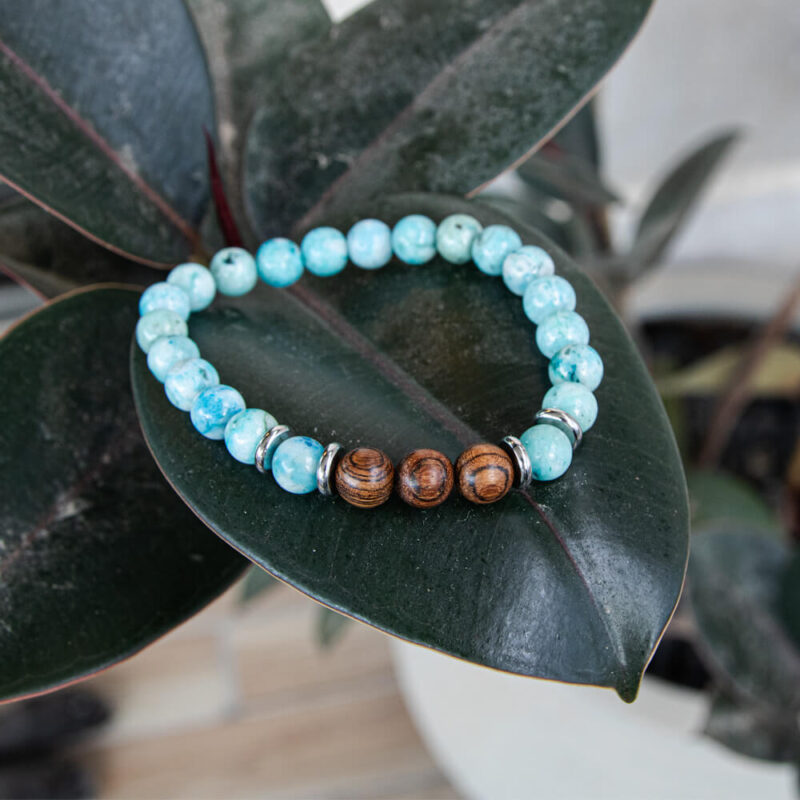
How Do You Know When the Cord Needs Replacing?
The cord is the part of the bracelet that fails first, and catching early signs of wear prevents an unexpected breakage. Run your fingers along the bracelet once a month or so, feeling for roughness, fraying or uneven tension between beads. If the bracelet feels noticeably looser than it did when new, the cord has stretched and lost elasticity – this is the first sign that restringing will be needed before long. If you feel rough or scratchy texture where the cord passes through a bead hole, the cord is fraying at that point. This is the warning sign that precedes breakage – restring promptly.
Never tug sharply on the bracelet to put it on or take it off. Slide the bracelet over the hand with a smooth motion. Repeated sharp stretching weakens the cord at bead holes faster than any other single habit.
When and How Do You Restring a Bracelet?
Restringing is simple, inexpensive and completely restores a bracelet whose cord has worn out while leaving the beads themselves unchanged. Signs it’s time to restring: the bracelet has become noticeably loose, the cord shows visible fraying between beads, the bracelet has had regular water exposure for more than a year, or the cord looks discolored or stiff. Any jeweler who works with beaded pieces can restring a standard elastic bracelet – it’s typically minimal cost and takes a few minutes. If a bracelet breaks before you get it restrung, collect all the beads: natural stone beads are the durable part of the piece and can always be restrung onto new cord.
Worth Considering
Red Tiger Eye Stone Bracelet with 316L Steel Engraved Bead – combines dense polished stones with natural wood. All three materials have simple care requirements covered in this guide.
Browse the full men’s bracelet collection – all bracelets are handmade in Israel and available in sizes 17-22cm.
Mr. Woodini was founded in 2018. We design eco-accessories built from materials with a story – recycled wood temples, natural stone beads, handcrafted construction. Our guides are written from direct experience: sourcing stones, testing daily wear, and building pieces by hand. Learn more about us.
Questions About Bracelet Care
A quick wipe with a soft dry cloth after each wear is enough for regular maintenance. A more thorough cleaning with a barely damp cloth (for polished stones) or dry cloth only (for porous stones) every few weeks keeps stone surfaces looking their best.
Chlorinated water, saltwater, perfume, sunscreen and cleaning products. Remove before swimming, showering and exercise. Apply perfume and lotion before putting on the bracelet, not after.
In a fabric-lined pouch or compartmentalized box, separated from other jewelry. Harder stones scratch softer ones in contact. Store in a cool, dry place away from direct sunlight – not in the bathroom, where ambient moisture from showering degrades elastic cord.
When the bracelet has become noticeably loose, when the cord shows visible fraying between beads, or after a year or more of regular water exposure. Any local jeweler can restring a standard elastic bracelet quickly and at minimal cost. The stone beads are the durable part and are not affected by restringing.