


Estimated Reading Time: 7 minutes

Blue works on a wrist the way navy works in a wardrobe – it pairs with almost everything without drawing attention to itself. The stone you choose determines whether it reads as casual, formal, or somewhere in between.
Table of Contents
- Why Blue Works in Everyday Jewelry
- Blue Stones Used in Bracelets
- Blue Stone Comparison Table
- Lapis Lazuli: The Classic Blue Stone
- How to Style a Blue Bracelet
- Using Blue in a Bracelet Stack
- Outfit Pairings for Blue Bracelets
- Outfit Pairing Table
- Blue Bracelets for Men
- Natural vs. Dyed Blue Stones
- Mr. Woodini Collection
- About Mr. Woodini
- Common Questions
Why Blue Works in Everyday Jewelry
Blue is one of the most reliably wearable colors in accessories because it operates as a near-neutral in most wardrobes. Most men already own blue clothing – jeans, shirts, suits – so a blue accessory connects naturally to what’s already there rather than introducing a color that needs to be justified.
The range of blue in natural stone is also wide enough to cover different style preferences. Deep lapis lazuli reads as rich and deliberate. Soft labradorite reads as understated and iridescent. Blue-veined howlite reads as minimal and quiet. There’s a version of blue that works for almost any style, which makes it more accessible than more polarizing colors like red or green.
Blue also photographs well and reads clearly across different skin tones and in different lighting, which matters if you’re someone who wears accessories as part of a considered everyday presentation.
Blue Stones Used in Bracelets
Several natural stones produce blue coloring through different mineral processes, and each has a distinct look in bracelet form. Understanding the differences helps you choose the shade and character of blue that works for your style.
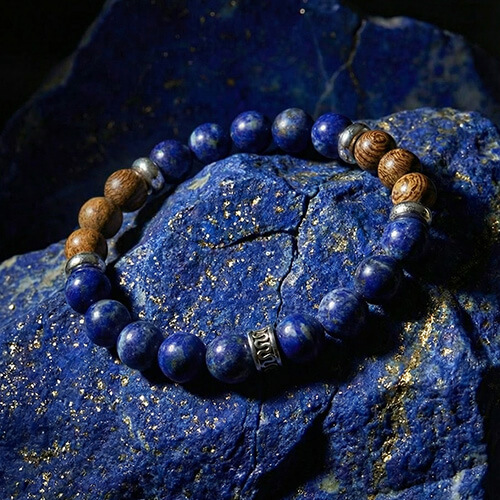
Lapis lazuli is the most saturated and traditional blue stone – deep navy with visible gold pyrite flecks and sometimes white calcite veining. It’s been used in jewelry and ornamentation since ancient times and has an established cultural presence that no other blue stone matches.
Labradorite sits at the blue-grey end of the spectrum. Its most distinctive quality is labradorescence – an optical effect that causes the stone to shift between grey, blue, green and gold depending on the angle of light. It’s subtler than lapis lazuli and particularly interesting in changing light conditions.
Blue howlite and blue-dyed turquoise are also common in the bracelet market, though both are typically enhanced rather than naturally blue. Howlite is naturally white and takes dye readily; many “blue” howlite bracelets are dyed white howlite rather than a naturally blue stone.
Aquamarine and blue topaz appear in higher-end jewelry. In 8mm bead form they’re less common than lapis or labradorite but available from specialty jewelers.
Blue Stone Comparison Table
| Stone | Shade of Blue | Key Characteristic | Natural Color? |
|---|---|---|---|
| Lapis Lazuli | Deep navy | Gold pyrite flecks, ancient stone | Yes |
| Labradorite | Blue-grey, iridescent | Color shifts with light angle | Yes |
| Blue Howlite | Medium blue | Usually dyed – check before buying | Usually no |
| Turquoise | Teal to sky blue | Often stabilized or dyed at lower price points | Varies |
| Aquamarine | Light blue | Transparent, light quality | Yes |
Lapis Lazuli: The Classic Blue Stone
Lapis lazuli deserves a section of its own because it’s the reference point for blue stone jewelry. It’s been used in decorative objects and jewelry for over 6,000 years – found in ancient Egyptian artifacts, Renaissance paintings (ground lapis was used to produce ultramarine pigment), and contemporary jewelry from every tradition. No other blue stone has this depth of cultural presence.
In bracelet form, lapis lazuli reads as rich and deliberate. The deep blue is not subtle – it commands attention when you look at the wrist. The gold pyrite flecks that appear in quality lapis add a warm metallic quality that keeps the stone from feeling cold or flat.
Quality lapis ranges from stones with even, deep blue color and visible gold fleck to paler, more mottled material with less saturation. Higher quality lapis is evenly colored with dense blue throughout and clearly visible gold pyrite rather than just surface dusting. Lower quality material shows significant white calcite patches and uneven color.
For everyday wear, lapis works best as the statement piece in a stack built around neutral foundation stones – black onyx, lava rock or wood – rather than as one of many colored elements competing for attention.
How to Style a Blue Bracelet
The key to wearing a blue bracelet well is treating it as a color accent rather than the primary element of an outfit. Blue stone on a wrist draws the eye to that point. If the rest of the look is neutral – grey, black, white, navy, earth tones – the bracelet reads as a considered detail. If the rest of the look already has competing color, the blue competes rather than accents.
The simplest rule: if you’re wearing a colorful outfit, choose a neutral stone bracelet. If you’re wearing a neutral outfit, a blue stone bracelet adds exactly the right amount of color interest without overwhelming.
Blue also echoes blue clothing in a way that reads as coordinated rather than matching. A lapis bracelet worn with a navy shirt or blue jeans has a visual connection to the clothing that feels intentional. The same bracelet with an olive green outfit stands as a deliberate contrast.
Using Blue in a Bracelet Stack
In a bracelet stack, blue is most effective as the accent piece rather than the foundation. Build the stack with neutral or earth-tone stones – onyx, tiger eye, lava, wood – and add one blue stone piece as the color element. This keeps the overall stack grounded while introducing a clear point of visual interest.
A three-piece stack might be: lava rock (foundation, dark and textured), black onyx (mid-layer, smooth and polished), lapis lazuli (accent, rich blue). Each piece is distinct in texture and color while all three share a natural-materials quality that holds them together.
Avoid stacking multiple blue stones of different shades. Blue lapis next to blue-grey labradorite creates color confusion rather than harmony. One blue stone, clearly present among neutrals, is more effective than two or three blue elements competing.
Outfit Pairings for Blue Bracelets
Blue stone bracelets work across a broader range of outfits than most single-color accessories because blue is already present in most men’s wardrobes. The stone connects to existing wardrobe pieces without requiring new ones.
With a white shirt: any blue stone looks clean and deliberate against white. The contrast is clear and the blue reads as the color accent for the whole look.
With navy or dark blue clothing: the bracelet echoes the clothing color at the wrist, creating a tonal connection. Deep lapis lazuli is particularly effective here because its shade of blue is close to navy without being identical.
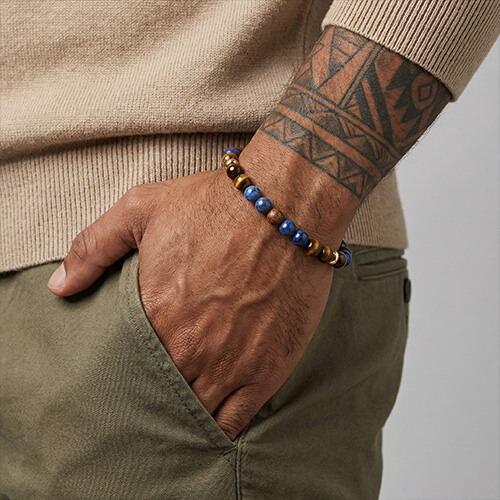
With earth tones – khaki, olive, tan, brown: blue provides a cool contrast against warm neutrals. Tiger eye and lapis lazuli in the same stack particularly suits this palette.
Outfit Pairing Table
| Outfit | Blue Stone Pick | Why It Works |
|---|---|---|
| White shirt | Lapis lazuli | Strong contrast, classic combination |
| Navy / dark blue | Lapis lazuli or labradorite | Tonal echo at the wrist |
| Earth tones (khaki, olive) | Lapis lazuli | Cool accent against warm neutrals |
| Grey | Labradorite | Similar tone, iridescent quality adds interest |
| Patterned / colorful | Skip blue – use neutral stone | Too many colors compete |
Blue Bracelets for Men
Blue is one of the more accepted bracelet colors for men who are new to wearing jewelry. It’s distinctive without being flamboyant, and it connects to blue clothing that most men already wear without effort.
For a first blue bracelet, lapis lazuli is the most considered choice. The depth of color and the cultural history behind the stone give it a gravity that lighter or more obviously decorative blue stones don’t have. It doesn’t read as trendy or try-hard; it reads as a deliberate choice made by someone who knows what he’s looking at.
8mm lapis beads in a single strand at 19cm is the right starting point for most men – large enough to be clearly visible, simple enough to work across contexts, and sized for a comfortable everyday fit.
Natural vs. Dyed Blue Stones
The blue stone bracelet market contains a significant proportion of dyed material – typically white howlite dyed blue, or low-grade turquoise that’s been color-stabilized and enhanced. These pieces can look similar to naturally colored stones at first glance and at low prices, but they behave differently over time.
Dyed stones can fade with prolonged wear, especially with water and sweat exposure. The dye sits on the surface rather than being part of the mineral structure, so it gradually wears off. Natural lapis lazuli doesn’t fade – the blue comes from lazurite in the mineral composition and is as stable as the stone itself.
To identify natural vs. dyed: look for consistency of color. Uniformly perfect, identical blue across every bead suggests dye. Natural lapis shows slight variation – areas of deeper and lighter blue, occasional white calcite patches, visible gold pyrite. That variation is the sign of real material.
Mr. Woodini Collection
Mr. Woodini’s bracelet collection includes natural lapis lazuli in 8mm beads, available in sizes from 17cm to 22cm. Each bracelet is handcrafted and ships with gift packaging included.
Lapis lazuli is one of the most distinctive stones in the Mr. Woodini collection. The deep blue with gold fleck reads as deliberate and considered – the right choice for someone who wants a color accent that says something specific. All orders ship internationally with gift packaging included.
Browse the full men’s bracelet collection to find your stone and size.
About Mr. Woodini
Mr. Woodini was founded in 2018 by Idan Birnberg. We design eco-accessories built from materials with a story — recycled wood temples, natural stone beads, handcrafted construction made in Israel. Our guides are written from direct experience: sourcing stones, testing daily wear, and building pieces by hand. Learn more about us.
Common Questions
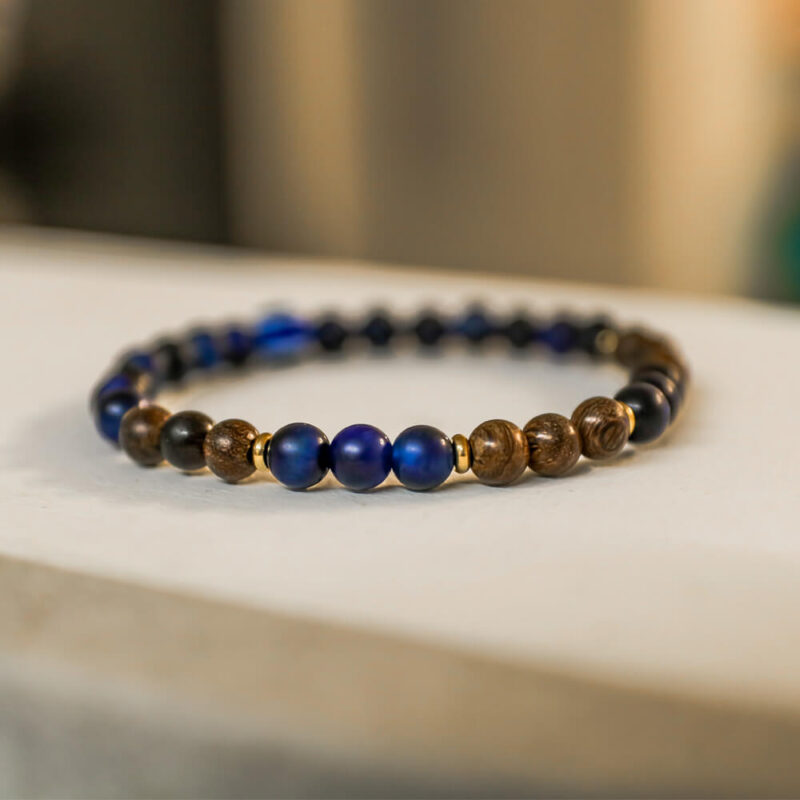

Unlike trendy colors that may feel dated quickly, blue remains a classic choice that withstands changing fashion cycles. Investing in quality pieces like lapis lazuli bracelets or blue tiger eye bracelets ensures long-term wearability and style relevance.
Care and Maintenance
To keep blue bracelets looking their best:
- Store lapis lazuli bracelets away from direct sunlight to prevent color fading
- Clean blue tiger eye bracelets gently with soft cloths to maintain their lustrous finish
- Avoid exposure to harsh chemicals that might affect stone color or clarity
- Rotate between different pieces to prevent excessive wear
Building Your Blue Bracelet Collection
Start with one versatile blue bracelet in a shade that complements your most-worn clothing colors. A lapis lazuli bracelet provides deep, rich color perfect for formal occasions, while a blue tiger eye bracelet offers subtle versatility for daily wear. Gradually add different tones and textures to create a collection that offers styling variety while maintaining color cohesion.
Consider mixing materials – combine the smooth finish of lapis lazuli bracelets with textured metals, or pair the natural patterns of blue tiger eye bracelets with complementary stones for visual interest and depth.
Conclusion
Blue bracelets offer an accessible way to incorporate color into everyday styling while maintaining sophistication and versatility. Whether you choose the royal elegance of a lapis lazuli bracelet or the subtle shimmer of a blue tiger eye bracelet, these accessories provide endless opportunities for personal expression and style enhancement in your daily wardrobe. Their calming psychological impact, broad color compatibility, and timeless appeal make them excellent additions to any jewelry collection.
Questions About Blue Bracelets
Lapis lazuli offers a deep royal blue with gold flecks. Dumortierite is more blue-violet with a glassy finish. Sodalite is softer and lighter. All are natural, not dyed.
Neutrals — white, grey, beige, black and navy — are the strongest pairings. Blue stone against a white shirt or grey sweater creates clean, strong contrast without competing colors.
Not with natural stone. The depth and variation in lapis or dumortierite makes the blue feel grounded rather than loud. It’s a statement that works without shouting.
Yes — pair blue with black onyx for a dark, bold stack. Or with wood beads for an earthy contrast. Avoid mixing blue with red or green in the same stack — it gets visually busy.