



Reading time: approximately 7 minutes
Most fake gemstone bracelets aren’t fake in an obvious way. They’re glass that’s been tinted to look like aventurine, resin poured to imitate turquoise, or white howlite dyed blue and sold under a better name. Under shop lighting, in a product photo, they look fine. The difference shows up on the wrist, after a few weeks.
The good news: you don’t need a gemologist to know how to tell if a gemstone bracelet is real. Natural stone behaves in ways that glass and plastic can’t copy for long – it holds temperature differently, it carries weight, and no two beads come out of the ground looking the same. This guide walks through seven checks you can do at home in about ten minutes, what each one actually proves, and where the limits are.
Table of Contents
Why Fake Stone Bracelets Are So Common
A strand of glass beads costs a fraction of a strand of natural tiger eye or lapis lazuli. On a marketplace listing, both get photographed on the same white background and described with the same words. The incentive is obvious.
There’s also a grey zone. Some stones are routinely treated – stabilized, heated or dyed – and sold under their natural name. That isn’t always dishonest, but it should be disclosed, and often it isn’t. Knowing what you’re looking at protects you from paying natural-stone prices for something that isn’t.
7 At-Home Checks
1. The temperature test
Hold the bracelet in your closed hand for a second, then touch a bead to your lip or the inside of your wrist. Natural stone feels cool at first and takes a while to warm up. Plastic and resin feel close to room temperature immediately. Glass sits somewhere in between, which is why this test is a first filter, not a verdict.
2. The weight test
Stone is dense. An 8mm natural stone bracelet has a noticeable, settled weight on the wrist; a resin copy feels light and slightly hollow. If you have a bracelet you trust, compare the two in each hand. Exceptions exist – lava stone is porous and light by nature – so judge weight against the specific stone, not against stone in general.
3. Look for variation between beads
This is the most reliable check without tools. Natural stones vary from bead to bead: tiger eye shifts in its banding, lapis lazuli carries different amounts of white calcite and gold pyrite flecks, jasper changes in pattern. If every bead on the strand looks identical – same color, same pattern, same placement of “inclusions” – you’re probably looking at a manufactured material.
4. Check for bubbles
Hold a bead up to a strong light or use your phone camera on maximum zoom. Small round air bubbles inside the bead are a sign of glass or resin. Natural stone can have fractures, crystals and mineral inclusions, but not perfectly round bubbles.
5. Inspect the drill hole
Look at the edge where the cord enters the bead. Painted or coated beads often show a different color at the drill hole, where the coating has thinned. On dyed stones, color can collect around the hole and in surface cracks, making those areas look darker than the rest of the bead.
6. The acetone swab (for suspected dye)
Dab a cotton swab with a little nail polish remover and rub it gently on one bead, ideally close to the drill hole. If color transfers to the cotton, the bead is dyed. This is the classic way to catch howlite or magnesite dyed to imitate turquoise. Test only one bead, and skip this on wood beads or anything with a wax finish.
7. Look at the light, not just the color
Some stones have optical effects that are hard to fake well. Real tiger eye shows chatoyancy – a band of light that moves across the bead as you rotate it. Glass “cat’s eye” imitations show a similar effect, but it looks too even and too bright, like a stripe painted on. Matte stones like onyx in a matte finish should show a soft, consistent surface, not a printed texture.
What to Look for Stone by Stone
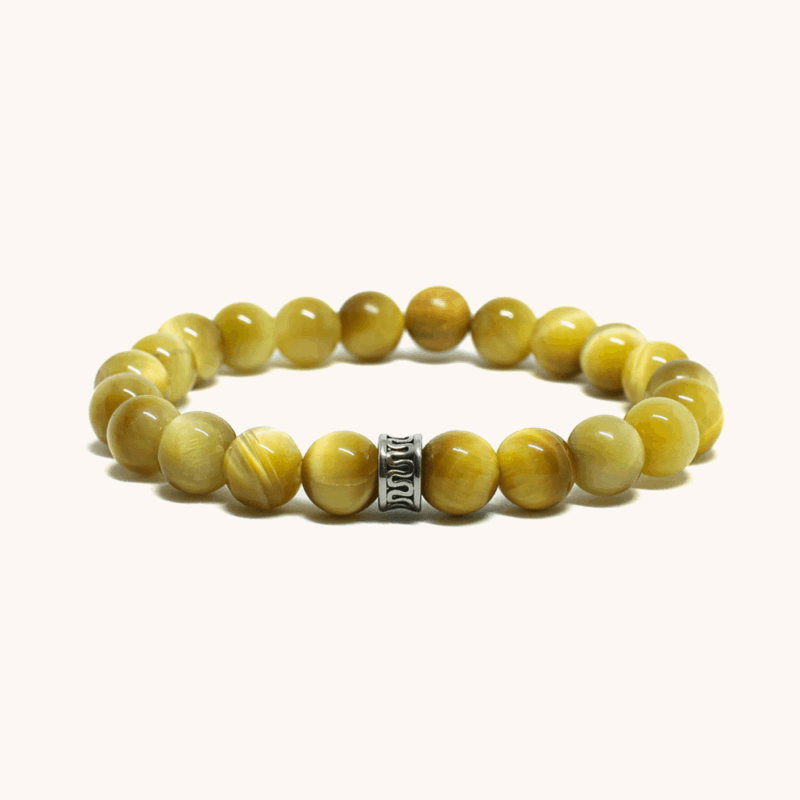
Tiger eye: moving band of light, warm gold-to-brown tones, banding that differs on every bead. Uniform, overly bright stripes suggest glass. Our tiger eye stone guide goes deeper into the color range.
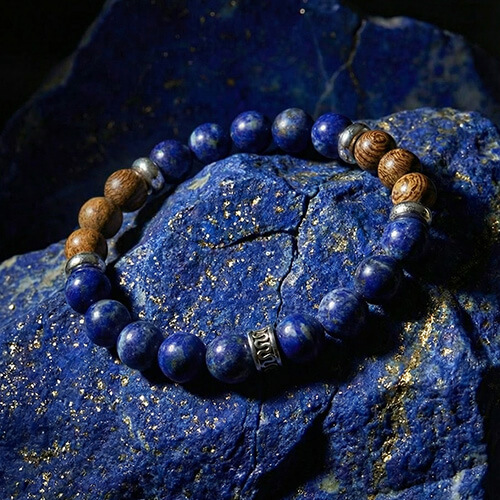
Lapis lazuli: deep blue with irregular white calcite patches and small gold pyrite specks. Perfectly even royal blue with no variation is a warning sign; so is blue color rubbing off on a swab. There’s more on what makes good lapis in why lapis has stayed popular for thousands of years.
Hematite: heavy, metallic, cool. Natural hematite is only very weakly magnetic. Beads that snap firmly to a fridge magnet are usually “magnetic hematite,” a manufactured material.
Lava stone: visibly porous, light for its size, matte and slightly rough. Smooth, shiny “lava” is usually dyed or coated.
Turquoise: one of the most imitated stones in jewelry. Look for natural matrix lines that sit in the surface rather than on it, and run the acetone test if the color looks unusually bright.
Dyed Stone vs Fake Stone: Not the Same Thing
It’s worth separating two problems. A fake is a different material entirely – glass, plastic or resin presented as stone. A dyed stone is real stone whose color has been changed. Dyed howlite is still howlite; it just isn’t turquoise.
Dyeing isn’t automatically bad – it’s common in the bead trade and some dyed stones look great. The issue is disclosure and price. If a listing calls it “turquoise” and it’s dyed howlite, you’re paying for a name you didn’t get. And dye can fade or bleed with sweat and water, which is one reason some beads change color over time.
How to Buy With Confidence
- Read the stone names closely. Trade names like “African jade” or “Canadian jade” are common and not necessarily misleading, but a good seller will tell you what the stone actually is.
- Look at real photos from several angles. Front, side and back shots let you see bead-to-bead variation.
- Be wary of very low prices. A natural stone bracelet with wood beads, sized to your wrist and finished by hand, can’t cost the same as a mass-produced glass strand.
- Ask how it’s made. Handmade bracelets are usually assembled in small batches by people who handle every bead – there’s more on why that matters in handcrafted vs mass-produced jewelry.
Every bracelet in our natural stone bracelet collection is made from natural stone and real wood, handmade in Israel, and named by the actual stones it contains. If you want a stone that makes these checks easy, a piece like the red tiger eye bracelet with an engraved steel bead shows its banding the moment you turn your wrist.
FAQ
How can I tell if my bracelet is real stone or glass?
Start with temperature and variation. Real stone feels cool and warms slowly, and its beads differ from each other in color and pattern. Glass warms faster, often shows tiny round air bubbles under strong light, and imitation beads tend to look identical. Use both checks together rather than relying on one.
Does a magnet test work for gemstone bracelets?
Only for a few stones. It’s useful for hematite: natural hematite is barely magnetic, while “magnetic hematite” beads stick firmly. For most other stones – tiger eye, onyx, lapis, jasper – a magnet tells you nothing, so don’t treat a lack of attraction as proof either way.
Is a dyed stone bracelet fake?
Not exactly. A dyed stone is real stone with altered color, while a fake is a different material such as glass or resin. Dyed stones are common and acceptable when disclosed and priced fairly. The problem is when dyed howlite is sold as turquoise or another more valuable stone.
Will the acetone test damage my bracelet?
On most natural stones a light swab on one bead does no harm. Avoid it on wood beads, waxed or oiled finishes, and stones with coatings, since acetone can strip the surface. Test close to the drill hole, use very little, and wipe the bead with a damp cloth afterwards.
Why does my natural stone bracelet look different from the photo?
Because no two natural beads are identical. Light, screen settings and the specific beads used in your bracelet all change how the color reads. Variation between the photo and your piece is normal for natural stone – and is one of the clearest signs that it is natural.
Mr. Woodini was founded in 2018. We design eco-accessories built from materials with a story – natural stone beads, real wood and handcrafted construction. Our bracelets are handmade in Israel, and our guides are written from direct experience: sourcing stones, testing daily wear, and building pieces by hand. Learn more about us.