





Reading time: approximately 6 minutes
The evil eye is one of the oldest ideas in recorded human history – older than most religions, older than most civilizations we can name. The core belief hasn’t changed much in five thousand years: a gaze driven by envy can cause real harm, and the right object can stop it.

What Is the Evil Eye?
The evil eye – “ayin hara” in Hebrew, “nazar” in Turkish and Arabic, “mal de ojo” in Spanish, “malocchio” in Italian – is the belief that a focused gaze, particularly one driven by envy or excessive admiration, can cause harm to the person being looked at. The harm is generally understood as unintentional. The person doing it may not know they’re doing it, but the effect is believed to be real regardless.
What makes the evil eye distinct from simple bad luck is the mechanism: it’s specifically envy that creates the danger. When someone looks at another person’s success, beauty, health or possessions with a covetous eye, that concentrated negative energy is thought to transfer directly to the subject. Children, newborns and people experiencing visible good fortune are traditionally considered most vulnerable. The evil eye appears in the Old Testament, in ancient Greek texts, in the Quran, and in the writings of philosophers including Plutarch and Francis Bacon. For more on how symbolism works in bracelet materials, see the meaning behind beaded bracelets.
Where Does the Evil Eye Come From?
The earliest documented reference is in Sumerian cuneiform texts from around 3000 BCE. Ancient Assyrian tablets describe the evil eye as a serious threat requiring ritual protection – not a metaphor, but a practical concern. In ancient Egypt, the Eye of Horus served partly as a counter to harmful gazes, and eye-form amulets have been found in tombs dating back to 3000 BCE. The Greeks called it “baskania” and theorized that the eyes could emit harmful rays. Roman writers including Pliny the Elder documented the evil eye extensively and specifically, describing particular families believed to have especially potent harmful gazes.
By the medieval period, the belief had spread through European Christian culture – officially condemned by the Church as superstition, widely practiced at the folk level regardless. That gap between official rejection and popular practice tells you something about how deeply embedded the belief was.
What Is the Nazar Bead?
The nazar boncugu – the blue glass eye bead – is the most globally recognized evil eye symbol. It’s produced primarily in Turkey, particularly in the Izmir region. Authentic nazar beads are made from melted glass formed in layers: a dark blue outer ring, lighter blue or white inner ring, black pupil, and typically a white or yellow highlight at the center. The layering is done while the glass is still hot, which is why mass-produced versions look flat by comparison – they don’t have the visual depth of genuine layered glass construction.
The blue color is deliberate. In Mediterranean tradition, blue – sometimes called “nazar blue” – was associated with protection. Anthropological research on the evil eye across cultures shows enough structural similarity that most scholars treat it as a single cross-cultural phenomenon with regional variations, not independent inventions.
Which Cultures Use Evil Eye Protection?
Almost all of them. Turkey and Greece have the nazar bead and the mati – the specific blue glass eye form most people recognize. The Middle East and Israel have the hamsa hand, blue beads and the red string. Italy has the cornicello – a twisted horn amulet. Spain and Latin America have the mal de ojo, treated with red ribbons and cleansing rituals. India has its own version, with black kajal applied to babies’ foreheads and iron objects used for protection. West African cultures have parallel protective traditions with different names and methods. The protective methods differ. The underlying structure – envy causes real harm, a physical object can deflect it – is consistent across all of them.
How Do You Wear an Evil Eye Bracelet?
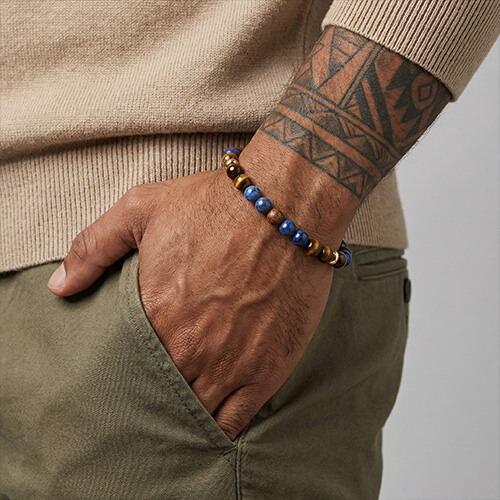
Evil eye bracelets are worn as protective objects, as cultural statements, and as style pieces – often as all three at once. In Mediterranean and Middle Eastern tradition, the left wrist is specified for protective amulets, as the left side is considered closer to the heart and more receptive to energy. In contemporary practice, most people wear their evil eye bracelet wherever it feels right or looks best with their other pieces. A blue glass evil eye bead bracelet pairs naturally with navy, white and neutral outfits. For pairing and stacking ideas, see the bracelet stacking guide. For lapis lazuli options in the same blue protective palette, see why choose a lapis lazuli bracelet.
“I got the evil eye bracelet as a gift and wasn’t sure what to expect – but I’ve been wearing it every day for four months. It stacks perfectly with my other bracelets and the quality is genuinely solid.”
Mr. Woodini Evil Eye Collection
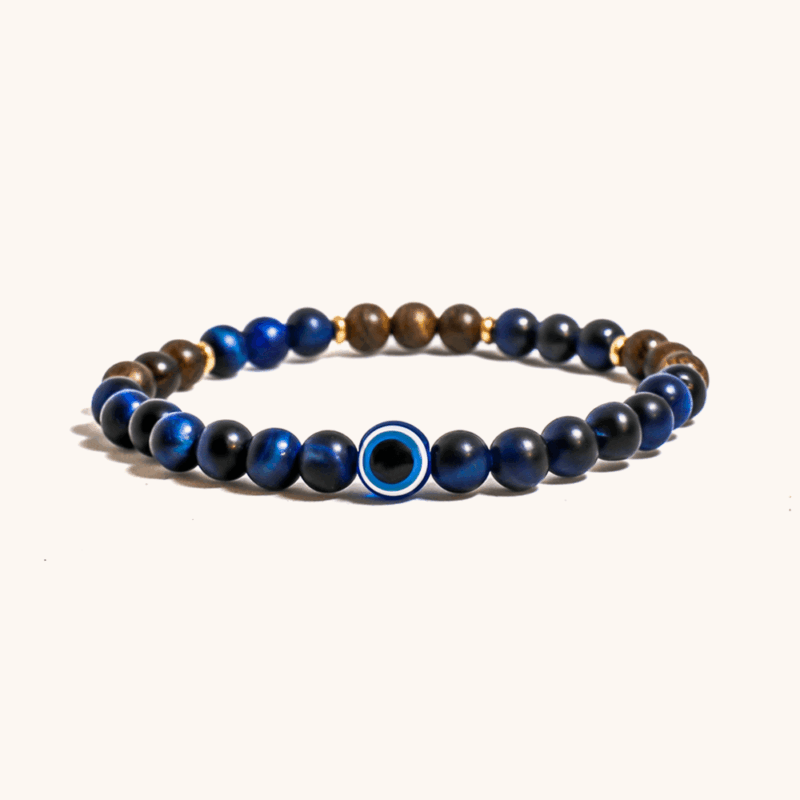
Evil Eye with Blue Tiger Eye and Sandalwood – the blue tiger eye stone and the evil eye charm work in the same protective blue tradition as the nazar bead. Handmade in Israel, ships internationally with gift packaging included.
Complementary pieces in the same palette: Lapis Lazuli and Zebrawood and Lapis and Howlite 8mm. Browse the full bracelet collection.
Mr. Woodini was founded in 2018. We design eco-accessories built from materials with a story – recycled wood temples, natural stone beads, handcrafted construction. Our guides are written from direct experience: sourcing stones, testing daily wear, and building pieces by hand. Learn more about us.
Questions About the Evil Eye Symbol
The evil eye is the belief that a focused gaze – particularly one driven by envy – can cause real harm to another person. An evil eye amulet (like the nazar bead) is worn visibly so the gaze lands on the amulet rather than on you. The protective object becomes the target instead of the person wearing it.
No. It appears in Jewish, Islamic, Christian, Hindu and animist traditions, among others, and predates all of them. The specific name, protective method and ritual language vary. The core belief – that envious attention causes harm and a physical object can deflect it – is consistent across all of them.
Yes. Evil eye jewelry has been worn by men across every culture that has the tradition – there’s no historical restriction on it. Men’s evil eye bracelets in dark blue, black and natural stone tones wear well as everyday pieces without reading as overly decorative.
The hamsa is a hand-shaped amulet from Middle Eastern and North African traditions. The evil eye (nazar bead) is an eye-shaped amulet from Mediterranean and Turkish tradition. Both protect against harmful gazes, and they’re frequently combined. They serve the same function from different but overlapping cultural origins.