


Estimated Reading Time: 8 minutes
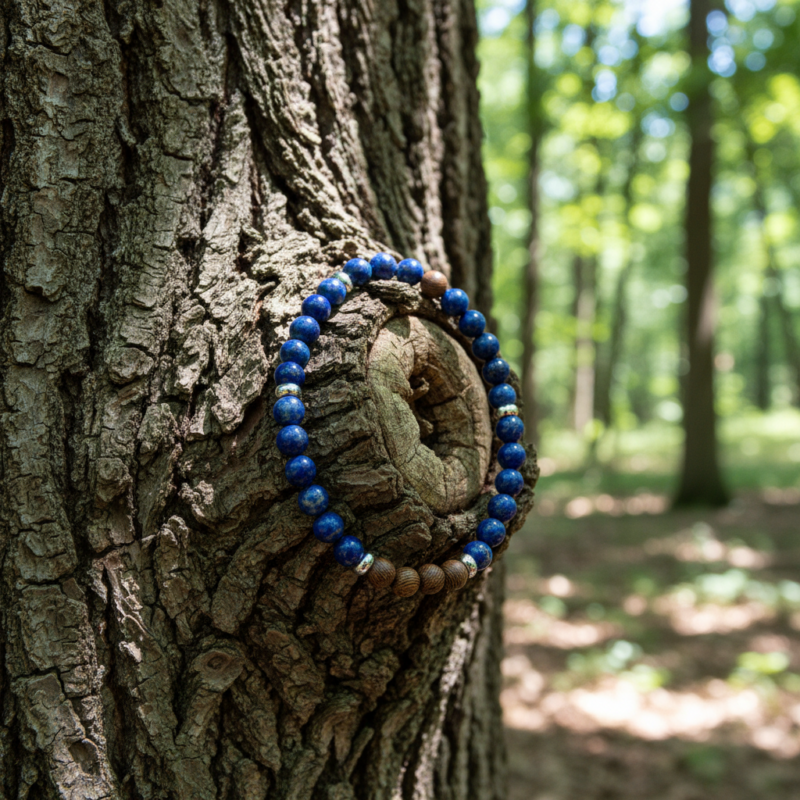
Lapis lazuli has been worn for over six thousand years. Not because of tradition – because the color is unlike anything else in natural stone. Deep, saturated blue with gold flecks that no synthetic material has convincingly replicated.
Table of Contents
- What Is Lapis Lazuli?
- Appearance and Visual Character
- 6,000 Years of Use
- Where It Comes From
- Traditional Beliefs and Cultural Meaning
- Hardness and Practical Durability
- 7 Reasons to Choose a Lapis Lazuli Bracelet
- How to Style It
- Stone Pairing Guide
- Mr. Woodini Collection
- About Mr. Woodini
- Common Questions
What Is Lapis Lazuli?
Lapis lazuli is not a single mineral but a metamorphic rock composed of several minerals in varying proportions. The primary component is lazurite, a blue tectosilicate mineral that gives the stone its characteristic deep blue color. Alongside lazurite, lapis typically contains calcite (white streaks or patches), pyrite (metallic gold flecks), and smaller amounts of other minerals including sodalite, haüyne, and diopside.
The blue color ranges from medium to deep navy blue, and the quality of lapis is assessed primarily on color depth, uniformity, and the ratio of blue lazurite to white calcite. High-quality lapis is deep, even blue with fine gold pyrite flecks scattered through it. Lower grades show more white calcite patches that interrupt the blue field. The pyrite flecks are a natural feature, not an impurity – they are part of what gives genuine lapis its distinctive character and distinguishes it from imitations and dyed substitutes.
Appearance and Visual Character
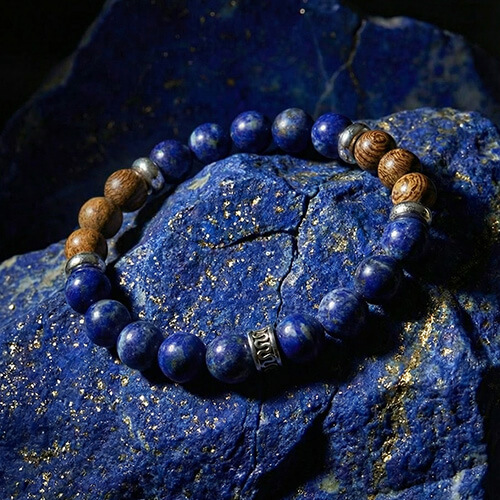
Lapis lazuli has a visual weight that few other stones match. The deep, saturated blue is opaque – it doesn’t transmit light like translucent stones – and the surface polishes to a waxy, slightly resinous luster. In 8mm beads, each bead shows a small section of the stone’s internal patterning: the distribution of blue, white, and gold varies from bead to bead, creating a natural rhythm along the bracelet without any two beads being identical.
The gold pyrite inclusions catch light independently of the stone’s surface. When a lapis bracelet is in direct light, the pyrite flecks reflect as small bright points across the deep blue field. This interplay between the matte blue background and the metallic inclusions gives lapis a complexity that solid-color stones lack.
The stone’s deep blue places it in a color category that very few gemstones occupy at this price point. Sapphire is the primary competitor in the blue range, but at a vastly higher price. Lapis offers comparable visual impact – a distinctive, saturated deep blue – in a natural stone that remains accessible for everyday use.
6,000 Years of Use
Lapis lazuli has been mined continuously from the same deposits in northeastern Afghanistan for at least 6,000 years, making it one of the oldest documented trade commodities in human history. Sumerian tombs from 3500 BCE at Ur contain lapis lazuli objects that were traded thousands of kilometers from the Afghan source. This trade predates written history and represents some of the earliest long-distance commercial exchange on record.
Ancient Egyptians prized lapis above almost all other stones. Pharaohs used it in jewelry, amulets, and funerary goods – Tutankhamun’s death mask incorporates extensive lapis lazuli inlay. Ground lapis was used as a blue pigment in painting, and the stone was associated with the night sky, the gods, and royal authority.
In medieval and Renaissance Europe, lapis lazuli was ground to produce ultramarine, a blue pigment so expensive that it was reserved for the most important figures in religious paintings – most commonly for the Virgin Mary’s robes. A single kilogram of ultramarine pigment in the 15th century cost more than the equivalent weight in gold. The word “ultramarine” means “beyond the sea” – describing the pigment’s origin from distant Afghanistan via Venice.
Where It Comes From
The Badakhshan province of northeastern Afghanistan, specifically the Sar-e-Sang mine in the Kokcha River valley, is the world’s oldest continuously operating mine and still the primary source of the highest-quality lapis lazuli. The mine sits at approximately 3,000 meters elevation and has been worked for at least 6,000 years with only brief interruptions.
Secondary sources include the Andes mountains in Chile and Argentina, where lapis of good quality is mined in the Coquimbo and Atacama regions. Chilean lapis tends to have more calcite (more white in the stone) and less pyrite than Afghan material, and is generally assessed as lower quality for jewelry purposes, though it is widely used in carving and decorative objects. Russia’s Lake Baikal region produces some lapis lazuli, and minor deposits exist in Canada, Pakistan, and the United States.
Traditional Beliefs and Cultural Meaning
Lapis lazuli carries a more consistent cross-cultural symbolic meaning than almost any other gemstone. Across Sumerian, Egyptian, Persian, Greek, Roman, and medieval European traditions – civilizations that had limited direct cultural contact – lapis is consistently associated with truth, wisdom, and divine insight. The recurrence of this association across independent traditions suggests something about the stone’s visual character that resonates universally: its deep, sky-like blue has been read as celestial and authoritative across human cultures.
In ancient Egypt, lapis was associated with the heavens and with the power of the gods. It was ground into eye shadow by the pharaohs and high priests – wearing the color of the sky was a statement of divine connection. In Sumerian myth, the gods’ thrones and the walls of paradise were described as being made of lapis lazuli.
In contemporary crystal healing tradition, lapis is associated with communication, clarity of thought, and intellectual honesty. It is often chosen as a gift for writers, teachers, lawyers, and others whose work involves careful use of language and truth-telling. These associations are cultural and traditional in nature, not medical claims, but they give lapis lazuli a gift-giving significance that goes beyond purely aesthetic choices.
Hardness and Practical Durability
Lapis lazuli sits at 5-6 on the Mohs hardness scale – softer than tiger eye or black onyx, but harder than malachite. At this hardness, the stone handles everyday wear well but benefits from some basic precautions. Avoid storing it in contact with harder stones, keep it away from household cleaners and acids (including perfume and sweat in quantity), and wipe it down after heavy use.
The stone should be cleaned with a soft damp cloth rather than soap or chemical cleaners, which can affect the calcite component and dull the surface over time. With appropriate care, lapis retains its deep blue color and polish indefinitely – examples from Egyptian tombs thousands of years old still show their original color quality.
7 Reasons to Choose a Lapis Lazuli Bracelet
| Reason | Why It Matters |
|---|---|
| 1. Visual distinction | Deep blue with gold pyrite is one of the most immediately recognizable gemstone looks – it reads as a considered choice, not a default |
| 2. Historical depth | 6,000 years of continuous use across major civilizations gives lapis a cultural weight that few materials can match |
| 3. Color versatility | Deep blue pairs cleanly with navy, black, white, grey, and gold – the colors that dominate most men’s wardrobes |
| 4. Natural pyrite detail | The gold flecks add complexity and light-catching interest that makes the stone compelling at close range |
| 5. Gift significance | Strong traditional associations with wisdom and truth make lapis a meaningful gift choice with a story behind it |
| 6. Natural uniqueness | No two lapis beads are identical – the distribution of blue, white, and gold varies throughout the stone |
| 7. Proven durability | Mohs 5-6 is sufficient for daily bracelet wear with normal care – proven over millennia of continuous use |
How to Style It
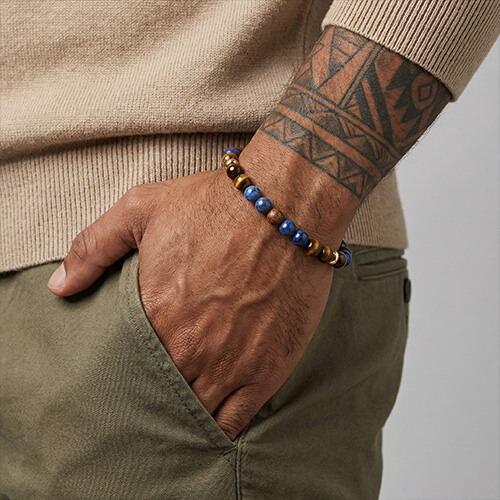
Lapis lazuli’s deep blue is a genuine accent color – it creates a clear focal point on the wrist and draws the eye. The most effective outfits for a lapis bracelet are those that don’t compete with it: black, white, navy, grey, and neutral earth tones all let the stone speak for itself.
For a refined daytime look, a single lapis bracelet paired with a gold or bronze watch creates a rich, layered wrist composition that works from a business meeting to a dinner. The gold hardware of the watch echoes the pyrite flecks in the stone, creating a visual connection between the two pieces.
In a casual setting, lapis works well as a single statement piece or stacked with a simple dark wood bracelet. The natural material combination – stone and wood – keeps the look grounded and organic. Avoid stacking lapis with other bright or saturated stones – it’s strongest when it has space to stand out.
Stone Pairing Guide
| Pairing | Effect | Best Context |
|---|---|---|
| Gold-tone watch or bangle | Echoes the pyrite flecks; classic and refined | Business casual, smart casual, evening |
| Dark wood bracelet | Grounds the blue with warm natural tone | Casual, outdoor, natural aesthetic |
| Black onyx | Strong dark-on-dark contrast; both stones hold their presence | Evening, bold casual |
| Worn alone | Maximum visual impact; the stone is the story | Any context – simplest and most versatile approach |
Mr. Woodini Collection
Mr. Woodini’s lapis lazuli bracelets use 8mm natural stone beads selected for deep color saturation and clear pyrite inclusions. Each bracelet is hand-strung on quality elastic cord and available in sizes from 17cm to 22cm.
At Mr. Woodini, every bracelet is handcrafted using natural materials selected for quality and consistency. Our stones are sourced for color and polish, strung on quality elastic cord with a finished double-knot at each bead. We offer sizing across the full adult range and ship internationally with gift packaging included on all orders.
Browse the full men’s bracelet collection to find the right stone and size for your wrist and style.
About Mr. Woodini
Mr. Woodini was founded in 2018 by Idan Birnberg. We design eco-accessories built from materials with a story — recycled wood temples, natural stone beads, handcrafted construction made in Israel. Our guides are written from direct experience: sourcing stones, testing daily wear, and building pieces by hand. Learn more about us.
Common Questions

Questions About Lapis Lazuli Bracelets
The combination of deep blue with natural gold pyrite flecks is almost impossible to find in other gemstones. Lapis has been mined for over 6,000 years and still holds a strong presence in modern jewelry.
Yes, with basic care. Lapis ranks 5–6 on the Mohs scale — not the hardest stone, but solid for a bracelet. Avoid hard impacts, prolonged water exposure and perfume contact.
Lapis works best with neutrals — white, grey, black and camel. The deep blue creates a strong focal point, so keep the rest of your accessories simple when wearing it.
It’s one of the strongest gift choices in the collection — visually striking, historically significant and genuinely handcrafted. It arrives in a gift-ready box with no extra steps needed.