




Reading time: approximately 7 minutes
Tiger eye is formed when blue asbestos fibers are slowly replaced by silica over time. The fibrous structure that creates the chatoyant shimmer is a record of that transformation. The result is a stone that moves differently from any other.
What Is Tiger Eye and What Causes Its Shimmer?
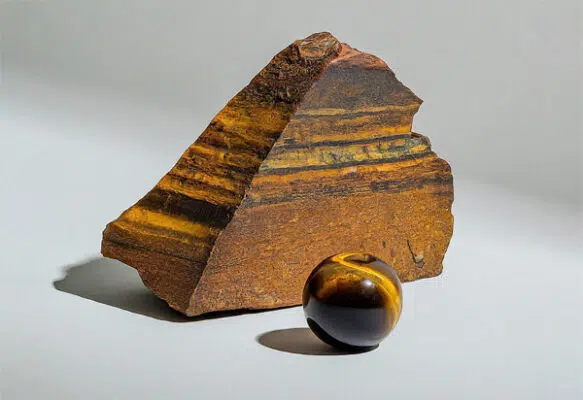
Tiger eye is a variety of macrocrystalline quartz that exhibits chatoyancy – a reflective optical phenomenon that produces a moving band of light across the stone’s surface, resembling the vertical pupil of a cat. The effect is caused by the parallel alignment of silica fibers within the stone, which reflect incident light in a single concentrated band that shifts as the viewing angle changes.
The stone forms through a process called pseudomorphic replacement: silica-rich groundwater slowly infiltrates deposits of crocidolite (blue asbestos), replacing the iron-rich mineral fiber by fiber while preserving its original fibrous structure. The result is a stone with the optical structure of the original fibers but the chemical composition of quartz – dense, durable and extraordinarily beautiful. According to the GIA Gem Encyclopedia, most of the world’s tiger eye comes from South Africa’s Northern Cape Province, where deposits were first commercially mined in the 1880s.
How Was Tiger Eye Used Through History?
Ancient Egypt. Tiger eye’s chatoyant quality made it naturally sacred to ancient peoples who associated it with the eyes of divine beings. Egyptian gods were depicted with tiger eye eyes in their statues. Soldiers wore tiger eye amulets as protective talismans, believing the stone would make them alert and courageous.
Roman soldiers and Persian merchants. Roman soldiers of the 1st and 2nd centuries AD carved tiger eye into rings and amulets worn on campaign. Persian merchants carried it along the Silk Road as both ornament and talisman. The stone’s association with sharp perception and watchfulness made it valued across cultures that knew nothing of each other.
Victorian revival. When South African deposits opened in the 1880s, tiger eye flooded the Victorian jewelry market, set into brooches, cufflinks and watch fobs. Today it remains one of the world’s top-selling gemstones, with particular popularity in men’s bracelet design.
What Are the Different Varieties of Tiger Eye?
Golden tiger eye is the most common – golden to reddish-brown, the variety most people picture when they hear the name. Blue tiger eye (hawk’s eye) is rarer and grey-blue in tone. Red tiger eye (dragon’s eye) has a reddish tone, typically from heat treatment of golden tiger eye. All three exhibit the same chatoyancy and share similar durability. Red tiger eye is a strong choice for bolder stacking; blue for a more subdued, cooler palette.
How Do You Style a Tiger Eye Bracelet?
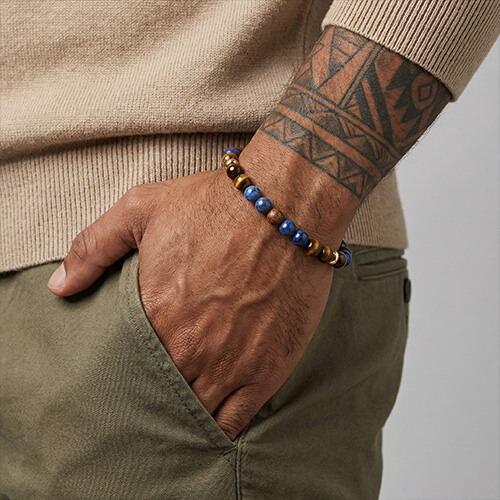
Tiger eye’s warm golden-brown tones occupy a middle ground between earthy and luxurious. Unlike many gemstones that work only in one register, tiger eye reads naturally with denim, linen, dark wool and smart-casual business attire. It pairs best with olive, tan, navy, charcoal and earth tones.
Best stone pairings for stacking: tiger eye and black onyx is the most classic masculine combination – high contrast, bold, sophisticated. Tiger eye and hematite gives warm gold against cool metallic grey. Tiger eye and malachite pairs warm gold with vivid green. And tiger eye with wood beads – covered below.
Why Do Tiger Eye and Wood Work So Well Together?
The combination of tiger eye and natural wood beads is more than aesthetically pleasing – it’s a conceptual match. Both materials are warm-toned and organic. Both develop character over time: tiger eye’s chatoyancy deepens slightly as natural skin oils bring out the stone’s luster; wood develops a richer patina with wear. Both have deep connections to nature and the philosophy of slow, intentional making.

Tiger Eye Bracelet Collection
Mr. Woodini’s tiger eye bracelets use natural South African stone with no treatments or dyes. Each piece is handmade in Israel from genuine gemstone beads. Browse the full tiger eye bracelet collection, or explore by gender: men’s bracelets and women’s bracelets.
Specific tiger eye pieces currently in the collection:
- Tiger Eye Wood Bracelet – golden tiger eye alternating with natural wood beads. Warm, versatile, works as a standalone or stacked.
- Gold Tiger Eye and Zebrawood (8mm) – tiger eye paired with zebrawood’s distinctive cream and dark stripe grain. One of the more visually distinctive pieces in the collection.
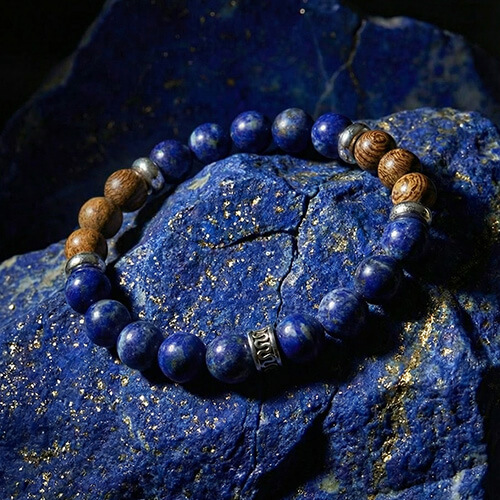
- Dumortierite and Brown Tiger Eye (8mm) – brown tiger eye paired with the blue-grey of dumortierite. A more subdued palette – strong choice for wearers who want something less immediately “warm” in tone.
For size guidance before ordering, see the bracelet size guide.
How Do You Care for a Tiger Eye Bracelet?
Tiger eye rates 7 on the Mohs hardness scale – the same as quartz – making it one of the more durable gemstones for everyday wear. Unlike porous stones such as turquoise or howlite, tiger eye is relatively dense and resistant to absorption. Perfumes, sweat and lotions are best applied before putting on the bracelet. Remove for swimming – chlorine and saltwater degrade the elastic cord over time. Wipe down after workouts. Not recommended for sleeping, as cord wears faster with repeated compression.
“Endless compliments. Top quality in both craftsmanship and appearance.”
Mr. Woodini was founded in 2018. We design eco-accessories built from materials with a story – recycled wood temples, natural stone beads, handcrafted construction. Our guides are written from direct experience: testing frames daily, sourcing materials, and building pieces by hand. Learn more about us.
Questions About Tiger Eye Stone
A phenomenon called chatoyancy – parallel fibrous structures within the stone reflect light in a shifting, banded pattern. It’s entirely natural and the effect changes as the angle of light changes. No two tiger eye beads look identical, which is part of what makes each bracelet unique.
Classic tiger eye is golden-brown. Blue tiger eye (hawk’s eye) is grey-blue and rarer. Red tiger eye (dragon’s eye) has a reddish tone, usually from heat treatment of golden tiger eye. All three are chatoyant and share similar durability.
Black onyx is the most popular combination – high contrast, sophisticated. Hematite gives warm gold against cool metallic grey. Malachite pairs warm gold with vivid green. Wood beads are the most natural pairing – same organic warmth, complementary texture.
Yes – it’s visually striking, widely appreciated and universally wearable. Its earthy tones work with most wardrobes without requiring adjustment, making it a strong choice for someone new to wearing bracelets. Check the size guide before ordering.