


Reading time: approximately 6 minutes
Most advice on men’s jewelry focuses on what not to wear. More useful is understanding what actually makes a piece work – material weight, bead size relative to wrist, and how the color reads against your skin.
Why Are Men Wearing Beaded Jewelry?
Men’s beaded bracelets went from a niche accessory to a mainstream style staple over the past decade. Part of the appeal is the material story. Gemstone and wood bracelets use natural materials with visible texture and depth that plastic or metal accessories don’t have. Every piece is slightly different because the stone itself varies – that individuality is part of what makes them worth wearing. For context on the historical dimension, see the meaning behind beaded bracelets.
The practical advantage is versatility. A well-chosen bracelet works across contexts – with a suit, with casual clothes, at the beach, at work. The key is choosing the right stones and wearing them appropriately for the context. For a full overview covering fit, context and stacking, see how to choose the right bracelet for men.
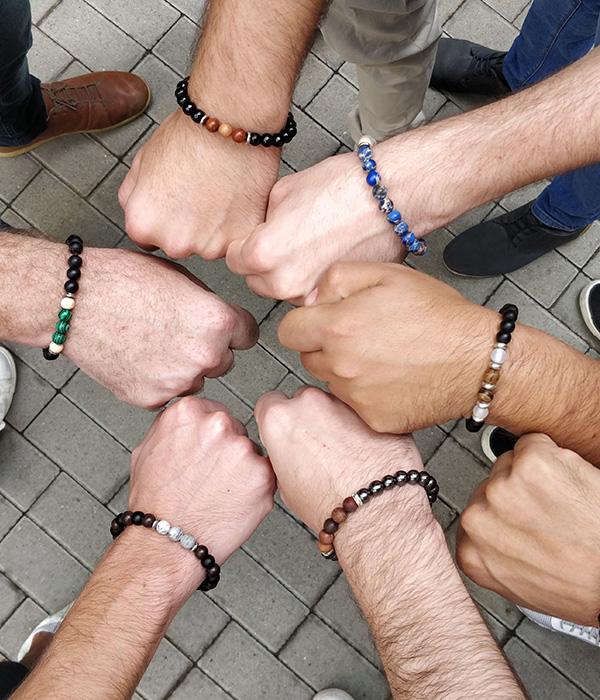
What Are the Main Types of Bracelet Stone?
Dense, dark stones. Black onyx, obsidian and hematite fall into this category. They’re heavily colored and polished to a smooth finish – serious, minimal and confident. Black onyx is the most universally wearable: a true neutral that pairs with any outfit and any other material. Hematite has a dark grey-black metallic quality that works particularly well alongside silver accents.
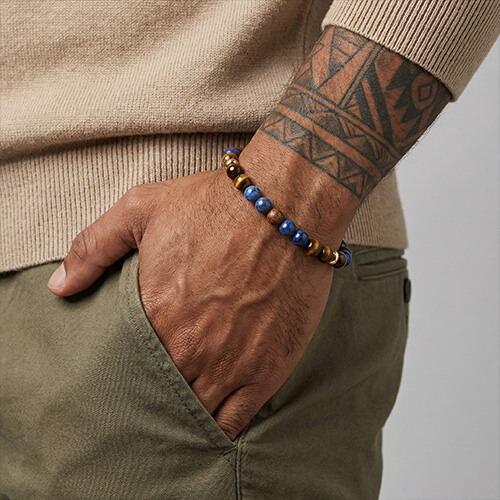
Earth-tone stones. Tiger eye, jasper, agate and sandalwood fall here – warm golden, amber and brown tones that work with earthy, outdoor or casual styles. Tiger eye is the standout: its chatoyant (light-shifting) quality makes it visually interesting from any angle, and the warm tone feels accessible for people new to wearing bracelets.
Volcanic and textured materials. Lava rock’s matte, porous surface contrasts sharply with polished stones, creating visual and textural interest when combined in a multi-material bracelet. It pairs naturally with black onyx and wood for a bracelet that reads rugged without being heavy.
Light and minimal stones. Howlite, white quartz, moonstone and labradorite. These are cooler, lighter stones that create a more understated look. They work best in stacking combinations or for men who prefer minimal, subtle accessories.
| Stone | Color | Style Match | Pairs Well With |
|---|---|---|---|
| Black Onyx | Deep opaque black | Universal – any wardrobe | Wood, lava, metal spacers |
| Tiger Eye | Golden-brown, chatoyant | Earthy, casual, outdoor | Wood, onyx, amber tones |
| Lava Rock | Matte black, porous | Rugged, active, natural | Onyx, ebony, metal |
| Hematite | Dark grey-black, metallic | Minimal, industrial | Stainless, silver, onyx |
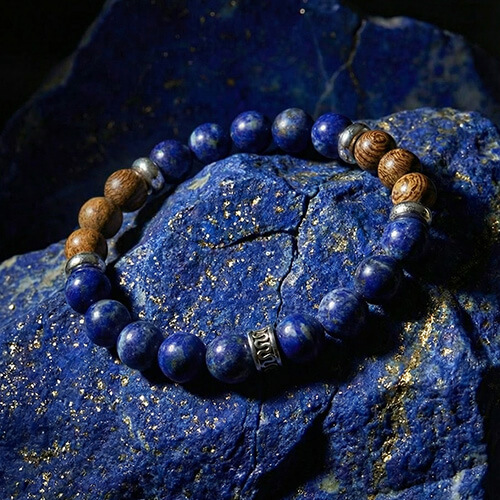
| Lapis Lazuli | Deep blue with gold flecks | Bold, considered, distinctive | Gold accents, dark wood |
| Howlite | White with grey veining | Minimal, clean, light palette | Clear quartz, silver, light wood |
How Does Bead Size Affect Visual Impact?
Bead diameter is one of the most overlooked decisions in bracelet buying. 6mm beads are subtle and close-fitting – they work well for stacking and for men who want an accessory that’s present but not obvious. 8mm is the standard for most men’s bracelets: it has enough visual presence to be seen clearly from a normal distance without dominating the wrist. 10mm beads make a clear statement and work best as a single standalone piece.
Wrist circumference affects the right bead size. As a general guide: wrists under 17cm work best with 6-8mm, 17-19cm is the standard 8mm range, and wrists over 19cm can carry 8-10mm comfortably. See the bracelet size guide for the full sizing table.
How Do You Mix Materials and Styles?
The most reliable approach is texture contrast within a single color family. Black onyx (smooth, polished) combined with lava rock (matte, porous) and ebony wood (fine-grained, warm) creates a combination where all three elements are dark but each has a different surface quality. The eye reads this as intentional because the variation is obvious but the color palette stays unified.
A second approach is material family. Natural stone and natural wood belong to the same broad material category – organic, varied, not manufactured-looking. Combining any gemstone with any wood species creates a natural-material coherence that holds together without requiring close color matching. What doesn’t work: mixing materials that have no visual connection, like a very shiny chrome spacer next to rough lava rock.
How Do You Get the Fit Right?
A bracelet that fits well sits 1-1.5cm above the wrist bone when the hand is relaxed. It should move slightly when you lift your arm but not slide down toward your hand. To find your bracelet size: measure your wrist circumference with a flexible tape at the point where you’d normally wear a bracelet. Add 1.5cm for a standard fit, 2cm for a relaxed fit. For elastic cord bracelets, aim for a bracelet labeled 1-2cm larger than your wrist measurement.
What Is the Style Guide by Occasion?
Office / business casual: Single bracelet in black onyx or hematite, opposite wrist from watch. Casual / weekend: Tiger eye, lava or mixed combination, one to three stacked. Beach / outdoor: Lava rock, wood or onyx, stacked or single. Formal / event: Single black onyx – or leave it off entirely. Gift: Black onyx is the safest universal choice; L size (18cm) if wrist size is unknown.
How Do You Care for Beaded Bracelets?
Most natural stone bracelets need minimal care. Wipe down with a soft cloth after wearing to remove skin oils and sweat. For deeper cleaning, mild soap and lukewarm water works on most stones – avoid soaking lava rock or porous materials. Keep bracelets away from perfume, sunscreen and harsh chemicals. Store separately from other jewelry – harder stones can scratch softer stone surfaces if they come into contact. For full care details, see the bracelet care guide.
“They sit on the wrist just right and have a seriously eye-catching look for the price. Will definitely be ordering more.”
Worth Considering
Black Onyx, Tiger Eye and Wood – combines the main stone categories in one piece: dark neutral onyx, warm tiger eye, and natural wood. Handmade in Israel, available in sizes 16-20cm.
Browse the full men’s bracelet collection to explore all current onyx, tiger eye and mixed combinations.
Mr. Woodini was founded in 2018. We design eco-accessories built from materials with a story – recycled wood temples, natural stone beads, handcrafted construction. Our guides are written from direct experience: testing frames daily, sourcing materials, and building pieces by hand. Learn more about us.
Questions About Men’s Beaded Bracelets
Bead consistency (no visible cracks or chips), cord tension (not overstretched at rest), stone authenticity (slight color variation between beads, not perfectly uniform) and finish quality. Natural stones will never be identical between beads – that variation is a quality indicator, not a flaw.
8mm for most men – it’s proportional, versatile and the most common size in quality natural stone bracelets. Too small reads as delicate on most men’s wrists; too large can overwhelm a smaller wrist. If your wrist is under 16cm, consider 6mm as the starting point.
No hard rule, but successful combinations usually share a color family or contrast intentionally. Tiger eye and black onyx work together because of tonal contrast within a warm-dark palette. Random mixing without a common element looks accidental rather than designed.
One is enough for most formal or business casual contexts. For casual wear, two or three stacked is the standard range. Beyond three, individual pieces stop reading as considered choices and start reading as quantity. Quality over quantity applies here as much as anywhere.