


Reading time: approximately 6 minutes
The variables that actually matter when choosing a bracelet are simpler than most guides suggest: wrist circumference, bead size, stone color relative to your wardrobe, and whether you want one piece or a stack.
Why Do Men Wear Bracelets?
Men wearing bracelets is not a modern trend – it’s a modern rediscovery. Archaeological evidence of men’s wrist adornment goes back over 7,000 years. Ancient Egyptian pharaohs wore gold and gemstone cuffs as symbols of authority. Roman soldiers wore leather and metal bracers that served both protective and status functions. Viking warriors wore arm rings as symbols of oath and allegiance.
What changed in the 20th century wasn’t men’s interest in wrist jewelry – it was the narrowing of what Western culture considered acceptable masculine adornment. That narrowing is now reversing. Beyond aesthetics, the most consistent thing customers report after making bracelets a daily habit: they become an anchor. A meaningful object worn every day becomes a touchpoint – you notice it in meetings, touch it when thinking, see it in photographs.

What Types of Men’s Bracelets Are There?
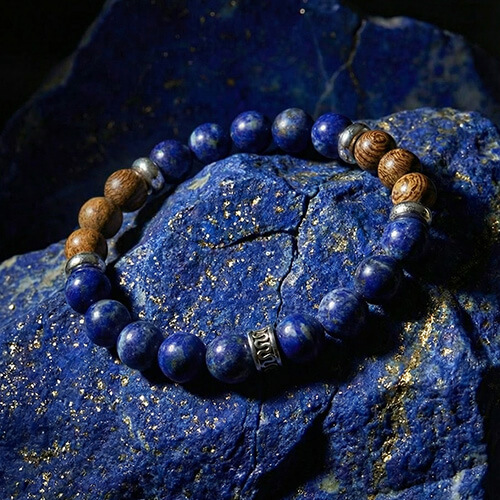
Natural stone beaded bracelets are the dominant format in modern men’s bracelet culture. The appeal is their combination of visual interest and wearability. Unlike metal or leather, gemstone bracelets are comfortable in all weather, suit a wide range of outfits and age well. Popular stones include tiger eye (warm tones), black onyx (matte black), lapis lazuli (deep blue) and malachite (vivid green).
Wood bead bracelets offer a lighter, more organic alternative. Sandalwood, zebrawood and ebony each have a distinctive grain pattern and natural character that develops over time. Wood bracelets pair exceptionally well with natural stone as accent pieces in a stack.
Leather bracelets are casual by nature and best in active or outdoor contexts. Quality leather ages well, developing patina with wear. The primary drawback: leather doesn’t handle water well and requires conditioning to prevent cracking.
What Is the Most Important Factor When Choosing a Bracelet?
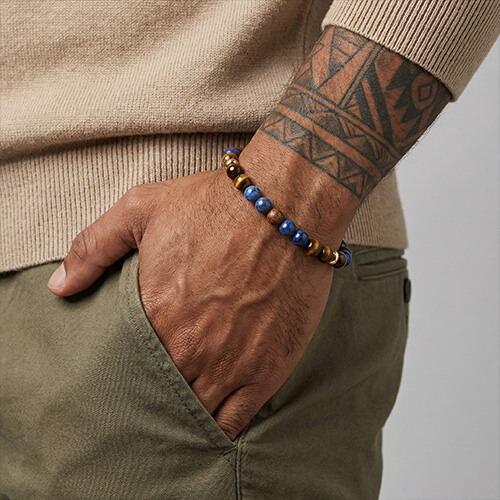
A bracelet that doesn’t fit correctly undermines everything else. Too loose and it slides down the hand constantly; too tight and it looks constrictive. The right fit: the bracelet sits comfortably 1-2cm above the wrist bone, moves slightly when the arm moves, but doesn’t slide past the widest point of the hand.
Measure your wrist with a soft tape or strip of paper, wrapped just above the wrist bone. Add 1-1.5cm for a looser fit or 0.5-1cm for a snugger fit. See the bracelet size guide for the full sizing table and step-by-step instructions.
| Wrist Circumference | Recommended Bead Size | Bracelet Size |
|---|---|---|
| Under 16cm | 6mm | S (16cm) |
| 16-17cm | 6-8mm | M (17cm) |
| 17-19cm | 8mm | L-XL (18-19cm) |
| 19-21cm | 8-10mm | XXL (20cm) |
Which Stone Should You Choose?
Stone choice comes down to color relative to your wardrobe and how durable you need it to be. Tiger eye (7 Mohs) is the most reliably versatile – warm golden-brown that works with almost everything. Black onyx (6.5-7 Mohs) is a clean minimalist anchor for a stack. Lapis lazuli (5-6 Mohs) makes a bold color statement. Malachite (3.5-4 Mohs) is softer and more fragile – beautiful, but not ideal for gym wear or rough daily use. Lava rock (3-3.5 Mohs) is porous and matte black – good for active wear.

How Do You Choose a Bracelet for Different Contexts?
The most common concern new bracelet wearers express is context-appropriateness: “Will this work in a business meeting?” A single, clean, natural stone bracelet is appropriate in nearly every non-black-tie context. The key variable is how you wear it: single strand vs. stack, subtle stone vs. bold color.
For corporate and formal settings: single strand, 6-8mm, hematite or black onyx. For business casual: single or double strand, tiger eye works well. For weekend wear: stack of 2-3, any stone plus wood accent. For active use: single 6-8mm lava rock or obsidian – avoid soft stones like malachite.
How Do You Match a Bracelet to Your Shirt?
A bracelet doesn’t exist on its own – it sits right at the cuff line, which means it’s constantly in visual conversation with whatever shirt you’re wearing. The pairing logic is simpler than it sounds: plain shirts give a bracelet room to stand out, and busy shirts need a quieter bracelet so the two don’t compete for attention.
With a solid-color or subtly textured shirt (a plain tee, an oxford, a knit), the bracelet becomes the visual detail, so it can carry more character – a bold stone like lapis lazuli, a mixed stack, or a wood-and-stone combination. With a graphic or heavily patterned shirt, the opposite rule applies: let the shirt do the talking and keep the bracelet to a single, clean strand in a neutral stone like black onyx or hematite. Two loud elements on the same silhouette usually read as cluttered rather than intentional, no matter how good each piece is on its own.
This is worth keeping in mind if your wardrobe leans toward statement graphic tees – the kind of bold, illustrated pieces brands like Biren are built around. A graphic tee with strong artwork is already the focal point of the outfit, so the bracelet’s job shifts from “stand out” to “support” – a single dark stone worn low and understated lets the shirt stay the statement piece.
How Do You Build a Stack?
The most common mistake is starting with three simultaneously. A stack looks best when it looks accumulated rather than purchased together. Start with your anchor bracelet (the primary stone, your first meaningful choice), wear it daily for a few weeks, then consider what’s missing before adding the next layer.
An effective stack has contrast in texture (smooth stone + matte lava), variety in size (8mm anchor + 6mm accent), and at most one “bold” element at a time. Classic formula that works: dark anchor (black onyx) + warm stone (tiger eye) + wood. The go-to men’s stack. For a full guide to layering, see the bracelet stacking guide.
“They sit on the wrist just right and have a seriously eye-catching look for the price. Will definitely be ordering more.”
Worth Considering
Tiger Eye Wood Bracelet – the most versatile starting point in the collection. Natural tiger eye alternating with wood beads, handmade in Israel. Works as a standalone or as the anchor in a stack.
Browse the full men’s bracelet collection – every product page lists available sizes and stone hardness.
Mr. Woodini was founded in 2018. We design eco-accessories built from materials with a story – recycled wood temples, natural stone beads, handcrafted construction. Our guides are written from direct experience: testing frames daily, sourcing materials, and building pieces by hand. Learn more about us.
Questions About Choosing Men’s Bracelets
Size first – a bracelet that doesn’t fit correctly looks wrong regardless of the stone. After size: stone color relative to your wardrobe. Black onyx and tiger eye are the easiest starting points because they work with almost everything.
Start subtle. A clean 8mm single-stone bracelet in black or earth tones gives you room to develop your own approach before committing to more visible pieces. You can always add more later – the anchor bracelet is the one you’ll keep wearing anyway.
Yes, in most professional contexts. A single clean 8mm stone bracelet in a neutral color (hematite, black onyx) is no more conspicuous than a watch. The exception is very conservative formal environments – in those, a slim single strand in a dark stone is still appropriate. A large stack of mixed materials is not.
Two or three covers most needs – one for daily wear, one for more considered occasions and one for stacking if you want that look. More than that and pieces start sitting unworn. Quality over quantity applies here as much as anywhere.