



Reading time: approximately 6 minutes
Black onyx has been used in jewelry for thousands of years – ancient Egypt, Rome, across the Middle East. The appeal has stayed consistent: a deep, uniform black that doesn’t fade, scratch easily, or go out of style.
What Is Black Onyx?
Black onyx is a variety of chalcedony – a form of microcrystalline quartz with a very fine-grained structure. The deep, opaque black color comes from organic matter and iron oxide present during the stone’s formation. Quality black onyx has an inky uniformity and a vitreous luster that gives it visual depth even in simple bead form.
In nature, onyx often forms with visible banding – parallel layers of different chalcedony colors running through the stone. Black onyx beads are typically cut from material where the black layers dominate, or from stones that have been heat-treated to produce consistent deep black color throughout. This treatment is standard in the industry and doesn’t affect the stone’s durability. According to the GIA Gem Encyclopedia, onyx sits at 7 on the Mohs hardness scale – harder than glass and harder than most metals used in jewelry, which makes it one of the more resilient choices for everyday bracelet wear.
Where Does Black Onyx Come From?
Ancient Greece and Rome. In Greco-Roman tradition, onyx was carved into amulets and signet rings, used for cameos, and worn as a talisman against misfortune. The Romans associated its dark, grounding quality with courage and self-possession – valued particularly in military contexts.
Babylonian and Middle Eastern traditions. Early Babylonian cultures connected onyx with Saturn – the planet associated with discipline, time and limitation. Similar associations appear in Arabic and Persian texts from the medieval period, where onyx was associated with clarity of thought and emotional stability.
In contemporary jewelry, black onyx has largely shed its symbolic associations and become primarily a design element – valued for its color, texture and versatility. Its neutral darkness makes it a reliable anchor for more complex bracelet stacking combinations.
How Does Black Onyx Compare to Other Dark Stones?
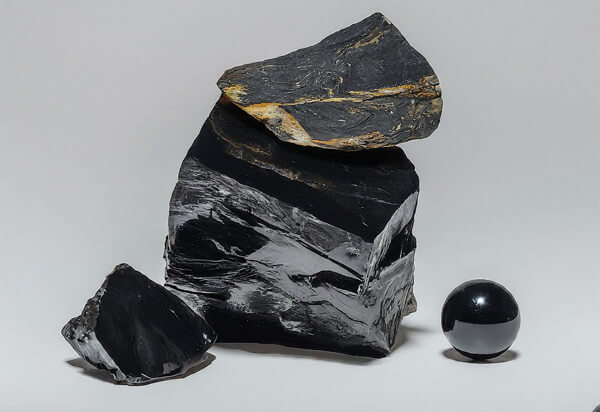
Not all black stones wear the same. Lava rock is matte and porous – it absorbs essential oils and shows wear differently. Obsidian is glossy and brittle, better as a display piece than a daily bracelet. Hematite has a dark grey-metallic sheen rather than true black. Black tourmaline is harder and striated, with a rougher surface texture even when polished.
Black onyx and lava rock are the most commonly paired stones in men’s bracelets because they offer complementary textures: the smooth, polished density of onyx against the rough, matte porosity of lava. The contrast is immediate and effective. See the meaning behind beaded bracelets for more on how stone pairings carry symbolism.
| Stone | Hardness | Look | Best Pairing |
|---|---|---|---|
| Black Onyx | 7 Mohs | Opaque deep black, glassy | Wood, silver, lava rock |
| Lava Rock | 3-4 Mohs | Matte black, porous | Onyx, metal, brown wood |
| Obsidian | 5-5.5 Mohs | Glassy black, reflective | Silver, clear quartz |
| Black Tourmaline | 7-7.5 Mohs | Striated, rough or polished | Hematite, copper |
| Hematite | 5-6 Mohs | Dark grey-black, metallic | Onyx, steel |
How Do You Style a Black Onyx Bracelet?
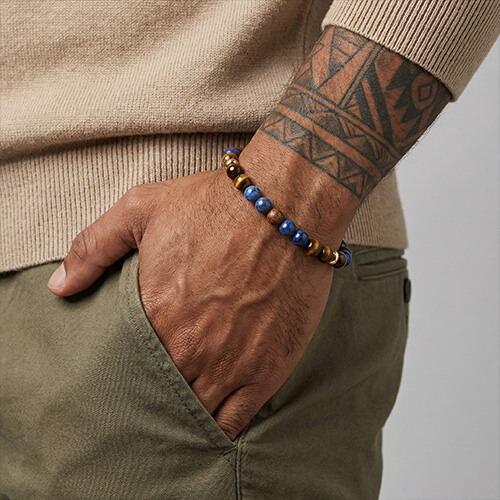
Black onyx works because it doesn’t compete with other elements in an outfit. It’s a true neutral – like black in clothing – which means it coordinates with almost everything and can be dressed up or down without much thought.
Standalone vs stacked. A single black onyx bracelet works best when the beads are substantial (8mm or larger) and the bracelet has a considered design – mixed materials or a distinctive wood combination. Stacking opens more options. The key is material contrast: onyx with lava (smooth vs textured), onyx with wood (stone vs organic), or onyx with hematite (stone vs metallic).
Metal pairings. Black onyx works with silver better than gold – the cool undertone of onyx harmonizes with silver’s neutral tone. Brushed copper or bronze works better than bright gold if you want a warm metal component. For a full context guide, see how to choose the right bracelet for men.
“The black onyx and zebrawood piece is the one I reach for most. It’s heavy enough to feel substantial but not overdone. Wears well with everything I own.”
Which Bead Size Is Right for You?
Bead size affects how a bracelet reads from a distance. A 6mm bracelet sits close to the skin and reads as subtle – versatile for stacking. An 8mm bracelet is clearly intentional: each bead is visible and the bracelet makes a statement. Anything above 10mm is maximalist by design. For matching bead size to wrist circumference, see the bracelet bead size guide.
How Do You Care for Black Onyx?
Black onyx is low-maintenance. Its hardness and non-porous surface mean it doesn’t absorb oils or moisture the way lava rock does. Regular care is simple: wipe with a soft cloth after wearing to remove skin oils and dust. For deeper cleaning, mild soap and lukewarm water works fine – rinse thoroughly and dry completely before storing. Avoid storage alongside harder stones like diamonds or sapphires, which will scratch the polished surface. For elastic-cord bracelets, the cord stretches and weakens over time – most bracelets can be restrung by a local jeweler when needed. Full care details in the bracelet care guide.
Mr. Woodini Black Onyx Collection
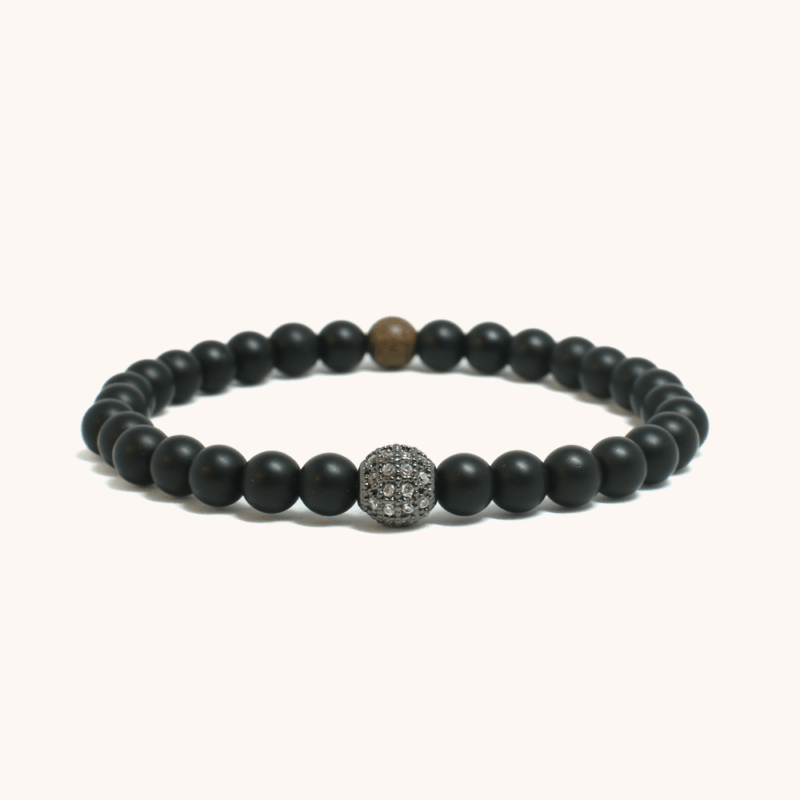
Mr. Woodini’s black onyx bracelets combine the stone with natural wood beads and metal spacers. All pieces use 8mm beads and are available in multiple wrist sizes. Every bracelet is handmade in Israel from natural materials – stones selected for consistent color and polish, strung on quality elastic cord.
- Grow – Black Onyx and Zebrawood – alternating onyx and zebrawood beads. The zebra stripe of the wood creates a high-contrast graphic pattern against the solid black stone.
- Half – Matt Black Onyx and Zebrawood – half matte onyx, half zebrawood. The split design creates two halves of different material in one balanced piece.
- Blackout – Black Onyx and Rosewood – deep black onyx with the warm reddish-brown of rosewood. Works particularly well as a standalone piece.
- Black Onyx and Wenge Wood with Gold Accents – the most formal piece in the collection. The gold accent hardware elevates it into business-casual and smart-casual territory.
Browse the full men’s bracelet collection to see all current onyx pieces and combinations.
Mr. Woodini was founded in 2018. We design eco-accessories built from materials with a story – recycled wood temples, natural stone beads, handcrafted construction. Our guides are written from direct experience: testing frames daily, sourcing materials, and building pieces by hand. Learn more about us.
Questions About Black Onyx Bracelets
Black onyx rates Mohs 7 – harder than glass and resistant to everyday scratching. Its deep, opaque black works as a true neutral, pairing with almost any outfit or other bracelet material. It has a satisfying weight that cheaper glass or plastic imitations don’t replicate.
Onyx naturally forms with banding – parallel layers of different colors. Most black onyx beads are cut from sections where the black layers dominate, or from material that has been heat-treated to produce consistent deep black color throughout. This treatment is standard in the industry and doesn’t affect durability.
Lava rock is the most popular pairing – the smooth density of onyx against the matte porosity of lava creates immediate textural contrast. Wood (zebrawood, rosewood, wenge) adds warmth. Silver metal spacers add a third element without adding color. Tiger eye works well if you want to introduce a warm tone into an otherwise very dark bracelet.
Wipe with a soft cloth after wearing to remove skin oils. For deeper cleaning, mild soap and lukewarm water works fine – dry completely before storing. Avoid ultrasonic cleaners and storage alongside harder stones like diamonds or sapphires, which can scratch the surface.