


Reading time: approximately 5 minutes
Wood sits differently on the wrist than stone – lighter, warmer in tone, more textured. The challenge is knowing which contexts it fits. A rosewood bracelet works in most professional settings; a chunky painted wood bead does not.
Why Do Wood Bracelets Work Across Styles?
Most accessories have a natural habitat – a context where they belong and contexts where they look out of place. A leather cuff reads rugged and casual; it looks wrong in a boardroom. Wood bead bracelets are unusual because they span a wider range of contexts than almost any other wrist accessory for men. Wood is natural, warm and visually unpretentious. It doesn’t signal wealth or status the way metal does. It reads as grounded and considered – qualities that translate across social settings from casual to professional.
The same wood bead bracelet worn loose and stacked at the beach can be worn as a single piece, snugged closer to the wrist, alongside a watch and a business suit. The material holds; the styling changes. For more on how natural materials read across contexts, see the bracelet choice guide.

What Wood Types Are Used in Beaded Bracelets?
Ebony – very dark brown to near-black, dense, fine-grained. Polishes to a smooth surface that reads almost like a dark stone from a distance. One of the more formal-compatible wood types. Pairs naturally with black onyx and hematite. Sandalwood – light to medium brown, aromatic, fine-grained. A traditional material in beaded jewelry with a warm, natural appearance. Rosewood – medium to dark reddish-brown with a visible grain pattern. The red-brown tone adds warmth. Pairs well with tiger eye and other warm-toned stones. Zebrawood – distinctive striped grain pattern, light-to-medium base with dark streaks. Creates strong visual contrast when combined with black stones.
How Do You Wear Wood Bracelets in Different Contexts?
Beach and outdoor wear: durability matters as much as looks. Wood beads handle brief water exposure reasonably well, but prolonged soaking can cause the wood to swell and crack. For active water use, remove before entering the water. The stacking approach for casual wear is less strict – mixing wood with lava rock, stone and cord bracelets in a layered arrangement is natural for this context.
Office and business casual: a single wood bracelet reads as a considered personal detail rather than a casual intrusion. Choose a dark wood – ebony or dark sandalwood. Wear it alone or with a watch on the opposite wrist. Size it accurately: a well-fitted bracelet stays in place and doesn’t draw attention. See the bracelet size guide.
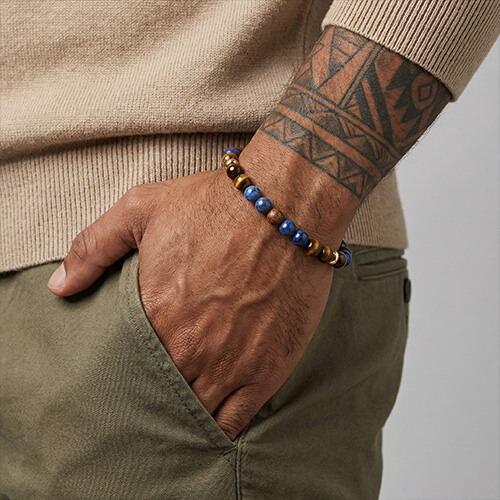
Smart-casual (the most common context): two or three bracelets is appropriate. Mixing wood with one or two stone bracelets creates the most versatile combination. Natural material pairing is visually coherent and works alongside most clothing choices – jeans and a button-down, chinos and a t-shirt, a casual blazer with darker denim.
| Context | Wood Type | How Many | Pair With |
|---|---|---|---|
| Beach / outdoor | Any – sandalwood, coconut | 2-4 stacked | Lava, cord bracelets, shell |
| Casual / weekend | Sandalwood, rosewood | 2-3 | Tiger eye, onyx, watch |
| Smart-casual | Dark sandalwood, rosewood | 1-2 | Black onyx, watch |
| Office / business | Ebony or dark wood only | 1 | Watch on opposite wrist |
| Formal event | Skip or single ebony | 0-1 | Nothing else on wrist |
How Do You Pair Wood with Gemstone Bracelets?
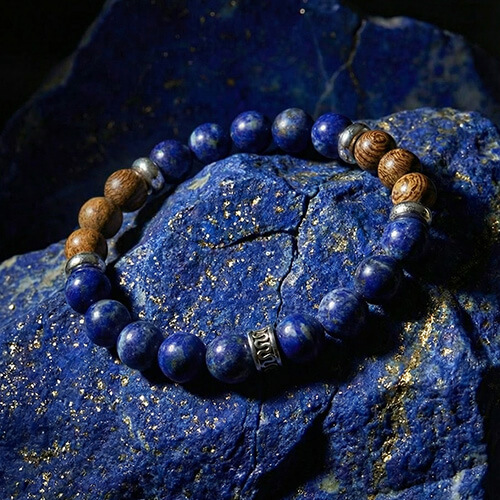
Wood and stone belong to the same broad category: natural, organic materials. This shared origin gives them an inherent visual compatibility. The key is keeping colors related. Dark wood (ebony, dark sandalwood) pairs best with dark stones: black onyx, lava rock, hematite. Medium wood tones (rosewood, regular sandalwood) pair well with warm stones: tiger eye, amber agate, red jasper. Zebrawood creates natural contrast with dark stones – the striped grain against solid black onyx or hematite is a graphic combination that works particularly well as a single-bracelet choice.
How Do You Care for Wood Bead Bracelets?
Wood bead bracelets have one specific vulnerability that stone bracelets don’t: water. Prolonged soaking can cause wood beads to expand, contract unevenly as they dry, and eventually crack. Brief exposure is fine; swimming or showering with the bracelet on shortens its lifespan. Dry with a soft cloth after any water exposure. Store flat or hanging rather than compressed in a bag. Wood beads benefit from occasional conditioning with a small amount of natural oil (jojoba or coconut) every few months. For a complete care guide covering all stone types, see the bracelet care guide.
Worth Starting With
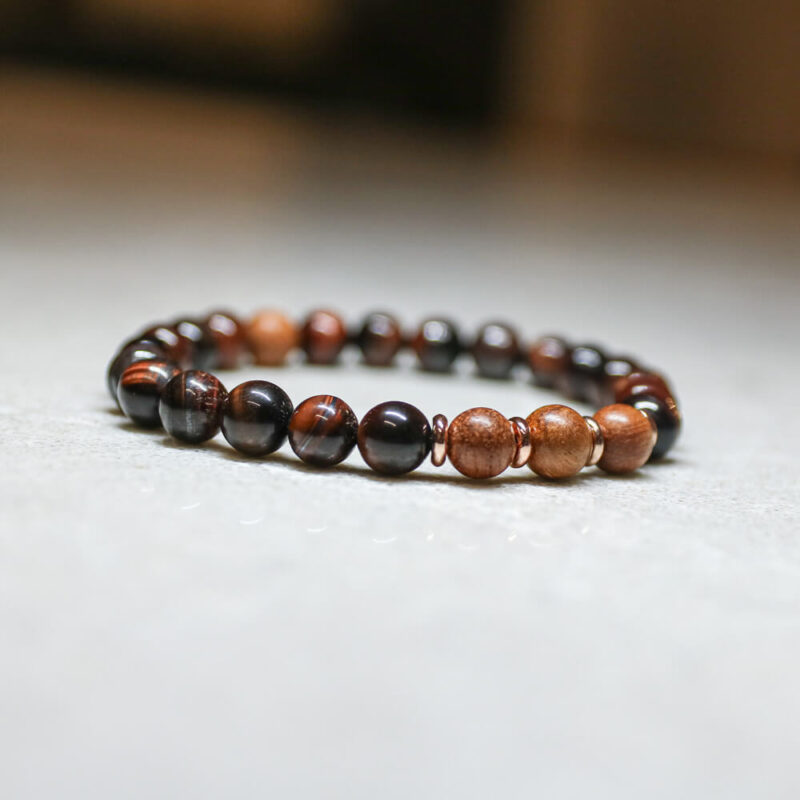
Grow (black onyx + zebrawood, 8mm) for the most versatile dark combination. Red Tiger Eye and Rosewood for a warm earth-palette piece. Tiger Wood bracelet for a wood-dominant piece where wood is the primary material rather than the accent.
Browse the full men’s bracelet collection – all pieces handmade in Israel, available in sizes S (16cm) to XXL (20cm).
Mr. Woodini was founded in 2018. We design eco-accessories built from materials with a story – recycled wood temples, natural stone beads, handcrafted construction. Our guides are written from direct experience: sourcing stones, testing daily wear, and building pieces by hand. Learn more about us.
Questions About Wood Bead Bracelets for Men
Yes – a single dark wood bracelet reads as an intentional personal detail rather than casual jewelry. Choose ebony or dark sandalwood, wear it alone or on the opposite wrist from your watch, and size it correctly so it doesn’t slide around.
Dark wood (ebony, dark sandalwood, zebrawood) pairs best with dark stones – black onyx, hematite, lava rock. Medium-warm wood (rosewood, sandalwood) pairs well with warm stones – tiger eye, red jasper. Both combinations stay within a tonal palette rather than mixing warm and cool.
Keep it dry – wood swells with prolonged water exposure and can crack when it dries. Wipe with a soft cloth after wearing. Apply a small amount of natural oil (jojoba or coconut) every few months to prevent the wood from drying out. Store away from direct sunlight.
One for professional and smart-casual contexts. Two to three for casual and weekend wear. The context determines the number more than any style rule – fewer pieces read as more considered in formal settings, more pieces are appropriate when the setting is relaxed.