



Reading time: approximately 7 minutes
Hematite is iron ore – dense, cold to the touch, and almost mirror-like when polished. That metallic finish makes it one of the few natural stones that reads like metal on the wrist, without the weight of steel.
What Is Hematite?
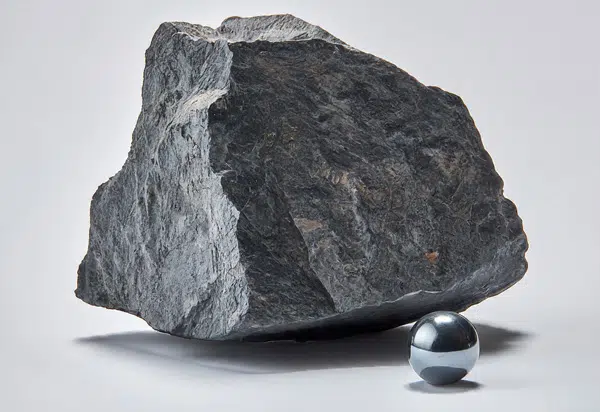
Hematite is iron(III) oxide, chemical formula Fe2O3. It is one of the most abundant iron minerals on Earth’s surface. The name comes from the Greek “haima” meaning blood – a reference to the red powder the stone produces when ground. Despite its red powder streak, polished hematite looks nothing like iron rust. The polished surface is a deep metallic grey-black, with a mirror-like quality that distinguishes it from opaque black stones like onyx. The metallic sheen is not a coating or treatment – it is an intrinsic property of hematite’s crystalline structure, which reflects light in a way that mimics a metal surface.
According to the GIA Gem Encyclopedia, major sources include Brazil, Australia, South Africa, China, Ukraine, and the United States. Brazil and Australia are the dominant sources for jewelry-grade hematite used in beads and polished pieces.
What Makes Hematite Distinctive in Appearance and Weight?
Hematite is one of the heaviest stones used in bracelet beads. Iron oxide has a specific gravity of approximately 5.3, compared to 2.6 for most quartz-based stones and 2.7 for onyx. An 8mm hematite bead feels substantially heavier than an 8mm tiger eye or onyx bead of the same size. This weight is part of the stone’s appeal – the bracelet has a physical presence on the wrist that lighter stones don’t provide.
The polished surface color ranges from dark charcoal grey to near-black, with a metallic luster that picks up ambient light. Under direct light, the surface has a silvery quality; in shadow, it reads as a deep, dark black. Because of its high iron content, hematite is weakly magnetic – a genuine hematite bead placed near a strong magnet will show a slight attraction. This is sometimes used as a simple authenticity test, since many products sold as “magnetic hematite” are actually synthetic ceramic materials.
How Was Hematite Used Throughout History?
Hematite’s history in human use is one of the longest of any mineral. Archaeological evidence from Swaziland’s Lion Cave dates the mining and use of red hematite ochre to approximately 43,000 years ago – one of the earliest documented instances of human mineral extraction. Indigenous peoples across Africa, the Americas, and Australia used ground hematite as body paint and ceremonial pigment for tens of thousands of years.
In ancient Egypt, polished hematite was used as a mirror material before glass mirrors existed. Roman soldiers carried hematite amulets, associating the iron-bearing stone with Mars, the god of war. The stone’s connection to iron – the metal of weapons and armor – made it a natural protective talisman in military cultures. In medieval European alchemy, hematite was classified under Mars and thought to be useful in stopping bleeding, relating to both its red streak and its iron content.
What Are the Traditional Associations of Hematite?
Hematite’s traditional associations cluster around a consistent theme: grounding, stability and the management of stress. This pattern appears across multiple unconnected traditions. In Chinese medicine-influenced thought, hematite’s weight and density are associated with drawing excess energy downward, stabilizing scattered mental states. In Native American traditions from the Southwest, hematite was used in protective and healing ceremonies.
In contemporary crystal healing practice, hematite is described as a grounding stone – one that helps people who feel scattered or overwhelmed to regain stability and presence. These are cultural and traditional associations, not medical claims, but they explain why hematite continues to be a popular choice for people who want a bracelet with intentional meaning. For more on the meaning behind gemstone bracelets, see the beaded bracelet meaning guide.
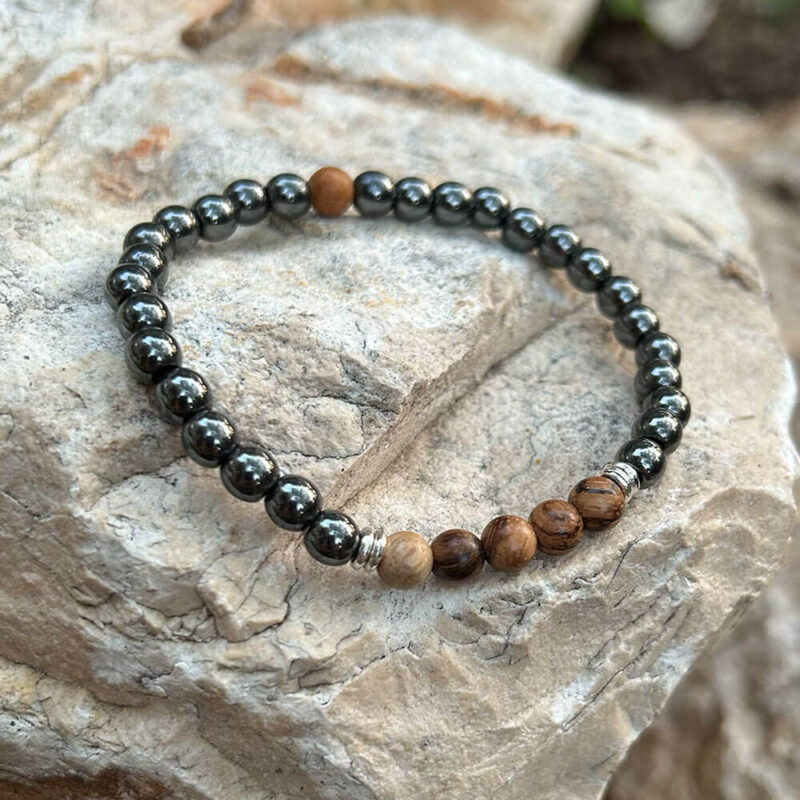
How Do You Style a Hematite Bracelet?
Hematite’s metallic grey-black sits perfectly at the intersection of gemstone and metal aesthetics. It works with silver, steel, gunmetal and chrome hardware in a way that most gemstone bracelets don’t. A hematite bracelet alongside a stainless steel sports watch creates a cohesive metallic-natural combination that reads as minimal and modern.
In terms of outfit context, hematite suits minimal, industrial and monochromatic styling better than earthy or warm aesthetics. An all-black outfit, a grey suit, a white shirt with dark trousers – these are natural contexts for hematite. For stacking, hematite pairs well with black onyx (same dark tone, contrasting matte vs. metallic surface). Avoid stacking hematite with warm-toned stones like tiger eye or wood – the color temperature clash works against both pieces. For full stacking guidance, see the bracelet stacking guide.
| Stone | Color / Finish | Weight | Best Paired With |
|---|---|---|---|
| Hematite | Metallic grey-black | Heavy (SG ~5.3) | Silver, steel, black onyx |
| Black Onyx | Deep matte-to-satin black | Medium (SG ~2.7) | Any material – most versatile |
| Lava Rock | Matte porous black | Light (porous, SG ~1.5-2) | Wood, onyx, earthy styles |
| Obsidian | Glossy volcanic glass black | Medium-light (SG ~2.4) | Minimal, clean palette |
How Do You Care for a Hematite Bracelet?
Hematite sits at 5-6 on the Mohs hardness scale – harder than malachite, comparable to lapis lazuli, and softer than tiger eye or black onyx. One specific consideration: hematite is brittle despite its density. It has a conchoidal fracture pattern, meaning it can chip if struck sharply against a hard surface. Buff with a dry soft cloth to restore metallic sheen. Brief water contact is fine but dry promptly to prevent any surface oxidation. Store away from harder stones that could chip the surface. Avoid perfume and cleaning products directly on beads. For full bracelet care guidance, see the bracelet care guide.
Worth Considering
Ghost – handcrafted in Israel with natural stone beads on quality elastic cord. Available in sizes 17-22cm to fit the full range of adult wrists. The metallic finish maintains its luster with basic care – a soft cloth after wearing is all it needs.
Browse the full men’s bracelet collection for all current stone options and combinations.
Mr. Woodini was founded in 2018. We design eco-accessories built from materials with a story – recycled wood temples, natural stone beads, handcrafted construction. Our guides are written from direct experience: sourcing stones, testing daily wear, and building pieces by hand. Learn more about us.
Questions About Hematite Bracelets
Hematite is metallic and dense – it has a weight and reflective quality that no other common bracelet stone matches. It sits somewhere between a stone bracelet and a metal one, which makes it uniquely suited to minimal, industrial or monochromatic styling.
Yes – hematite ranks 5-6 Mohs and handles daily wear well. One consideration: it is brittle and can chip if struck sharply against hard surfaces. Brief water contact is fine but dry immediately. Avoid perfume and cleaning products directly on the beads.
Hematite’s grey-black metallic tone pairs well with all-black outfits, grey suits and white shirts with dark trousers. It sits comfortably in business-casual contexts and works particularly well alongside silver or stainless steel watches.
Natural hematite is mined iron oxide with a slightly magnetic quality. Magnetic hematite (hemalyke) is a man-made composite with stronger magnetic properties and a more uniform, flat luster. Authentic gemstone jewelry uses natural hematite – natural beads have slight color variation between pieces; synthetic ones are perfectly uniform.