



Reading time: approximately 6 minutes
Quality sunglasses announce themselves in specific ways – hinge tension, lens clarity, frame weight, how the acetate feels at the edge. Most of these can be assessed in thirty seconds before you buy.
Why Does Quality Matter Beyond Appearance?
Two pairs of sunglasses can look identical from a distance while differing dramatically in the protection they provide and how long they last. Cheap frames with no UV coating can actually cause more harm than wearing no sunglasses at all – the dark tint causes pupils to dilate, allowing more UV radiation to reach the retina without any filtering. For a full explanation of how UV protection works, see the UV protection guide.
Quality sunglasses serve two distinct functions: protecting your eyes from UV radiation, and providing optical clarity so your vision isn’t distorted. A lens that blocks UV but introduces distortion causes eye strain during extended wear. These eight tests cover the key quality indicators you can assess before buying – or use to evaluate a pair you already own.
How Do You Check UV Protection?
UV400 is the minimum standard worth wearing. It means the lens blocks 99-100% of ultraviolet radiation up to 400 nanometers – covering both UVA and UVB. Look for this marking on the lens, the frame arm or the product documentation. According to the National Eye Institute, UV400 protection is the standard required to prevent UV-related eye damage including cataracts and macular degeneration.
Lens darkness is not an indicator of UV protection. UV filtering is a coating applied to the lens and has nothing to do with tint level. A very dark lens with no UV coating protects your eyes less than a clear UV-coated lens.
How Do You Test Lens Optical Clarity?
Hold the frames at arm’s length and look through one lens at a straight edge – a door frame, window frame or horizontal line. Move the lens slowly across your field of view. A high-quality lens keeps that straight line perfectly straight throughout the movement. A low-quality lens causes the line to bend, wave or jump as the lens moves.
This reveals optical distortion that’s often invisible when wearing the glasses but contributes to headaches during extended wear. Also check for bubbles or inclusions by holding the lens up to a light source.
How Do You Verify Polarization?
Hold the glasses in front of your phone screen and rotate them 90 degrees – at a certain angle, a polarized lens will noticeably darken the screen or turn it almost black. This happens because phone screens emit polarized light, and when the lens polarization is perpendicular to the screen’s, they cancel each other out. A lens that doesn’t pass this test is not polarized, regardless of what the label says. For more on when polarization matters, see the polarized lenses guide.
How Do You Assess Frame Material Quality?
Premium acetate is dense and slightly flexible – it doesn’t feel hollow or brittle. Press gently on the frame bridge: it should have a slight give without feeling like it might snap. Cheap injected plastic feels lighter, sometimes hollow, and less consistent in surface finish.
Metal frames should feel solid with no sharp edges or rough spots at joins. Wood components should be smooth, sealed and consistent in grain. Rough or splintered edges indicate poor finishing. Sealed wood resists moisture; unfinished wood absorbs it and degrades over time.

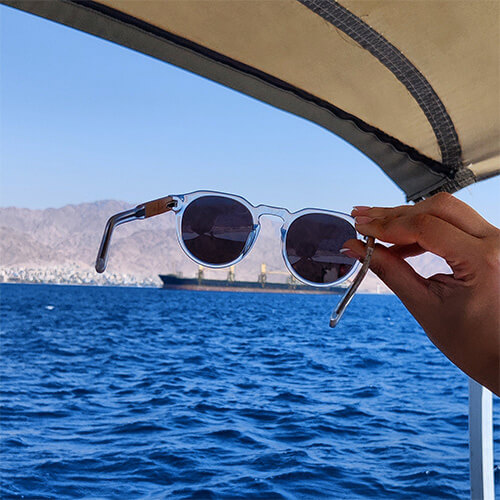
Miamii – transparent green bio-acetate with recycled wood temples
What Should Quality Hinges Feel Like?
Open and close each temple slowly. A quality hinge moves smoothly with even resistance throughout the full range of motion – no grinding, clicking or wobble. At the fully open position, the temple should stay in place without flopping loose or snapping too tight.
Spring hinges add an extra quality dimension. Press the temple outward past its natural open position and release it – it should spring back smoothly and consistently. For a full explanation of how spring hinges work, see the spring hinges guide.
How Do You Check Weight and Balance?
Put the glasses on and walk around for a minute. Quality frames feel balanced – the weight distributes evenly between the nose bridge and the temples, so no single point carries disproportionate pressure. Pay attention to whether the frames stay in position when you look down or move your head. A frame that shifts significantly with normal movement isn’t well-fitted for your face, regardless of build quality.
What Does Quality Finishing Look Like?
Look closely at frame edges, hinge connections and lens edges where they meet the frame. Quality finishing shows even color, clean joins and no visible mold lines, flash or rough edges. Lens edges in a quality frame are polished smooth and fit the groove precisely. Gaps between lens and frame, or a lens that rattles when tapped, indicate poor fit – which affects both appearance and peripheral UV protection.
How Do You Test if Sunglasses Fit Correctly?
A frame that’s too wide leaves gaps at the sides that allow UV and glare to enter from the periphery. A frame that’s too narrow presses the temples against the head and causes headaches. The frame width should match the width of your face at the temples. Put the glasses on and shake your head – quality-fitting frames stay in position. If they shift significantly with any head movement, the fit needs adjustment.
| Test | What to Look For | Red Flag |
|---|---|---|
| UV certification | UV400 marking on lens or frame arm | No marking or vague “UV protection” claim |
| Lens clarity | Straight lines stay straight when swept | Waviness or distortion visible |
| Polarization | Darkens phone screen when rotated 90° | No change in screen brightness |
| Frame material | Dense, consistent feel – no hollow spots | Lightweight hollow feel, rough surface |
| Hinges | Smooth movement, no wobble or grinding | Clicking, loose feel, uneven resistance |
| Balance | Even weight distribution when worn | Nose-heavy or temple pressure |
| Finish | Clean edges, flush screws, even color | Mold lines, rough joins, lens gaps |
| Fit | Stays in place when you move your head | Slides down or shifts with movement |
“I had hesitations about buying from a brand I’d never heard of. But the clear explanation, the fast shipping and the product itself won me over. Beautiful frame, excellent lenses.”
Worth Considering
Miamii – bio-acetate frame with recycled wood temples, stainless steel spring hinges and TAC polarized lenses with UV400. All eight quality indicators covered as standard.
Frame dimensions and UV specs listed on every product page in the men’s sunglasses collection.
Mr. Woodini was founded in 2018. We design eco-accessories built from materials with a story – recycled wood temples, natural stone beads, handcrafted construction. Our guides are written from direct experience: testing frames daily, sourcing materials, and building pieces by hand. Learn more about us.
Questions About Sunglasses Quality
Look for explicit “UV400” or “100% UV protection” labeling on the product page, tag or frame arm. If it’s not stated clearly – don’t assume it’s guaranteed. Lens darkness is not an indicator of UV protection level.
Hinge quality is one of the most reliable indicators of overall construction. Quality hinges flex smoothly and return to position cleanly. Cheap hinges feel stiff, loose or grind – and they fail first. Spring hinges specifically indicate a more serious approach to durability.
Frame width matches face width. Lenses don’t touch your cheeks. Nose bridge sits without sliding. Temples rest behind the ears without pressure. Correct fit affects both comfort and how well the frame protects from peripheral UV.
No. Brand markup, retail location and fashion premiums all inflate price without improving optical quality or durability. The eight tests in this guide are a more reliable measure of quality than price alone.