


Reading time: approximately 6 minutes
The bracelet that looked right on someone else’s wrist won’t automatically look right on yours. Skin tone, undertone, and what you wear day to day are the three variables that actually determine which color works.
How Does Bracelet Color Actually Work?
Choosing a bracelet color isn’t just about what looks attractive in a product photo. The color you choose will sit against your skin every day, interact with your clothing, and be seen in different lighting conditions. There are three factors to weigh: your skin tone and undertone, your typical wardrobe palette, and the contexts you’ll wear the bracelet in. Most guides focus on skin tone alone, but wardrobe match is often more useful in practice because the bracelet is almost always seen against clothing, not just against bare skin.

Why Are Dark Stones the Universal Option?
Black onyx, hematite, obsidian and black lava rock all fall into the category of dark neutrals. These stones work across skin tones, wardrobe palettes and wearing contexts because dark grey and black are genuinely neutral colors that don’t clash with other colors. On fair skin, black onyx creates strong contrast and reads with high presence. On medium or olive skin, it reads as clean and intentional. On deep skin, the contrast comes from the stone’s smooth, polished surface against skin texture and still reads clearly. If you’re unsure where to start, a black onyx bracelet in 8mm beads is the lowest-risk, highest-versatility choice available. For a detailed look at black onyx specifically, see the black onyx bracelet guide.
Which Stones Suit Your Undertone?
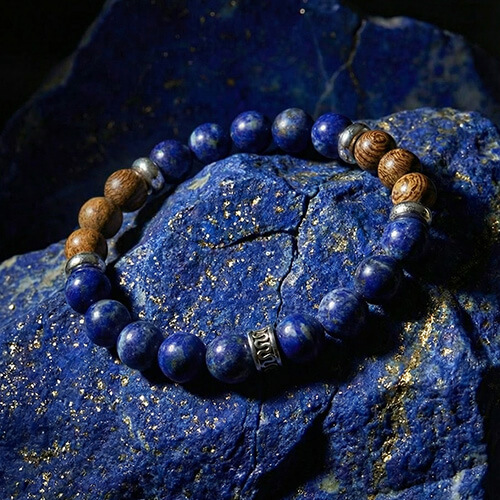
Tiger eye, rosewood, zebrawood and ebony carry warm amber and golden tones that sit naturally against warm or olive skin. Lapis lazuli, hematite and malachite lean cool — lapis is the boldest of the three, best worn with dark neutrals rather than on its own. For the full breakdown, including how to test your own undertone, see the bracelet colors for your skin tone guide.
How Does Your Wardrobe Affect the Choice?
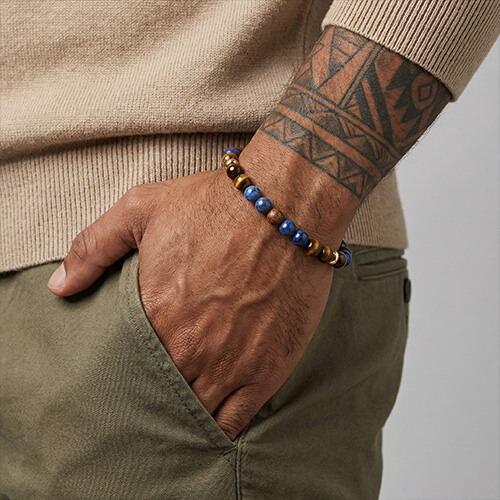
Most men’s wardrobes cluster around one of three main palette types. A dark neutral wardrobe (black, navy, charcoal, white) pairs best with dark stones like black onyx or hematite, or with a bold color accent like lapis for contrast. A warm neutral wardrobe (beige, olive, tan, brown, rust) pairs best with earth tones – tiger eye, wood, rosewood. A casual mixed wardrobe with no dominant palette has the most flexibility and can carry a wider range of stone choices. When wearing more than one bracelet, stay within one color family: all darks, or all earth tones. Two statement-color pieces compete with each other and both lose.
| Stone | Color | Best Skin Tone | Best Wardrobe Match |
|---|---|---|---|
| Black Onyx | Deep opaque black | All – true universal | Any palette |
| Tiger Eye | Golden-brown, shifting | Warm to medium | Earth tones, casual |
| Lapis Lazuli | Deep blue with gold | Fair to medium, cool | Dark neutrals |
| Lava Rock | Matte black, porous | All | Casual, outdoor |
| Rosewood / Zebrawood | Warm brown, natural grain | Warm to olive | Earth tones, natural fabrics |
Starting Points from the Collection
Black Onyx, Tiger Eye and Wood – the best starting point for anyone building a first stack: dark neutral anchor plus warm earth tone accent. Lapis Lazuli and Zebra Wood Premium for cool-toned skin and dark wardrobes. Browse the full men’s bracelet collection.
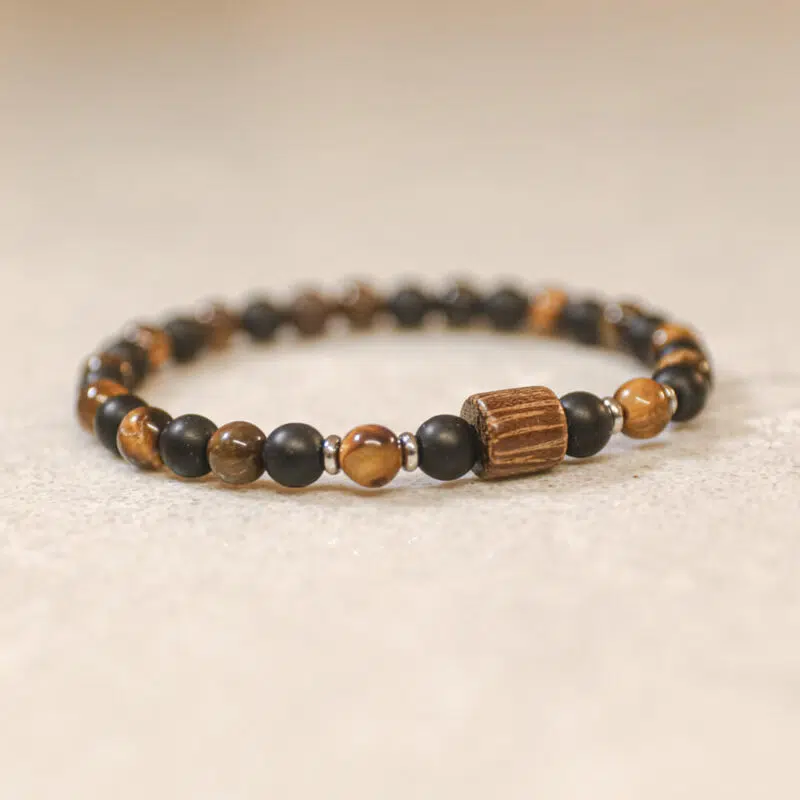
Black Onyx, Tiger Eye and Zebrawood Bracelet
Mr. Woodini was founded in 2018. We design eco-accessories built from materials with a story – recycled wood temples, natural stone beads, handcrafted construction. Our guides are written from direct experience: sourcing stones, testing daily wear, and building pieces by hand. Learn more about us.
Questions About Bracelet Colors and Skin Tone
Warm skin tones (olive, golden, brown) – tiger eye, wood, earthy reds. Cool skin tones (fair, pink, bluish) – lapis lazuli, dumortierite, black onyx. Neutral tones work with almost anything. When in doubt, black onyx is the universal starting point that suits every undertone.
Black is the safest universal choice – it contrasts with every skin tone and matches any outfit. If you want something with more visual character, tiger eye is a close second for warm-toned skin.
No – it needs to complement, not match. A stone bracelet should anchor an outfit rather than mirror it. Neutral stones work with everything. Bold stones (lapis, malachite) work best against simpler clothing.
Yes, but keep it cohesive. Stick to a palette – earth tones together, or dark stones together. Mixing lapis blue with malachite green and tiger eye brown in one stack creates tension rather than harmony.