




Reading time: approximately 6 minutes
Bracelets in professional settings are no longer unusual – but wearing them badly is still easy. The mistakes aren’t about the bracelet itself; they’re about proportion, material, and context.
Why Do Bracelets and Professional Style Intersect?
Men’s bracelets have become common enough in professional environments that they’re no longer automatically read as out of place. Senior executives, lawyers, designers and people across most industries wear them regularly. The question has shifted from “should I wear a bracelet at work?” to “how do I wear one without it working against me?” The underlying principle throughout is restraint. In professional environments, accessories that draw attention to themselves create distraction. Accessories that complement without demanding notice create polish.

Mistake 1: Wearing a Bracelet That Doesn’t Fit
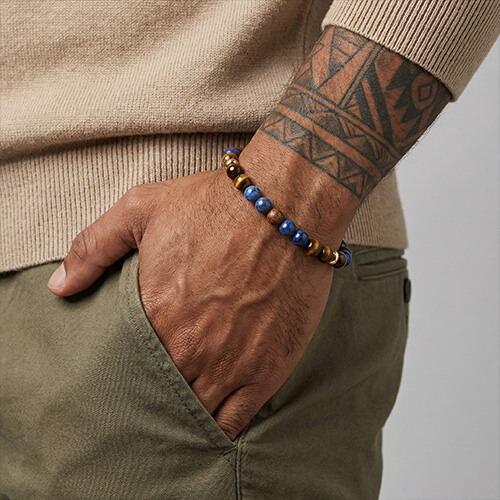
A bracelet that’s too loose slides down toward the hand constantly. You adjust it. It slides again. That repeated adjustment is a visible nervous habit in professional settings. A bracelet that’s too tight creates an indent in the skin and can restrict wrist movement subtly in ways that affect how you gesture and type. The correct fit for a professional setting is slightly more snug than beach-casual wearing – the bracelet should stay in place on the wrist without sliding when the arm is raised or lowered. To get the right fit: measure your wrist circumference and add 1.5cm for a standard professional fit. For the full measurement method, see the bracelet size guide.
Mistake 2: Stacking in a Formal Context
Stacking multiple bracelets is a legitimate style approach for casual and weekend contexts. In formal or high-stakes professional settings – client meetings, presentations, job interviews – stacking reads as casual. The professional rule is simple: one bracelet in formal settings. There’s one exception: if you always stack two very thin, subtle pieces that function essentially as a single element, the combined visual is small enough to work in most professional environments. But three or more pieces, or any combination with significant visual weight, is a casual choice.
Mistake 3: Choosing the Wrong Stone for the Setting
Not all stones translate equally to professional environments. In formal settings, the bracelet should recede rather than demand attention. Black onyx is the professional standard for a reason – it’s dark, polished and neutral: it reads as a deliberate, confident choice without drawing attention away from the overall presentation. Bright or highly saturated stones – vivid red jasper, bright turquoise – attract attention in ways that can feel incongruous in formal settings. Patterned or highly textured stones like rough lava rock introduce visual complexity that works against the clean lines of formal clothing.
| Stone | Formal Office | Business Casual | Casual / Weekend |
|---|---|---|---|
| Black Onyx | Yes | Yes | Yes |
| Tiger Eye | Depends on outfit | Yes | Yes |
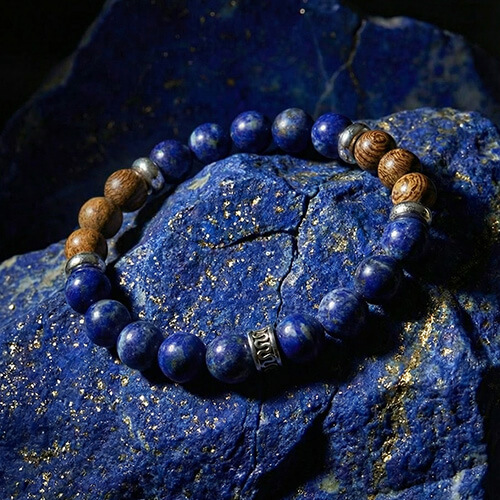
| Lapis Lazuli | Use caution | Yes | Yes |
| Lava Rock | No | Casual Friday only | Yes |
Mistake 4: Wearing It on the Same Wrist as Your Watch
A dress watch and a beaded bracelet on the same wrist compete for the same visual space. The result is visual clutter that reduces the impact of both pieces. The standard approach is to wear the watch on your dominant-hand wrist and the bracelet on the other. This separates the two accessories and allows each to be seen clearly. An exception: a thin, subtle bracelet in a dark color can sometimes sit alongside a watch without competing, particularly if the watch has a dark or leather strap rather than a bright metal case.
Mistake 5: Wearing Something That Makes Noise
Metal bracelets with links or charms make noise when they move. Some beaded bracelets with loose stringing or large beads click audibly. In quiet professional settings – meetings, interviews, negotiations – that sound creates a distraction that the wearer often doesn’t register but everyone else notices. The solution is to choose bracelets with tight, consistent stringing where the beads don’t move independently. Well-strung elastic cord bracelets where each bead is knotted in place are essentially silent in use – this is also a quality indicator: tight, consistent stringing is a sign of careful construction.
Professional Bracelet Choices from Mr. Woodini
Black Onyx and Rosewood – the most reliable professional choice: dark, neutral and well-strung. Gold Tiger Eye and Ebony Wood for business casual settings where warmer tones work. Browse the full men’s bracelet collection.

Gold Tiger Eye and Ebony Wood Beaded Bracelet
Mr. Woodini was founded in 2018. We design eco-accessories built from materials with a story – recycled wood temples, natural stone beads, handcrafted construction. Our guides are written from direct experience: sourcing stones, testing daily wear, and building pieces by hand. Learn more about us.
Questions About Bracelets in Professional Settings
Yes, in most modern workplaces. The key is restraint – one bracelet, well-chosen and well-fitted. A single dark stone bracelet reads as intentional style, not casual carelessness.
Single-stone bracelets in black onyx, hematite or dark tiger eye, in 8mm bead sizes. Avoid chunky stacks, bright colors, rough textures or mixed materials with a formal dress code.
It should coexist with them, not match perfectly. A black onyx bracelet works alongside a silver watch without them being identical. The goal is balance – neither piece should dominate or clash with the other.
In a professional context, wearing them on different wrists is cleaner. It keeps each piece visible without crowding the wrist. If you must wear them together, both pieces need to fit well and work visually – avoid pairing a large dress watch with a substantial stone bracelet on the same wrist.