


Reading time: approximately 7 minutes
Winter dressing runs dark – charcoal, forest green, navy, burgundy. The bracelets that hold up in that context are the ones built from materials that get better in low light: stone and wood.
Why Is Winter a Good Season for Beaded Bracelets?
Winter is underrated as a season for bracelets. The heavier fabrics and darker palettes of winter wardrobes – wool coats, thick knitwear, flannel shirts, dark denim – provide a rich visual backdrop for natural stone and wood. A black onyx bracelet against a dark grey wool sleeve reads with more texture contrast than the same bracelet against a summer t-shirt. The natural materials interact with natural fabrics in a way that reads as coherent and considered. Longer sleeves also create a practical framing effect: when a heavy sleeve is pushed back to reveal a bracelet, the contrast between fabric and wrist accessory is immediate and visible.
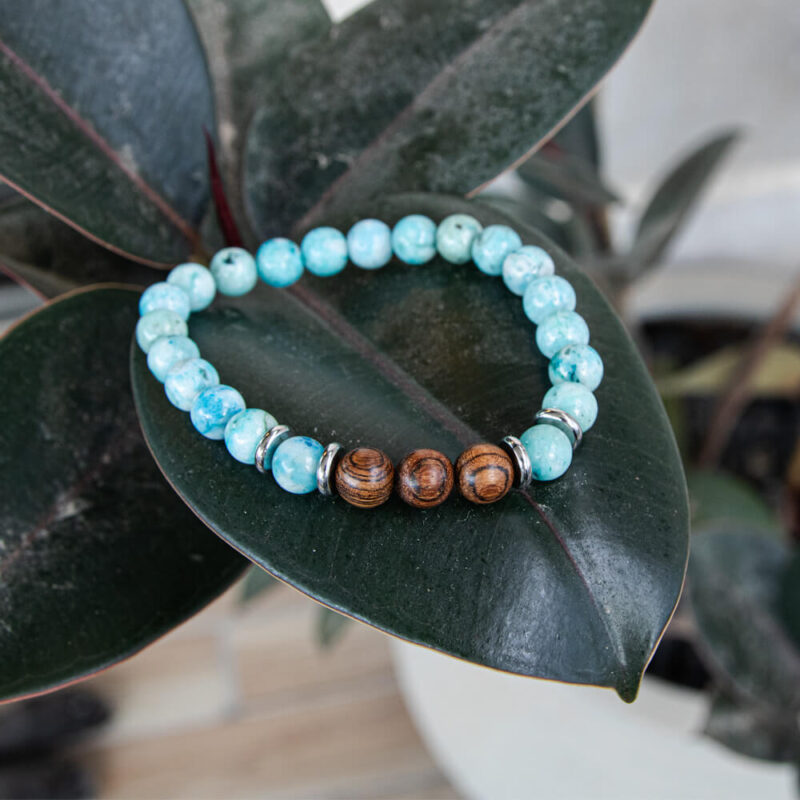
Turquoise Blue Hemimorphite and Zebrawood Bracelet (8mm)
Which Dark Stones Work Best in Winter?
Black onyx, hematite and lava rock are the strongest performers for winter specifically. Their dark, matte or polished surfaces work with the lower light levels and darker palettes of the season. Black onyx functions as a true neutral against any dominant winter color: charcoal, navy, black, olive, burgundy, camel. Hematite is particularly strong because its dark metallic quality resonates with heavier accessories typical of the season – steel watch cases, dark belt hardware, leather boots. The tonal relationship between hematite and steel is stronger in winter when those combinations appear more frequently. Lava rock benefits from the season’s appreciation for texture: the rough, matte, porous surface contrasts sharply with the smooth surface of a wool coat or flannel shirt.
How Do Wood Bracelets Work in Winter?
Ebony’s deep near-black with subtle grain reads alongside dark wool and leather. Zebrawood’s striped pattern in brown and tan tones pairs naturally with the earth tones – camel, tan, brown – that appear frequently in winter knitwear and outerwear. Wood bracelets also have a practical advantage in cold weather: they don’t conduct cold the way metal accessories do. A stainless steel bracelet in sub-zero temperatures is uncomfortable against the wrist. A wood or stone bracelet remains at approximately skin temperature because neither material is a good thermal conductor. The natural grain of wood also interacts with winter fabrics – tweed, herringbone, heavy linen – in a way that manufactured materials don’t replicate.
Why Do Lapis and Bold Stones Work Against Winter Neutrals?
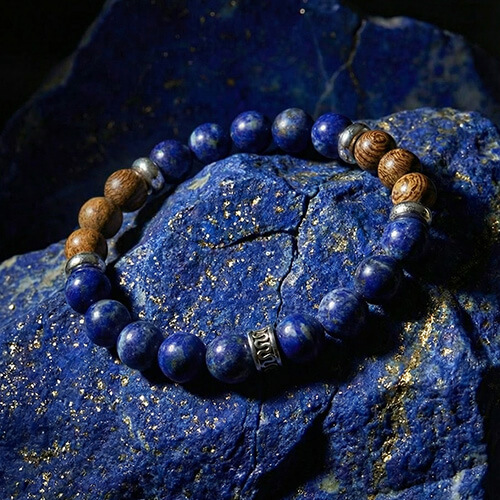
Winter wardrobes are often more neutral and monochromatic than summer – which makes them an excellent context for a single bold color accessory. Lapis lazuli’s deep royal blue with gold flecks reads as a striking accent against charcoal, black, or navy, in a way that would be harder to carry off against a varied summer wardrobe. The deep saturation of lapis works because winter light tends to be lower and more diffused than summer light – colors that might feel harsh in bright sun read as rich and warm in winter conditions. Malachite’s saturated green similarly works well against the wine, burgundy and forest green tones that appear in winter fashion.
How Do Sleeves Interact With Bracelets?
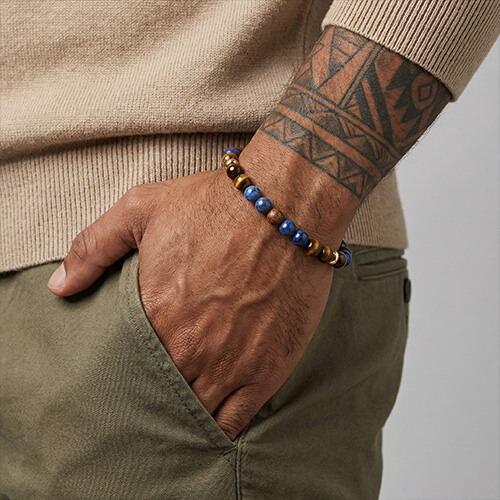
Elastic-cord bracelets work better under and over sleeves than clasped bracelets because they have no mechanism that can catch on fabric. The bracelet should sit above the wrist bone – closer to the hand than the forearm – so it clears the sleeve cuff naturally when rolled down, and sits visibly on the wrist when the sleeve is pushed up. Knit sleeves interact differently with bracelets than woven sleeves: a rough lava rock bead can snag on loose-knit fabric if the bracelet is too close to the cuff. Polished stone bracelets (onyx, hematite) slide against knitwear more cleanly. For practical guidance on stacking when wearing winter layers, see the bracelet stacking guide.
How Do You Care for Bracelets in Cold Weather?
Cold weather itself doesn’t damage natural stone bracelets, but a few winter-specific factors are worth being aware of. Hand moisturizer, which many people use more frequently in cold weather, can build up on stone surfaces over time – wipe the bracelet down with a dry cloth regularly. Gloves and bracelets interact awkwardly in practice: putting on or removing gloves repeatedly can stress the elastic cord over time. If you wear gloves daily, consider removing the bracelet before putting them on, or choose a wrist placement that sits above the glove line. Remove before showering to protect the cord – as always. Full guidance is in the bracelet care guide.
| Stone | Winter Wardrobe Match | Winter Advantage |
|---|---|---|
| Black Onyx | All winter palettes | True neutral, never clashes |
| Hematite | Charcoal, black, steel grey | Metallic tone fits winter hardware |
| Lava Rock | Casual winter, outdoor | Texture contrast against smooth fabrics |
| Lapis Lazuli | Dark neutrals as backdrop | Bold accent in low winter light |
| Ebony / Zebrawood | All dark winter tones | Warm against skin, grain suits heavy textures |
Winter Picks from the Collection
Black Onyx and Rosewood – the most reliable winter combination: dark, grounded, works with any palette. Lapis Lazuli and Zebra Wood Premium for a bold accent against dark neutrals. Browse the full men’s bracelet collection – all pieces handmade in Israel, sizes 17-22cm, gift packaging included.
Mr. Woodini was founded in 2018. We design eco-accessories built from materials with a story – recycled wood temples, natural stone beads, handcrafted construction. Our guides are written from direct experience: sourcing stones, testing daily wear, and building pieces by hand. Learn more about us.
Common Questions
Dark stones – black onyx, hematite and lava rock – are the strongest choices for winter. They complement the heavier fabrics and darker palettes of the season. Lapis lazuli works well as a bold accent against winter neutrals like charcoal or navy.
Yes. A bracelet worn under a cuff creates a reveal when you move your arm – one of the cleaner ways to wear jewelry in a formal winter context. Position it above the wrist bone so it clears the cuff naturally when the sleeve is rolled down.
Wood and stone are poor thermal conductors – they stay close to body temperature rather than absorbing the cold. A metal bracelet feels freezing when you step outside. Stone and wood bracelets remain comfortable at any temperature.
Yes. Natural stone and handcrafted quality make them a strong gift choice for Christmas or winter birthdays. Every bracelet ships in gift-ready packaging. Black onyx in 19cm is the safest choice when you don’t know the recipient’s wrist size.