


Reading time: approximately 6 minutes
Face shape gives you a starting point, not a rulebook. The frame width relative to your cheekbones and the bridge fit against your nose are the two measurements that actually determine whether a frame works. This guide covers the full picture – face shape, lifestyle, materials, lens color and fit.
Why Does Face Shape Matter When Choosing Sunglasses?
Choosing sunglasses based on what looks good on a model often leads to disappointment. What works on someone else’s face depends entirely on the proportions of that face. The basic principle is contrast: round faces benefit from angular frames that add definition. Angular faces benefit from softer, rounder frames that reduce sharpness. Oval faces are balanced and suit most styles.
This isn’t a rigid system – but it’s a useful filter. When you’re looking at dozens of frame options, face shape is the fastest way to cut the list down to something manageable.
How Do You Identify Your Face Shape?
Pull your hair back so your full face is visible. Look at the outline and identify the widest point – is it your forehead, cheekbones or jaw? Then consider whether your face is longer than it is wide, or roughly as wide as it is tall.
The main shapes: oval (slightly longer than wide, no dramatically wide points), round (wide at the cheeks, soft chin), square (equally wide at forehead and jaw, sharp corners), heart (wide forehead tapering to a narrow chin) and oblong (significantly taller than wide). If you’re unsure, photograph your face straight-on and trace the outline – the shape becomes clearer in two dimensions.
| Face Shape | Best Frames | Avoid |
|---|---|---|
| Oval | Almost anything – oversized, square, round, aviator | Frames much wider than the forehead |
| Round | Square, rectangular, geometric, wayfarer | Circular or very small round frames |
| Square | Round, oval, aviator | Heavy square or rectangular frames |
| Heart | Aviator, round, oval, rimless | Cat-eye or frames that add width at the top |
| Oblong | Oversized, wide square frames | Narrow or small frames that emphasize length |
How Should Your Lifestyle Affect Your Choice?
Once you’ve narrowed down by face shape, the next filter is lifestyle. A frame that suits your face but not how you actually live won’t get worn.
For outdoor use – hiking, cycling, beach – you need frames with good coverage, secure fit and durable materials. Polarized sunglasses for men with UV400 reduce glare from water and reflective surfaces. For everyday urban use, standard frames handle the requirements without the bulk of sports-specific designs. For travel, the destination matters: beach needs polarized, high altitude needs darker tints. The American Academy of Ophthalmology recommends UV400 as the minimum standard for all outdoor sun exposure.

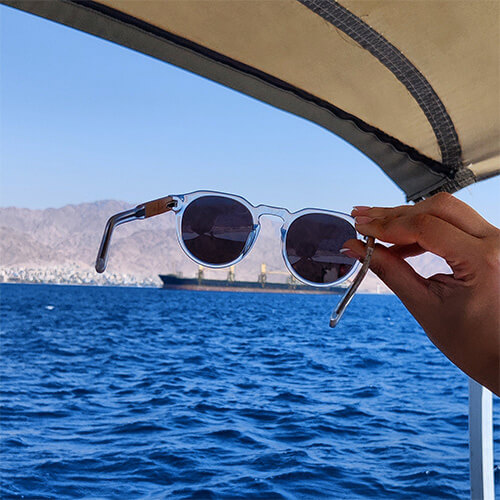
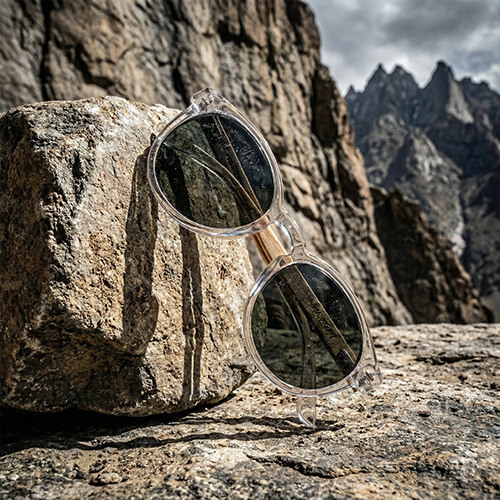
Malibu – round acetate frame with recycled zebrawood temples
What Frame Material Should You Choose?
Acetate is plant-derived, more flexible and lighter than standard injection-molded plastic. It holds color well, can be produced in complex patterns, and can be adjusted by an optician for a better fit over time. Quality acetate frames are durable and age well.
Metal frames – titanium, stainless steel or aluminum – are thinner and more minimal. Titanium is the lightest and most corrosion-resistant option but less adjustable if bent.
Wood temples paired with acetate fronts offer a distinctive combination: the warmth and texture of natural wood with the structural precision of acetate. Many people find the weight distribution more comfortable for extended wear than all-acetate or all-metal frames. The Porto is a good example – a square-leaning acetate front with recycled wood temples that sit lighter than they look.
How Do You Choose the Right Lens Color?
Grey is the most neutral option – reduces brightness without shifting color balance. Everything looks natural, just darker. Ideal for bright, sunny conditions and everyday use. According to WHO guidance on UV radiation, the lens tint has no bearing on UV protection – that comes from the coating alone.
For a deeper look at how polarized lenses differ from standard UV lenses, see our guide on what polarized sunglasses actually do.
Brown and amber enhance contrast and depth perception. Particularly good for driving, hiking and activities where reading terrain matters.
Green offers a middle ground – better color accuracy than brown, better contrast than grey.
Yellow and orange increase contrast in low-light conditions – performance lenses for overcast weather or early morning, not general sunglasses.
How Do You Know If a Frame Fits Correctly?
Frame width should roughly match the width of your face at the temples. Too narrow and the frames look pinched; too wide and they look unintentionally oversized. The bridge should sit flush on your nose without digging in. Temple length affects how the glasses sit behind your ear – too short and they feel tight, too long and they move around.
“I ordered based on the photo alone, took the risk that they might not fit – and they fit perfectly.”
Worth Considering
Malibu – round bio-acetate frame with recycled wood temples. Works well on square and angular faces. TAC polarized lenses with UV400, stainless steel spring hinges. Frame dimensions and size guide on the product page.
Browse the full sunglasses collection to compare frame shapes by face type.
Mr. Woodini was founded in 2018 by Idan Birenberg. We design eco-accessories built from materials with a story – recycled wood temples, natural stone beads, handcrafted construction. Our guides are written from direct experience: testing frames daily, sourcing materials, and building pieces by hand. Learn more about us.
Questions About Choosing Sunglasses
UV400 protection. Everything else – style, material, price – is secondary to whether the lenses actually protect your eyes. Sunglasses without adequate UV protection can cause more damage than wearing nothing, by dilating pupils while providing no UV barrier.
Frames that contrast with face shape create balance. Round face – angular frames. Square face – rounder frames. Oval face – most shapes work. Long face – wider frames with depth add proportion. It’s a guide, not a rule – try different styles and see what works.
Acetate is the most versatile starting point – durable, comfortable, available in every color and shape, and significantly better looking than standard plastic over time. Adding recycled wood temples elevates the look and improves comfort for long wear.
Not necessarily. Polarized lenses reduce glare from reflective surfaces – most useful at the beach, on the water, skiing or driving in bright conditions. For general urban use, UV400 lenses without polarization are sufficient. Polarization is worth having if you spend time in high-glare environments.