


Estimated Reading Time: 10 minutes

Blue is the most versatile stone color on a wrist – it holds up with navy, grey, olive, black, and white without competing. The shade you pick changes everything about how it reads.
Table of Contents
- The Blue Stone Spectrum
- Lapis Lazuli: The Standout Choice
- Other Blue Stones Worth Knowing
- Blue Stone Comparison Table
- Outfit Pairing: What Works
- Outfit Pairing Table
- Blue and Gold: A Reliable Combination
- Blue Bracelets in Men’s Styling
- Blue Bracelets in Women’s Styling
- Stacking Blue with Other Stones
- Mr. Woodini Collection
- About Mr. Woodini
- Common Questions
The Blue Stone Spectrum
Blue gemstones span from barely-there pale aqua to deep, near-black navy. Each position on that spectrum reads differently as an accessory, pairs with different clothing, and creates a different overall impression on the wrist. Understanding where your stone sits on the spectrum is the first step to wearing it well.
At the pale end: aquamarine and blue lace agate offer soft, cool tones that read as subtle and understated. These are bracelet colors that add a hint of blue without making a definitive statement.
In the mid-range: blue aventurine, sodalite, and blue howlite create a clear, recognizable blue that registers from a normal distance. These stones have enough saturation to function as a color accent without the visual weight of the deepest blues.
At the deep end: lapis lazuli and blue tiger eye (hawk’s eye) produce rich, saturated blue that has significant visual presence. These are stones for people who want blue to be an active part of their outfit rather than a quiet background note.
Lapis Lazuli: The Standout Choice
Lapis lazuli is one of the oldest decorative materials in human history – it was used in ancient Egyptian jewelry, ground into ultramarine pigment for Renaissance paintings, and worked into architectural decoration across the Islamic world. That depth of history isn’t just trivia; it means lapis has been refined and appreciated as a visual material across thousands of years of human aesthetic judgment.
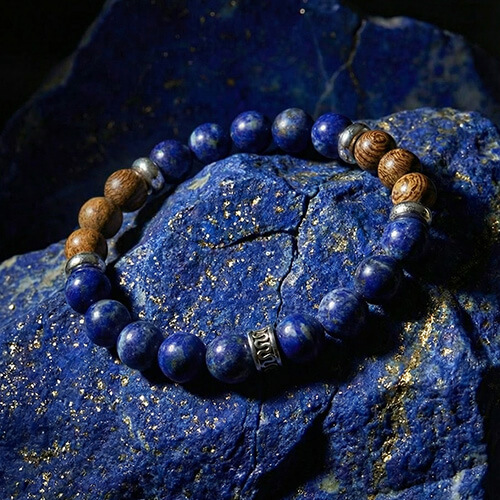
As a bracelet stone, lapis has specific qualities that make it distinctive. Its color is a deep, rich ultramarine that doesn’t fade or wash out in low light. The gold pyrite inclusions – small metallic flecks scattered through the blue – catch light and create a surface that shifts slightly depending on the viewing angle and light source. No two lapis beads are identical because the pyrite distribution varies throughout the stone.
Lapis is harder than many decorative stones at 5-6 on the Mohs scale – durable enough for daily wear without special handling. It polishes to a smooth, deep surface that holds its finish well over time. These practical properties make it a good bracelet stone beyond its visual appeal.
Other Blue Stones Worth Knowing
Sodalite is the most common alternative to lapis lazuli for people who want deep blue at a lower price point. Its blue is slightly less saturated than lapis, and it typically has white calcite veining rather than gold pyrite. The visual result is still a strong, rich blue – just cooler and less dramatic than lapis. Sodalite is a reliable daily-wear stone that doesn’t require special care beyond basic bracelet maintenance.
Blue tiger eye (hawk’s eye) is one of the more unusual blue stones. It has the same fibrous chatoyant structure as golden tiger eye, but in dark teal-blue rather than amber. The shifting light effect that makes golden tiger eye shimmer operates the same way in the blue variety, creating movement within the stone as viewing angle changes. It’s a subtle stone – the blue reads as dark and cool rather than vivid – but the internal movement gives it a quality that flat blue stones lack.
Aquamarine is a pale, cool blue that’s best suited to stacking contexts rather than standalone wear. Its delicate color can disappear against skin or dark clothing. Used as part of a multi-stone stack alongside white quartz or pale grey labradorite, it adds a light blue note to a cool-toned wrist combination.
Blue Stone Comparison Table
| Stone | Blue Shade | Hardness | Best Use |
|---|---|---|---|
| Lapis Lazuli | Deep ultramarine, gold flecks | 5-6 | Statement piece, single or stack anchor |
| Sodalite | Deep blue, white veining | 5.5-6 | Daily wear, versatile |
| Blue Tiger Eye | Dark teal-blue, chatoyant | 6.5-7 | Subtle statement, unique visual |
| Blue Aventurine | Mid-tone blue, slight sparkle | 6.5-7 | Casual, everyday color accent |
| Aquamarine | Pale, cool blue | 7.5-8 | Stacking, light palettes |
Outfit Pairing: What Works
Blue is a color that pairs most cleanly with neutrals. White creates the highest contrast and lets deep blue stones read at full saturation – a lapis bracelet against a white shirt sleeve is as vivid as the stone gets. Navy clothing creates a tonal relationship with blue stones: same color family, different intensity. Grey lets blue sit as a quiet accent without the formality of the white contrast.
Black clothing with blue stones creates a strong, sophisticated combination. The depth of the black background makes even pale blue stones more visible, and deep blues like lapis against black have a richness that reads as considered and intentional.
Denim is a natural partner for blue stones. Both are blue, but they occupy different enough shades and textures that the combination doesn’t read as accidental matching – it reads as a coherent blue-palette outfit where the stone adds a refined material note to the casual fabric.
What to be careful about: pairing blue stone bracelets with warm-colored clothing. Orange, rust, and warm brown are the complement of blue on the color wheel, which means they create strong contrast – not necessarily bad, but demanding. Pale blue against warm orange reads as deliberate contrast. Deep lapis against rust orange can feel discordant if not handled carefully.
Outfit Pairing Table
| Clothing Color | Blue Stone Result | Recommended Stone |
|---|---|---|
| White / cream | Maximum contrast, vivid blue | Lapis lazuli or sodalite |
| Navy | Tonal, sophisticated | Lapis or blue tiger eye |
| Grey (any shade) | Cool, composed accent | Sodalite or blue aventurine |
| Black | Rich, deep combination | Lapis – reads most vividly |
| Denim | Tonal, relaxed, natural | Any blue stone |
Blue and Gold: A Reliable Combination
Blue and gold is one of the oldest and most tested color combinations in decorative arts. Egyptian pharaohs wore lapis lazuli set in gold. Renaissance painters used ultramarine (made from ground lapis) alongside gold leaf. The combination works because the warm yellow of gold and the cool deep blue of lapis create a contrast that’s vivid without being harsh.
In bracelet styling, this translates practically: a lapis lazuli bracelet paired with gold-toned metal accessories – a gold watch, gold rings, gold chain – creates a combination with the same underlying logic as those historical precedents. The gold warms the cool blue; the blue deepens the otherwise all-warm metal palette.
This combination works for both men and women. For men, a lapis bracelet opposite a gold or two-tone watch creates a wrist combination where the warm metal and the cool stone balance each other. For women, lapis alongside gold bangles or rings uses the same logic in a layered context.
Blue Bracelets in Men’s Styling
Blue is one of the few non-neutral stone colors that has gained genuine mainstream acceptance in men’s jewelry styling. The combination of blue’s visual appeal and its position as a culturally neutral color (unlike pink, which carries strong gender associations) made it accessible to a wide range of men who wouldn’t reach for other color stones.
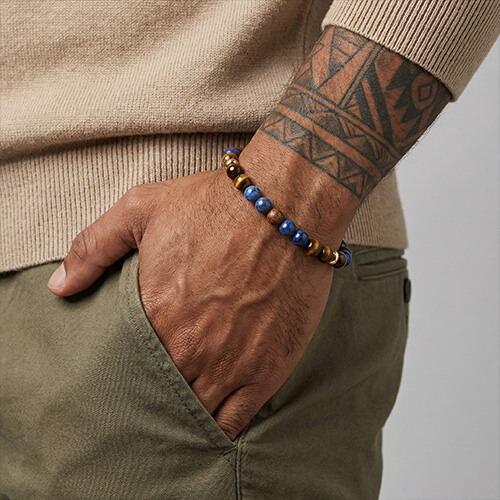
The most common men’s styling approach: a single lapis or sodalite bracelet on the wrist opposite a watch, worn with a neutral outfit. The blue functions as the one color note in an otherwise dark or neutral palette. This is controlled, intentional use of color that reads as confident rather than decorative.
For men who stack, blue works well as the accent piece in a predominantly dark stack. Black onyx as the anchor, lapis as the accent, and dark wood or hematite as the connector gives the stack a structured color logic – dark neutrals with one deliberate color note.
Blue Bracelets in Women’s Styling
Women’s styling with blue beaded bracelets tends toward more active color conversation between the bracelet and the outfit. A lapis bracelet chosen to echo a blue detail in a printed dress, or a pale aquamarine bracelet paired with a white linen outfit for a summer combination – these uses are more deliberately coordinated than the typical men’s approach.
Layering blue with other jewelry opens more options. Lapis alongside clear quartz or white howlite creates a cool, structured stack. Lapis alongside labradorite (grey with blue flash) creates a monochromatic blue-grey wrist combination that’s more subtle than lapis alone.
For women who prefer minimal jewelry, a single lapis bracelet worn alone has enough visual weight and color presence to function as a complete accessory without any other pieces. The stone’s visual richness carries the wrist look independently.
Stacking Blue with Other Stones
Blue stones stack best with stones that either share their cool tone or provide a specific, considered contrast. The three most reliable stacking partners for blue are: black (onyx or lava – dark neutral that grounds the blue), white or grey (howlite, quartz, labradorite – cool tones that complement rather than compete), and natural wood (warm neutral that contrasts the blue’s coolness without clashing).
Two blue stones in the same stack generally don’t work as well as one blue anchor with supporting neutral pieces. Two different shades of blue next to each other create a comparison that emphasizes the differences between them rather than letting each read cleanly.
Gold-toned spacer beads between stone beads are a traditional bracelet design element that works especially well with blue stones. Even small brass or gold-colored metal spacers between lapis or sodalite beads pick up the gold note in the stone itself and create a visually coherent piece.
Mr. Woodini Collection
Mr. Woodini’s bracelet collection includes natural blue stone options alongside the full range of earth tones and dark neutrals. All pieces use 8mm natural stone beads, available in sizes 17cm to 22cm.
Every Mr. Woodini bracelet is handcrafted using natural gemstone and wood materials selected for color depth and consistency. All orders ship internationally with gift packaging included on every order.
Browse the full bracelet collection to find the right stone and size.
About Mr. Woodini
Mr. Woodini was founded in 2018 by Idan Birnberg. We design eco-accessories built from materials with a story — recycled wood temples, natural stone beads, handcrafted construction made in Israel. Our guides are written from direct experience: sourcing stones, testing daily wear, and building pieces by hand. Learn more about us.
Common Questions

Struggling to find the right gift? Blue beaded bracelets solve that dilemma beautifully. Blue’s universal appeal transcends age, gender, and personal style preferences. Teenagers love trendy turquoise. Professionals appreciate sophisticated lapis. Spiritual seekers value blue stones’ metaphysical properties. Retirees enjoy blue’s calming energy. Whether you’re shopping for Mother’s Day, birthdays, graduations, or “just because” moments, a blue beaded bracelet is a thoughtful gift that recipients will actually wear and treasure.
The Health Connection: Unexpected Benefits
Beyond aesthetics, some wearers report additional benefits from blue stone bracelets. While scientific evidence varies, many crystal healing traditions attribute specific properties to blue stones. Turquoise is believed to strengthen the immune system. Lapis lazuli purportedly alleviates insomnia and anxiety. Sodalite is thought to enhance mental clarity and logical thinking. Whether you embrace these metaphysical beliefs or simply enjoy the placebo effect of positive thinking, there’s no denying that wearing something beautiful and meaningful can improve your daily experience.
Care and Longevity: Making Your Investment Last
Blue beaded bracelets require minimal maintenance to stay beautiful. Most blue stones are relatively durable, though some (like turquoise) benefit from occasional gentle cleaning with a soft, damp cloth. Avoid harsh chemicals, extreme temperatures, and prolonged water exposure. Store your bracelet separately from harder gemstones to prevent scratching. With proper care, your blue beaded bracelet will maintain its beauty for years, potentially becoming a cherished heirloom piece.
Sustainable and Ethical Choices
Many blue beaded bracelets feature ethically sourced stones and eco-friendly materials. Artisan-crafted pieces support small businesses and traditional craftsmanship. When choosing your blue beaded bracelet, consider brands like Mr. Woodini that prioritize sustainability, fair trade practices, and transparent sourcing. Your purchase becomes more meaningful when it supports ethical practices and environmental responsibility.
Conclusion: More Than Just Blue
A blue beaded bracelet represents far more than a pop of color on your wrist. It’s a connection to ancient traditions, a tool for emotional well-being, a versatile styling piece, and a meaningful personal talisman. Whether you’re drawn to blue for its calming properties, its rich cultural history, its styling versatility, or simply its undeniable beauty, adding a blue beaded bracelet to your collection is a decision you’ll celebrate every time you fasten it around your wrist.
Questions About Blue Beaded Bracelets
Lapis lazuli and dumortierite are the primary blue stones in the collection. Lapis is a deep royal blue with gold flecks. Dumortierite leans more blue-violet with a glassy finish.
Blue stone bracelets are most versatile with neutrals — white, grey, navy, black and beige. They add a focal point without clashing. Avoid pairing with other bold colors at the same time.
Yes. A single lapis or dumortierite bracelet reads as intentional and polished in most workplaces. Keep the rest of your accessories minimal and the bracelet will do its work quietly.
Yes. Both lapis and dumortierite are durable enough for daily use. Remove before water exposure, heavy exercise or contact with chemicals to maintain the stones’ surface over time.