



Reading time: approximately 5 minutes
There’s no law about which wrist a bracelet goes on. But there is a reason most men who wear one look comfortable and a few look like they’re fighting it – and it usually comes down to which hand they use, where their watch sits, and how much the bracelet gets in the way of their day.
So the short answer to which wrist to wear a bracelet on: for most men, the non-dominant wrist, either alongside the watch or on its own. The longer answer depends on whether you wear a watch, how many bracelets you’re wearing, and what you do with your hands all day. Here’s how to decide.
Table of Contents
The Default: Your Non-Dominant Wrist
If you’re right-handed, that’s the left wrist. If you’re left-handed, the right.
The reason is practical. Your dominant hand writes, uses the mouse, carries coffee, opens doors and shakes hands. A beaded bracelet on that wrist knocks against the desk every time you type, catches on sleeves, and wears faster. On the other wrist it simply sits there and gets seen.
This is also why watches traditionally go on the non-dominant wrist – the same logic, applied a century earlier.
If You Wear a Watch
This is where most of the real decisions happen. You have two good options.
Option 1: Same wrist as the watch
Wearing a bracelet next to your watch is the more styled, intentional look – a “wrist stack.” It works best when:
- The bracelet sits above the watch (closer to the elbow), so the watch stays visible and the beads don’t scratch the case.
- The bracelet is one bracelet, or two at most. More than that and the watch disappears.
- The materials talk to each other. A steel watch pairs naturally with a bracelet that has a steel bead; a leather strap pairs with wood and matte stone.
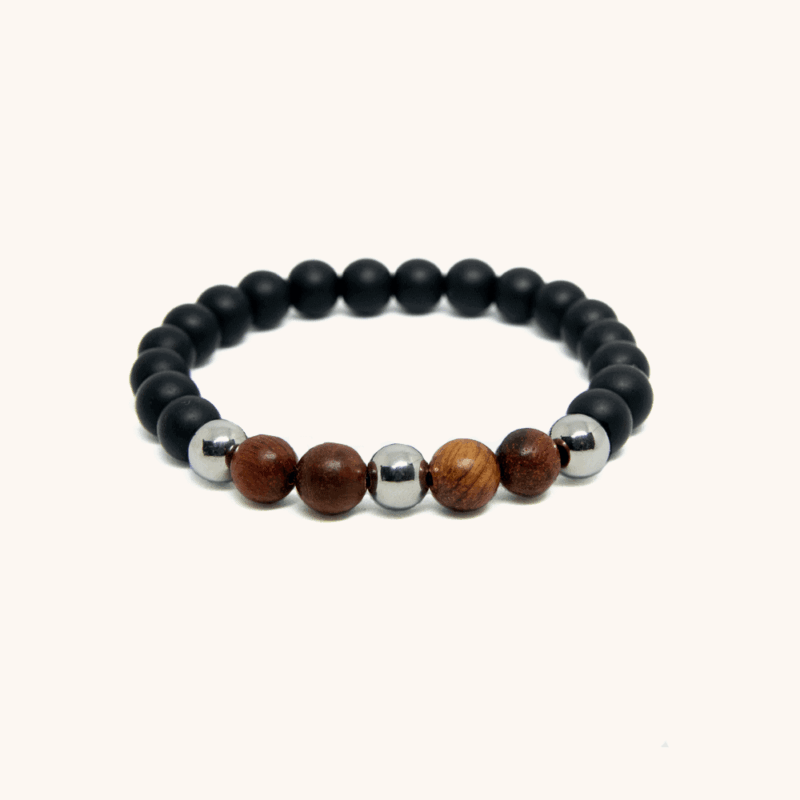
Matte and dark stones are the safest next to a watch, because they don’t compete with the dial. Something like the Berlin black onyx and rosewood bracelet sits quietly beside most watches.
Option 2: Opposite wrist from the watch
Watch on one wrist, bracelet on the other. This is the more balanced, minimal look and the one we’d suggest if you’re wearing a bracelet for the first time, or if your watch is large. It also protects the watch – stone beads and polished cases don’t always get along.
When the Dominant Wrist Makes Sense
There are good reasons to break the default:
- Your watch is on your non-dominant wrist and you want separation. Putting the bracelet on the dominant side keeps both visible.
- You don’t do much desk work. If your day isn’t spent on a keyboard, the wear argument matters less.
- You want it seen. The dominant hand moves more and gets noticed more – handshakes, gestures, holding a glass.
If you go this way, choose a tighter fit so the bracelet doesn’t slide over your hand while you work. The bracelet size guide shows how to measure, and the guide to bead size and proportion explains why 8mm beads need a slightly larger size than 6mm.
Wearing Bracelets on Both Wrists
It can work, but it’s the hardest look to get right. Two rules:
- Make one side clearly the main one. A stack of two or three on one wrist, a single bracelet on the other.
- Keep them in the same family. Same bead size, related colors or the same wood. Random pieces on both wrists look accidental.
If you’re building toward a stack, our guide to stacking bracelets for men goes through combinations that work.
Wrist Traditions Worth Knowing
Some bracelets come with their own rules. The red string bracelet associated with Kabbalah is traditionally worn on the left wrist. Many religious and cultural bracelets – prayer beads, blessing threads – have a specific wrist depending on the tradition, and sometimes on gender or marital status. If a bracelet was given to you with a meaning attached, ask how it’s meant to be worn.
For a natural stone or wood bracelet bought for style, there’s no rule beyond comfort and how it looks with what else you’re wearing.
Choosing a Bracelet That Works on Either Wrist
If you’re still choosing, look for something that won’t fight a watch or a shirt cuff: 6mm or 8mm beads, matte or dark stones, and natural wood, which is lighter than stone. A lava stone and zebrawood bracelet is light enough to forget on the dominant wrist; a gold tiger eye with a steel bead works beside a steel watch. You can see more in the men’s bracelets collection.
FAQ
What wrist should a man wear a bracelet on?
Most men wear a bracelet on their non-dominant wrist – the left wrist for right-handed men – because it gets in the way less and lasts longer. There’s no fixed rule, though. If your watch is on that wrist, you can wear the bracelet beside it or move it to the other wrist.
Can I wear a bracelet and a watch on the same wrist?
Yes. Wear the bracelet above the watch, closer to the elbow, so the watch stays visible and the beads don’t scratch the case. Keep it to one or two bracelets, and match materials – steel beads with steel watches, wood and matte stone with leather straps.
Is it wrong to wear a bracelet on the right wrist?
No. Wearing a bracelet on the right wrist is completely normal, especially for left-handed men or anyone who wears their watch on the left. The only practical downside for right-handed people is extra wear from typing and daily tasks, which a slightly tighter fit helps with.
Should a bracelet go above or below a watch?
Above – closer to the elbow. That keeps the watch face clear, stops beads rubbing against the crystal and case, and looks more deliberate. Wearing a bracelet between the watch and the hand makes the wrist look crowded and tends to slide over the watch strap.
How many bracelets can a man wear on one wrist?
One to three is the comfortable range. One bracelet is clean and easy; two or three make a stack. Beyond three, especially with a watch, the wrist starts to look busy. If you wear several, keep bead sizes and colors related so the stack looks planned.
Mr. Woodini was founded in 2018. We design eco-accessories built from materials with a story – natural stone beads, real wood and handcrafted construction. Our bracelets are handmade in Israel, and our guides are written from direct experience: sourcing stones, testing daily wear, and building pieces by hand. Learn more about us.