


Estimated Reading Time: 7 minutes
The men’s/women’s label on a bracelet is mostly a marketing convention. What actually differs – size, bead diameter, color palette – is worth understanding before you buy.
Table of Contents
- The Real Question Behind the Difference
- Size and Bead Diameter
- Color Palette Differences
- Construction and Materials
- Clasp vs. Elastic
- Where Bracelets Are Truly Unisex
- Buying Across Gender Labels
- Gifting Considerations
- Men’s vs. Women’s Comparison
- Mr. Woodini Collection
- About Mr. Woodini
- Common Questions
The Real Question Behind the Difference
When someone asks whether a bracelet is for men or women, they’re usually asking one of a few more specific questions: Is this the right size for my wrist? Is this color appropriate for how I dress? Will this read the way I want it to in my social context?
The gender label on a bracelet product is a shortcut for these questions – a rough heuristic that’s often less accurate than just measuring your wrist and looking at the color in the context of your wardrobe. Understanding what the real differences are makes it easier to choose correctly regardless of which category a product is filed under.
The honest answer is that most natural stone and wood bracelets are physically unisex. The beads are the same material, strung on the same elastic cord, with the same basic construction. What varies is the size, the bead diameter, the color selection, and the styling choices used in product photography. None of those are inherent properties of the stone.
Size and Bead Diameter
The most meaningful physical difference between bracelets marketed to men versus women is size – both in terms of the overall bracelet circumference and the bead diameter.
Men’s bracelets are typically sized for wrist circumferences from 17cm to 22cm. Women’s bracelets typically cover a range from 15cm to 19cm. The overlap zone (17-19cm) is where wrist sizes overlap across genders, which means bracelets sized for that range are genuinely wearable by anyone whose wrist falls there.
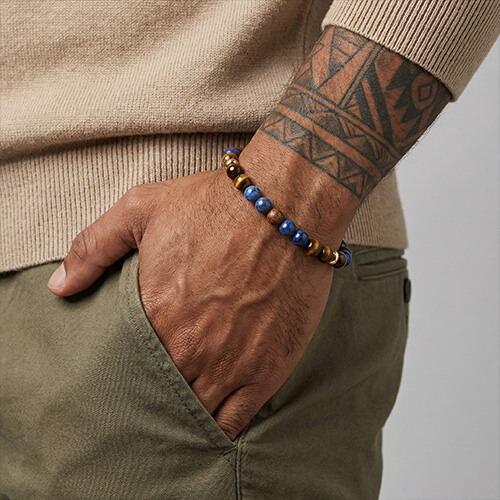
Bead diameter follows a similar pattern. Men’s bracelets commonly use 8mm or 10mm beads. Women’s bracelets more often use 6mm or 8mm beads. An 8mm bead is genuinely the middle ground – it appears in both categories and reads well on a range of wrist sizes. A 10mm bead reads as more substantial and masculine on a smaller wrist; a 6mm bead can look proportionally small on a larger wrist.
If you know your wrist size and preferred bead diameter, the gender label becomes largely irrelevant.
Color Palette Differences
Color is where the most visible difference between men’s and women’s bracelets appears. Men’s collections typically emphasize dark neutrals (black onyx, hematite, lava rock), earth tones (tiger eye, wood), and occasionally bold colors with historically masculine associations (lapis lazuli, malachite).
Women’s collections typically include a broader and brighter color range: pink quartz, amethyst, turquoise, white howlite, pastel-dyed stones, and iridescent materials that aren’t commonly found in men’s collections.
The darker, more neutral palette in men’s bracelets reflects wardrobe compatibility rather than any property of the stone itself. Black onyx works with a typical men’s wardrobe (dark neutrals, blues, whites) in the same way that pink quartz works with a wardrobe that includes pinks and warm pastels. Change the wardrobe and the stone choice would change too.
Construction and Materials
The underlying construction of most natural stone bracelets is identical regardless of gender labeling. Natural stone beads are drilled through the center and strung on elastic cord or thread. The quality of the stone, the cord, and the finishing (how the knots are tied, whether there are spacer beads, how the ends are finished) determines the quality of the piece regardless of who it’s marketed to.
One area where construction differences sometimes appear is in hardware. Bracelets with clasps, charms, or decorative elements may use more delicate hardware in women’s versions – thinner wire, smaller charm mounts, finer chain elements. Men’s versions with hardware tend toward heavier, more solid construction. But for pure beaded bracelets without hardware, the construction is essentially identical.
Clasp vs. Elastic
Beaded bracelets come in two main construction types: elastic (stretch) cord and fixed cord with a clasp. Elastic is more common in both men’s and women’s natural stone bracelets because it’s more practical – no clasp means no mechanism to fail, easier to put on without assistance, and a continuous visual line around the wrist.
Clasped bracelets appear more often in women’s fine jewelry and in men’s leather or chain bracelets. For natural stone specifically, elastic is the standard and the practical choice for most wearers.
The elastic cord quality matters. Cheap elastic degrades quickly with exposure to water, sweat, and stretching. Quality elastic cord, properly finished with secure knots at each bead position, lasts significantly longer. This is one area where construction quality differences between price points are genuinely significant.
Where Bracelets Are Truly Unisex
Natural stone bracelets in dark neutrals and earth tones occupy genuinely unisex territory. Black onyx, tiger eye, lava rock, hematite, and wood all read equally well across genders when sized correctly for the wrist. The stones don’t have inherent gender associations – the associations come from color conventions that have shifted significantly over the past decade.
The growing popularity of natural stone bracelets for men has actually pulled these materials toward the unisex center rather than associating them exclusively with men’s fashion. Both men and women choose onyx and tiger eye, and the bracelets work for both when sized correctly.
Buying Across Gender Labels
Buying a bracelet labeled for a different gender than yourself is straightforward if you focus on the right variables: wrist size, bead diameter, and color. A woman with a larger wrist who wants a more substantial bracelet may find better fit and proportion in a men’s 8mm bracelet sized at 17cm. A man with a smaller wrist (under 17cm) may find women’s sizing more accurate.
The color selection in men’s bracelets is often more limited than in women’s collections because the market assumption is narrower. But the stones available in men’s collections – onyx, tiger eye, lava, hematite, lapis – are genuinely the most versatile and universally wearable options, which makes the limitation less significant in practice.
Gifting Considerations
When buying a bracelet as a gift without knowing the recipient’s specific preferences, the safest approach is to default to dark neutral stones in a medium size. Black onyx in a 19cm bracelet works for most adult male wrists. Tiger eye in the same size reads as warm and approachable for a wider range of recipients.
Knowing the recipient’s wrist size makes gifting much more accurate. Most adults know their wrist measurement if asked, and many bracelet brands including Mr. Woodini offer the full adult size range. A correctly sized bracelet in a neutral stone is a practical, wearable gift in almost any context.
The same logic extends to what a bracelet is paired with. A neutral stone bracelet works as a quiet accompaniment to almost anything, including bolder apparel choices elsewhere in the outfit – a graphic tee, a printed jacket, a statement sneaker. For men building out that side of the wardrobe, brands like Biren’s oversized tees follow the same principle from the opposite direction: the shirt carries the statement, so the bracelet stays understated and lets it.
Men’s vs. Women’s Comparison
| Feature | Men’s Bracelets | Women’s Bracelets | Unisex Zone |
|---|---|---|---|
| Typical size range | 17-22cm | 15-19cm | 17-19cm overlap |
| Common bead size | 8-10mm | 6-8mm | 8mm works for both |
| Color palette | Dark neutrals, earth tones | Full spectrum including pastels | Onyx, tiger eye, lava |
| Construction | Elastic or cord, minimal hardware | Elastic, clasp, or chain options | Elastic natural stone |
| Stone selection | Onyx, tiger eye, lava, hematite, lapis | Quartz, amethyst, turquoise, onyx, rose | Onyx, tiger eye, lava |
Mr. Woodini Collection
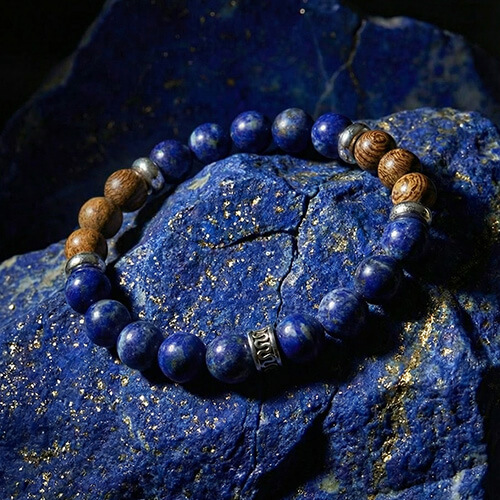
Mr. Woodini handcrafts natural stone and wood bracelets in sizes from 17cm to 22cm, covering the full adult range for men and many women. All pieces use 8mm natural stone beads in onyx, tiger eye, lava rock, hematite, lapis lazuli, malachite, zebrawood, ebony and rosewood.
Mr. Woodini bracelets are sized across the full adult range and use natural materials that work for any wearer. The dark neutral and earth-tone palette is genuinely wearable across genders – the gender distinction in this collection is primarily about size, not style. All orders ship internationally with gift packaging included.
Browse the full men’s bracelet collection to find the right size and stone.
About Mr. Woodini
Mr. Woodini was founded in 2018 by Idan Birnberg. We design eco-accessories built from materials with a story — recycled wood temples, natural stone beads, handcrafted construction made in Israel. Our guides are written from direct experience: sourcing stones, testing daily wear, and building pieces by hand. Learn more about us.
Common Questions
Questions About Men’s vs Women’s Bracelets
Sizing is the biggest difference. Men typically wear 19–21 cm, women 17–19 cm. Design-wise, men’s bracelets tend to use larger beads (8–10mm), darker stones and simpler clasps.
Absolutely. Natural stone bracelets are inherently unisex — the stone doesn’t care about gender. What matters is that the size fits and the style aligns with how you want to look.
Yes. The collection includes sizes for different wrist circumferences. Check the size guide on each product page before ordering to ensure the right fit.
Black onyx, tiger eye and lapis lazuli are the most universally wearable stones — they work across gender, age and personal style without being too specific.