


Reading time: approximately 5 minutes
Car dashboards in summer can reach 80°C. That’s enough to warp acetate frames, expand lens coatings, and loosen spring hinges permanently. Most heat damage is irreversible and takes less than an hour to happen.
How Hot Can a Car Actually Get?
Research from NHTSA and Stanford University documents car interior temperatures rising 19-22°C above outside air temperature within the first hour of parking in direct sun. On a 35°C day – common in Israel, Southern Europe and the Middle East – the interior temperature can reach:
- Dashboard surface: up to 80-90°C – hot enough to burn skin
- Back window shelf: 70-85°C – the single most dangerous spot
- Seat surfaces in sun: 65-75°C
- General interior air: 55-65°C
These temperatures are well above the softening point of acetate (60°C), the delamination temperature of many lens coatings (55-65°C), and the melting point of standard elastic nose pads (70°C+). For more on acetate and its heat properties, see the acetate frames guide.
What Does Heat Actually Damage?
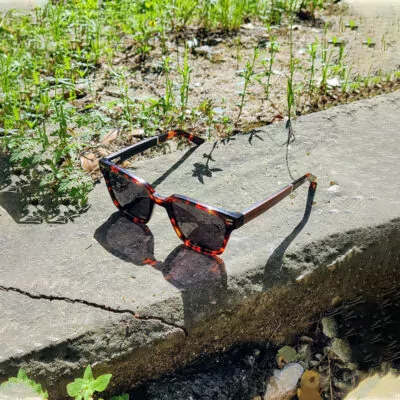
Frame warping. Acetate frames soften progressively above 55-60°C and can deform under their own weight when left resting on a surface. This often produces subtle changes: nose bridge curvature, uneven temple angles, or lenses that no longer sit parallel. Minor warping is sometimes correctable by an optician; severe warping is permanent.
Lens coating failure. Heat causes differential expansion between the lens substrate and the coating layers, leading to delamination – visible as peeling, bubbling or milky discoloration that appears gradually after heat exposure. This is irreversible and the lens must be replaced.
Polarized laminate separation. Polarized lenses use a thin laminate of polarizing film bonded to the lens surface. This is among the most heat-sensitive components. Heat causes the adhesive to soften, allowing the layers to shift or bubble – resulting in a subtle “swimming” visual distortion in the optical center.
Which Frame Materials Are Most Heat-Sensitive?
| Material | Softening Temp | Car Risk | Failure Mode |
|---|---|---|---|
| Acetate | 55-65°C | High | Warping, distortion |
| TR-90 Nylon | 80-100°C | Moderate | Elastic fatigue at extreme heat |
| Metal (stainless) | 400°C+ | Low | Frame fine; coatings still at risk |
| Natural wood | Doesn’t melt – dries/cracks | Moderate | Drying, splitting, finish degradation |
Where Should You Store Sunglasses in a Hot Car?
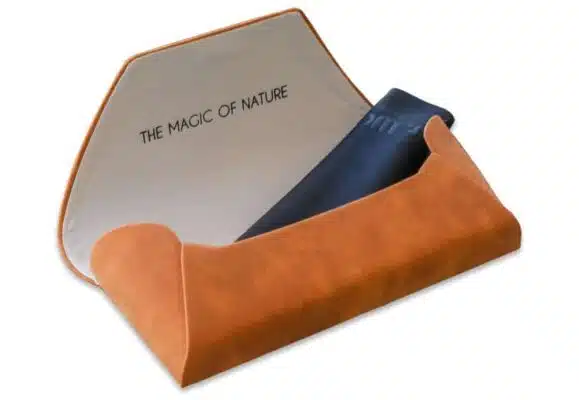
Best options: hard case in a bag (carries with you – best), glove compartment (significantly cooler than dashboard), or under a shaded seat.
Worst spots: dashboard (80-90°C surface), back window shelf (70-85°C, rear window acts as a greenhouse), visor clip (direct sun, no case protection), and seat surfaces in direct sun.
What Do You Do If Frames Are Already Warped?
Minor warping – often fixable. Acetate frames can be carefully reshaped using targeted heat. Most opticians have a frame warmer that heats acetate to its softening point and allows gentle reshaping. Attempt DIY reshaping with great caution – uneven heat from a hairdryer can create new distortions worse than the original.
Coating damage – irreversible. Peeling, bubbling or delaminating lens coatings cannot be repaired. The lens must be replaced. For cleaning guidance that protects coatings in daily use, see the sunglasses cleaning guide.
How Do You Protect Sunglasses When Travelling to Hot Destinations?
If you’re travelling to the Mediterranean, Middle East or tropics – sunglasses protection needs to be part of your packing strategy:
- Always carry sunglasses in a hard case. Soft pouches offer zero thermal protection.
- On beach days, store under an umbrella or in a bag rather than leaving on a towel in the sun.
- In a hot room without AC, store in the bathroom – typically the coolest room with minimal direct sunlight.
“Three years with these glasses and they still look brand new. Solid quality.”
Worth Considering
Sumatra – bio-acetate frame with recycled wood temples. Ships with a hard eco case included – the simplest protection against the most common form of damage.
Every frame in the sunglasses collection ships with a hard case included on every order.
Mr. Woodini was founded in 2018. We design eco-accessories built from materials with a story – recycled wood temples, natural stone beads, handcrafted construction. Our guides are written from direct experience: testing frames daily, sourcing materials, and building pieces by hand. Learn more about us.
Questions About Sunglasses and Heat Damage
Yes. Car dashboards in summer can reach 80-90°C – enough to warp acetate frames, delaminate lens coatings and weaken wooden temples. Heat damage is one of the most common causes of premature sunglasses failure and is typically not covered by warranty.
In the glove compartment or in a bag – not on the dashboard or back window shelf. If you must leave them in the car, a hard case provides some insulation. The glove compartment is significantly cooler than any above-seat location.
Frame warping that wasn’t there before, lens surface that looks cloudy or has developed tiny cracks, a “swimming” visual distortion in the lens center, or peeling at the lens surface. Minor frame warping can sometimes be corrected by an optician; coating damage cannot.
Minor acetate warping can often be corrected by an optician using a frame warmer. Severe distortion or cracking cannot be fixed. Lens coating damage is irreversible – the lens must be replaced.