


Reading time: approximately 6 minutes
Malachite is one of the few green stones where the pattern matters as much as the color. Each bead has a different arrangement of concentric rings – no two look identical. That variation is the point.

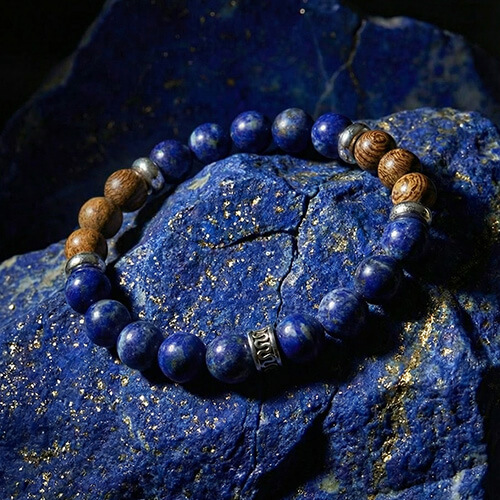
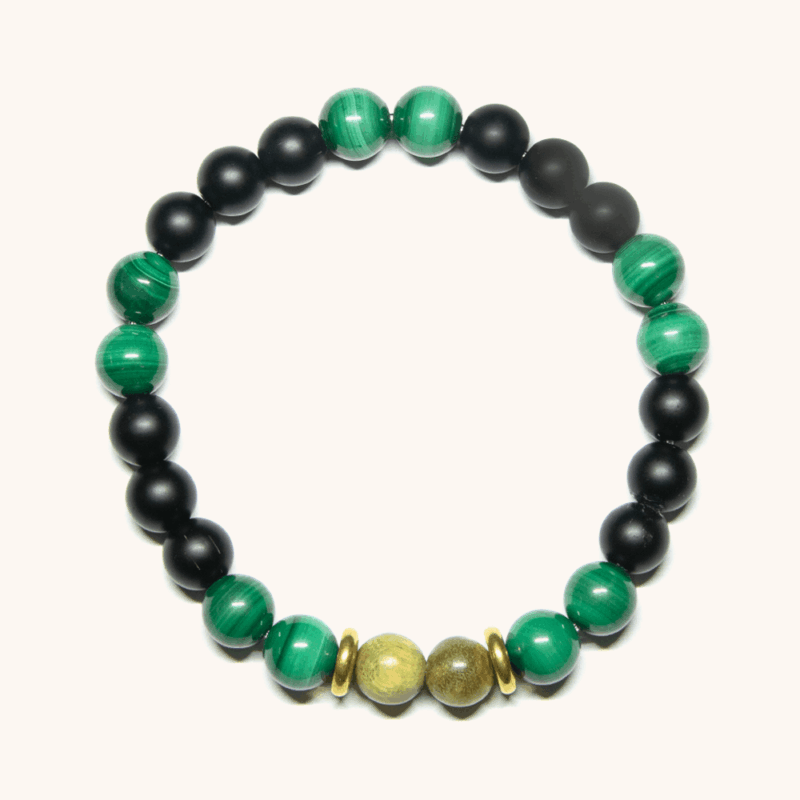
Malachite, Black Onyx and Ebony Wood Bracelet
What Is Malachite?
Malachite is a copper carbonate hydroxide mineral, formed through the weathering of copper ore deposits. It grows in banded layers that create the distinctive concentric ring patterns the stone is known for. The vivid green color comes from its high copper content. The stone is found primarily in the Democratic Republic of Congo, Zambia, Russia, Australia, and parts of the United States. The Congo is the world’s largest producer, noted for tight, well-defined banding and deep color saturation.
According to the GIA Gem Encyclopedia, malachite forms in the oxidation zone above copper sulfide deposits, often occurring alongside other copper-based minerals like azurite (deep blue), chrysocolla (turquoise-green), and cuprite (red).
What Makes Malachite Visually Distinctive?
No two malachite beads are identical. The layered banding – which appears as concentric rings, wavy lines, or eye-like formations – forms during crystallization and varies depending on the specific conditions in the host deposit. A bracelet made from malachite beads shows a natural rhythm of pattern repetition without any two beads matching exactly.
The green ranges from pale mint at the lighter end of the banding to deep forest green at the darker end. Most malachite used in jewelry sits in the mid-to-deep range, with strong saturation and clearly visible bands. When polished, malachite has a waxy to vitreous luster. The smooth surface reveals the banding clearly and gives 8mm beads enough surface area to show the full pattern detail.
What Is the Historical Use of Malachite?
Malachite has one of the longest documented histories of any gemstone in human ornamentation. Ancient Egyptians used it as both jewelry and pigment – ground malachite served as green eye paint in cosmetics, and malachite amulets were worn as protective talismans. Artifacts from Egyptian tombs dating back to 3000 BCE include carved malachite beads and scarabs.
In ancient Rome, malachite was associated with Venus, the goddess of love and beauty. Russian imperial culture elevated the stone to architectural status – the malachite room in the Winter Palace in St. Petersburg, built in the 1830s, uses over two tonnes of Ural malachite in its columns, fireplace, and decorative surfaces. In sub-Saharan Africa, malachite has been traded and worn for centuries as a protective stone for children and travelers.
How Do You Care for Malachite?
Malachite sits at 3.5-4 on the Mohs hardness scale – notably softer than black onyx (6.5-7) or tiger eye (7). The practical implication is that malachite beads can scratch if stored in contact with harder stones, and the surface can be dulled by acidic substances including sweat, perfume and cleaning chemicals. Store separately from harder stones in a soft pouch. Wipe with a dry or slightly damp soft cloth after wearing – no soap. Brief water contact is fine but avoid prolonged soaking. Apply perfume before putting on the bracelet to prevent direct contact. For full general bracelet care guidance, see the bracelet care guide.
How Do You Style a Malachite Bracelet?
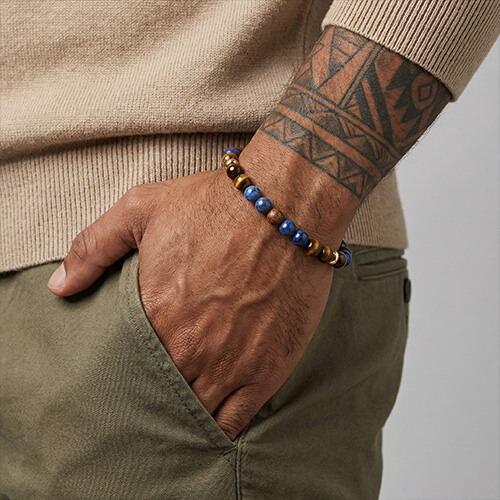
Malachite’s deep green makes it a statement piece. It draws the eye and creates a clear focal point on the wrist, so it works best when the rest of the outfit is relatively neutral. Earth tones, navy, black, white and grey all provide good contrast without competing with the green. For a casual setting, a single malachite bracelet on one wrist with a plain watch on the other is a clean, balanced combination. Avoid stacking malachite with stones of clashing colors – the green is saturated enough that it needs visual breathing room.
| Pairing Stone | Effect | Works Best For |
|---|---|---|
| Dark wood (ebony) | Ground the green with a warm earth tone | Casual, natural, outdoorsy style |
| Howlite (white) | Clean contrast that lets each stone breathe | Minimal, clean palette |
| Black onyx | Bold, strong contrast – both stones stand out | When you want maximum visual impact |
| Gold accents | Classic combination – mirrors historic Egyptian use | Refined, dressed-up look |
From the Mr. Woodini Collection
Malachite and Black Onyx – the most popular malachite combination; the dark neutral of onyx provides maximum contrast for the green. Malachite and Black Agate for the bolder green option.
Browse the full men’s bracelet collection – all pieces handmade in Israel, available in sizes 17-22cm.
Mr. Woodini was founded in 2018. We design eco-accessories built from materials with a story – recycled wood temples, natural stone beads, handcrafted construction. Our guides are written from direct experience: sourcing stones, testing daily wear, and building pieces by hand. Learn more about us.
Questions About Malachite Bracelets
Malachite is softer than onyx or tiger eye (Mohs 3.5-4), so it needs slightly more care. Avoid hard impacts, prolonged water exposure and direct contact with perfume or cleaning chemicals. With reasonable care it holds up well for regular wear.
White, black, beige and navy are the strongest pairings. Malachite is a statement stone – keep the clothing simple and let the green speak. Avoid busy patterns or other bold colors alongside it.
Keep it dry, avoid perfume and acids, and store separately from harder stones that could scratch its surface. Wipe with a dry soft cloth after wearing. Malachite is sensitive to chemicals and prolonged sunlight can fade the color over time.
Black onyx creates bold, maximum contrast – both stones stand out. Dark wood (ebony) grounds the green with a warm earth tone. Howlite (white) provides clean contrast that lets each stone breathe. Gold accents mirror the historic Egyptian combination.