


Reading time: approximately 6 minutes
Canadian jade isn’t true jade. That’s worth knowing upfront – not because it’s a lesser stone, but because understanding what it actually is explains why it looks and wears the way it does. The name has stuck commercially, but the mineralogy is different, and the practical properties follow from that difference.
The short version: Canadian jade is a green variety of serpentine, sometimes classified more specifically as bowenite. It’s harder than most serpentine, smoother than malachite, more uniform in color than African jade, and sits in a price range that makes it an accessible daily-wear option. As a bracelet stone, it offers a clean, deep green that works across a wider range of contexts than the more visually dramatic green stones.
What Canadian Jade Actually Is
The stone marketed as Canadian jade is primarily serpentinite – a metamorphic rock composed largely of serpentine group minerals. In British Columbia, where the majority of commercial material comes from, the deposits are found in the mountain ranges of the interior and were first mined commercially in the mid-20th century. The stone polishes to a smooth, waxy surface with a slightly translucent quality at edges – different from the fully opaque character of African jade (which is jasper) and the dense matte of malachite.
True jade comes in two forms: nephrite and jadeite. Canadian jade is neither – it’s serpentine marketed under a trade name. This matters because serpentine is softer than both nephrite and jadeite, which affects care requirements. It doesn’t make the stone less attractive or less wearable as a bracelet, but it does mean slightly more care is needed to maintain the surface over time.
Color and Visual Character
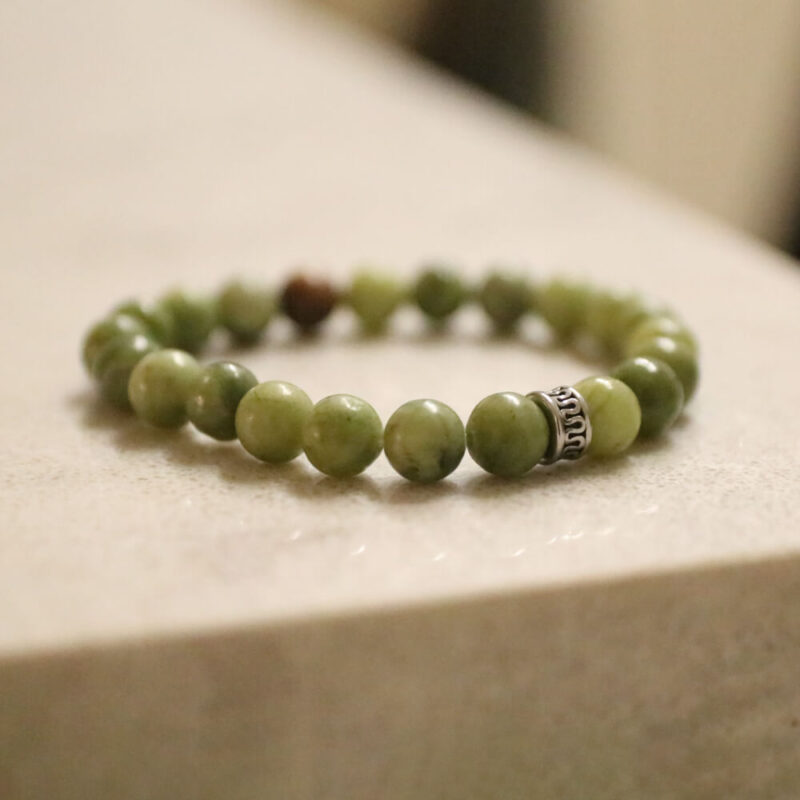
The green in Canadian jade ranges from medium to deep forest green, often with subtle variations in tone across the surface of each bead. Unlike malachite’s dramatic banding, Canadian jade presents a more even color field – closer in character to African jade but typically cooler and more saturated. The slight translucency at bead edges catches light differently from fully opaque stones, giving the bracelet a quiet luminosity that’s distinct from the flat surface of howlite or the metallic sheen of hematite.
Hardness and Practical Durability
Serpentine registers around 3.5-5.5 on the Mohs scale depending on the specific variety – softer than true jade (nephrite is 6-6.5, jadeite is 6.5-7) but comparable to malachite. In practice for a bracelet worn daily, this means avoiding storage in contact with harder stones, keeping it away from abrasive surfaces, and cleaning with a soft damp cloth rather than any chemical cleaner. The surface can develop fine scratches with rough handling – which is more visible on a polished green stone than on a dark matte stone like lava rock. With reasonable care, the polish holds well for years.
Where the Stone Comes From
British Columbia’s serpentine deposits are extensive – the province is one of the world’s significant sources of material marketed under the jade trade name. The stone is found in association with other metamorphic rocks in mountain belt geology, where oceanic crust has been tectonically altered over geological time. Carving-quality material has been used by Indigenous peoples of the Pacific Northwest for thousands of years, and commercial jewelry-quality stone has been exported internationally since the 1960s. Most bracelet-quality Canadian jade in the global market originates from British Columbia deposits, with some material also sourced from similar geological environments in other Canadian provinces.

How to Style a Canadian Jade Bracelet
The cooler, more uniform green of Canadian jade sits comfortably against a different palette than the warmer greens of African jade or the dramatic banding of malachite. It reads cleanly against:
Dark neutrals
Black, charcoal and dark navy let the green read without competition. The stone’s cool undertone aligns with the blue-grey register of these colors more naturally than warmer greens would. A Canadian jade bracelet against a charcoal wool sleeve is one of the most coherent winter combinations in the collection.
White and light grey
High contrast – the deep green against a clean light background – creates maximum visual presence. This is the right approach when the bracelet is the only accessory and the intent is to let the stone speak for itself.
Steel and silver accents
The Green Canadian Jade with 316L Steel Engraved Bead builds this pairing directly into the design: a single engraved steel bead sits among the jade beads, providing a material contrast that reads as considered rather than decorative. The steel’s cool metallic tone aligns with the stone’s cooler green register. The same logic applies to wearing the bracelet alongside a silver or steel watch.
Canadian Jade vs. Other Green Stones
Understanding where Canadian jade sits relative to other green stones makes the choice clearer.
vs. Malachite: Malachite is visually busier – the banding is dramatic and each bead is distinctly patterned. Canadian jade is quieter: more uniform color, less internal drama. Malachite demands attention; Canadian jade fits into an outfit without requiring it. Malachite is also softer (3.5-4 Mohs) and requires more careful handling.
vs. African jade: African jade (green jasper) is harder (6.5-7 Mohs), more opaque, and typically warmer in tone – more olive and forest green. Canadian jade is cooler, slightly translucent at edges, and softer. For daily wear durability, African jade has the advantage. For a cooler, more refined green, Canadian jade is the better choice.
vs. Malachite and Black Agate: The Malachite and Black Agate combination is for men who want green stone with maximum visual complexity. Canadian jade with steel is for men who want green stone with restraint. Different intentions, both valid.
Who This Stone Is For
Canadian jade works best for men who want to wear a green stone without the bracelet becoming the focal point of every outfit. The color is real and visible – it reads as a deliberate choice – but the uniformity of the stone means it integrates more easily than malachite’s banding or the strong variation in African jade.
The steel bead version in particular suits men who already wear metal accessories – a steel watch, a leather belt with steel hardware – because the bracelet speaks the same material language. It bridges the gap between natural stone and modern hardware without being a compromise in either direction.
Canadian Jade in the Collection
Green Canadian Jade with 316L Steel Engraved Bead (8mm) – the steel bead adds a modern element to the natural stone, available in sizes 17-22cm. For other green stones in the collection: Green Africa Jade and Sandalwood for a warmer approach, or Malachite and Black Agate for maximum visual character. Browse the full Canadian jade collection.
Mr. Woodini was founded in 2018. We design eco-accessories built from materials with a story – recycled wood temples, natural stone beads, handcrafted construction. Our guides are written from direct experience: sourcing stones, testing daily wear, and building pieces by hand. Learn more about us.