


Reading time: approximately 8 minutes
Most blue stones used in bead bracelets are either lapis lazuli or sodalite. Dumortierite is neither – and it’s visually distinct from both. Here’s what sets it apart and how to wear it.
What Is Dumortierite?
Dumortierite is an aluminum borosilicate mineral, first described in 1881 and named after the French paleontologist Eugene Dumortier. It forms in metamorphic and pegmatite environments, typically as fibrous or columnar crystals within a quartz matrix. Most dumortierite used in jewelry is a combination of dumortierite crystals embedded in quartz – which gives the polished stone its smooth, workable surface.
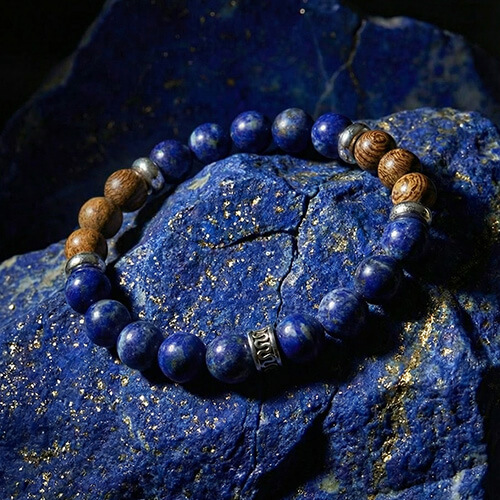
The stone’s defining quality is its color: a deep, intense blue ranging from medium blue to blue-violet depending on the specimen. Unlike lapis lazuli – a composite rock with visible white and gold components – dumortierite quartz presents a more uniform blue field. Dumortierite is less widely known than tiger eye or lapis lazuli. For men who want a distinctive bracelet that most people won’t immediately recognize by name, that’s part of the appeal.
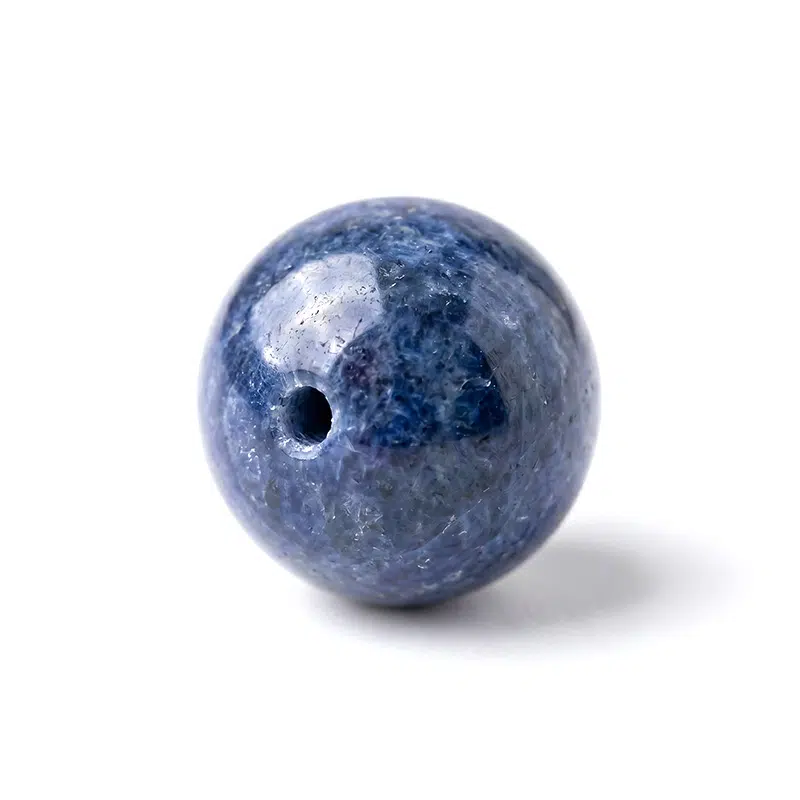
What Does Dumortierite Look Like?
In 8mm bead form, dumortierite presents a clean, saturated blue with a smooth polished surface and a slightly glassy luster. Color intensity varies between specimens – some will run deeper blue-violet, others a brighter medium blue. That natural variation creates a gentle visual rhythm along the bracelet without the dramatic banding you’d see in malachite or tiger eye. Some specimens show fine fibrous inclusions or subtle color zoning visible at close range – natural features, not defects. The blue reads as cool and considered rather than warm or earthy. Noticeable without being loud.
Where Does Dumortierite Come From?
Brazil is the primary commercial producer – large quantities of dumortierite quartz in the medium-to-deep blue range, available in sufficient volume for consistent bracelet production. Madagascar produces dumortierite in blue, pink and lavender varieties, with the blue considered high quality for strong color saturation. Namibia produces blue dumortierite in the Erongo region. The United States has deposits in Nevada and California, though these are primarily of mineralogical interest rather than major commercial sources.
How Does Dumortierite Hold Up to Daily Wear?
At Mohs hardness 7-8, dumortierite is among the harder stones used in bead bracelets – harder than lapis lazuli (5-6), hematite (5-6) and malachite (3.5-4), and comparable to tiger eye and black onyx. In practice, it handles daily wear exceptionally well: it resists scratching from most everyday surfaces, holds its polish over time, and doesn’t need the careful storage that softer stones require. According to the GIA gem encyclopedia, hardness ratings above 7 on the Mohs scale indicate strong resistance to everyday abrasion.
| Stone | Mohs Hardness | Daily Wear |
|---|---|---|
| Dumortierite | 7-8 | Excellent – minimal care needed |
| Tiger Eye | 7 | Excellent |
| Black Onyx | 6.5-7 | Excellent |
| Lapis Lazuli | 5-6 | Good – moderate care |
| Malachite | 3.5-4 | Fair – careful handling required |
What Associations Does Dumortierite Carry?
Dumortierite has developed a clear set of associations in contemporary crystal and metaphysical traditions. The consistent themes are mental discipline, patience under pressure and clarity in communication. It’s frequently connected to work requiring sustained concentration – writing, legal work, analysis, engineering. Some traditions also connect it to self-discipline and resistance to impulsive decisions, making it a meaningful gift choice for men entering demanding academic programs or professional transitions. These are traditional and cultural associations, not medically established properties.
How Do You Style a Dumortierite Bracelet?
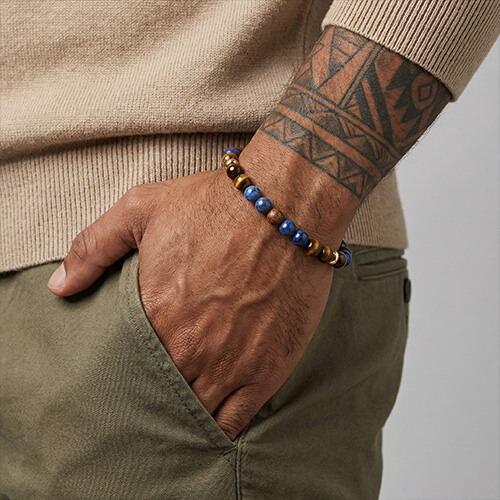
Dumortierite’s deep blue is bold enough to anchor a look but refined enough for professional and smart casual contexts. Navy and dark blue outfits create a tone-on-tone effect where the bracelet adds texture rather than contrast. Black provides maximum contrast and lets the blue read clearly. Grey – in any shade from light to charcoal – works cleanly. For business casual, a single dumortierite bracelet on the non-watch wrist adds a personal touch that most office environments will accommodate. For stacking, it pairs naturally with black onyx (cool, strong, minimal) or dark wood (cool blue against warm wood grain). More on stone combinations in the bracelet stacking guide.
“Bought the dumortierite and tiger eye combination. The blue is more interesting in person than in photos – there’s real depth to it. Wears well, comfortable on the wrist all day.”
Dumortierite vs. Lapis Lazuli: Which Should You Choose?
Both are deep blue. The differences are significant enough that they suit different buyers. Lapis lazuli has more visual complexity – white calcite streaks and gold pyrite flecks create a rich, multi-element pattern, and it carries over 6,000 years of recorded history in human jewelry. However, lapis is softer (Mohs 5-6) and requires more careful handling. Dumortierite presents a cleaner, more uniform blue and is harder (Mohs 7-8) – more practical for daily wear without care requirements. If you want a deep blue bracelet you can put on and forget about, dumortierite is the better choice. If you’re drawn to historical depth and visual richness, lapis is the stronger fit despite the higher care requirement.
How Do You Find the Right Size?
Wrap a flexible tape around your wrist where you’d wear the bracelet and add 1.5cm for a standard fit, or 2cm for a slightly looser feel. Mr. Woodini bracelets are available from 17cm through 22cm. For gift purchases where you don’t know the recipient’s wrist size, 19cm is the most common fit for adult men. Full measuring instructions in the bracelet size guide.
Dumortierite in the Collection
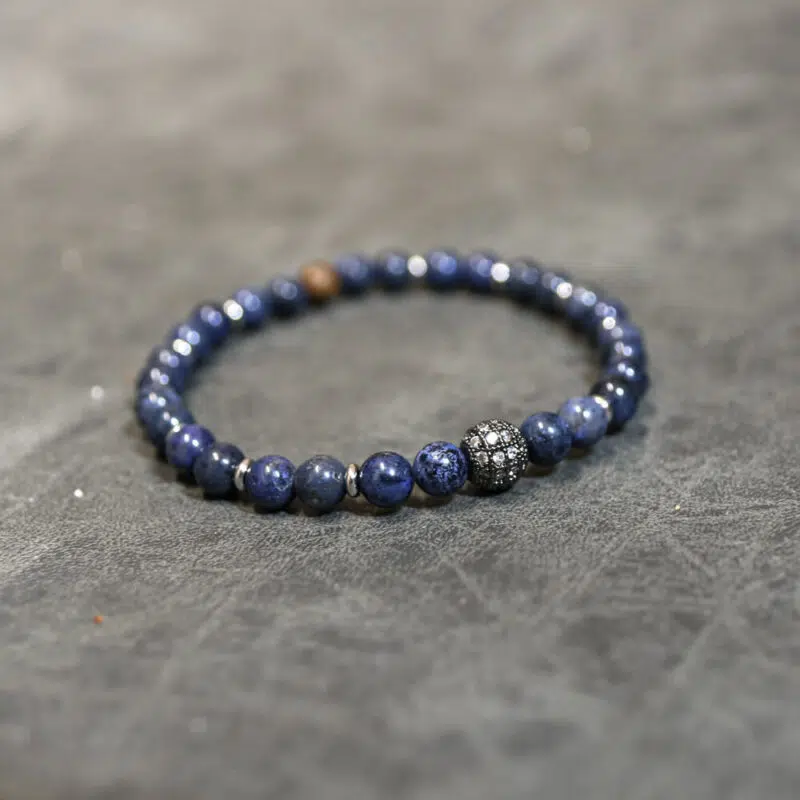
Dumortierite Bracelet – 8mm natural stone beads in deep blue, hand-strung on quality elastic cord, sizes 17-22cm. Also available as Dumortierite and Brown Tiger Eye – blue and warm earth tones in a single piece. Browse the full dumortierite collection.
Mr. Woodini was founded in 2018. We design eco-accessories built from materials with a story – recycled wood, natural stone beads, handcrafted construction made in Israel. Learn more about us.
Common Questions
Dumortierite isn’t rare in the geological sense – significant deposits exist in Brazil, Madagascar and Namibia. It’s less commercially prominent than stones like tiger eye or lapis lazuli, which means most people won’t recognize it by name. That relative obscurity is part of what makes it a distinctive choice.
Yes. At Mohs 7-8, dumortierite is one of the harder stones used in bead bracelets. It resists surface scratching better than lapis lazuli or hematite and doesn’t require special storage. Remove it before swimming or showering to protect the elastic cord, but daily wrist wear involves no meaningful risk to the stone.
Both are deep blue. Lapis lazuli has more visual complexity – white and gold flecks, a longer history, and more cultural recognition. Dumortierite presents a cleaner, more uniform blue and is significantly harder, making it better suited for daily wear without care. Choose lapis for richness and history, dumortierite for durability and a quieter kind of distinction.
Measure your wrist with a flexible tape and add 1.5cm for a standard fit. Mr. Woodini bracelets are available from 17cm to 22cm. For adult men buying without measuring, 19cm fits the majority of wrists and is a reasonable default for gift purchases.