


Reading time: approximately 7 minutes
Elastic bracelets are the most practical format – no clasp, no sizing anxiety, easy to put on and take off. The trade-off is longevity: the elastic degrades before the stone does.

Mars – Red Tiger Eye and Lava Stone Bracelet
What Makes an Elastic Bracelet Different?
An elastic beaded bracelet is strung on a stretchable cord rather than a fixed wire, chain, or rigid frame. The beads sit on the cord under slight tension, forming a circle that expands when slipped over the hand and contracts to fit the wrist once in place. There’s no clasp, no closure, no mechanism to operate.
This simplicity is the format’s main advantage. An elastic bracelet goes on in one motion and stays on. The format is well-suited to natural stone beads – stone has weight, and that weight is distributed evenly around the wrist on elastic cord in a way that feels balanced. The cord is invisible between beads when sized correctly.
What Should You Look for in Cord Quality?
Not all elastic cord is the same. The difference between a bracelet that lasts two years of regular wear and one that snaps within six months usually comes down to cord quality and knotting technique. Good elastic cord has consistent diameter throughout its length, significant stretch without deformation, and recovery – meaning it returns to its original size after stretching rather than gradually becoming longer. Low-quality cord stretches unevenly, develops thin spots, and eventually frays at the knotting points.
The knotting method matters equally. Each bead should be knotted individually or the cord should be secured at multiple points. When evaluating a bracelet, the knots should be tight and recessed within the bead holes, not visible on the surface. If you can see the knot sitting exposed on the cord, that’s a sign of a rushed finishing job.
Which Stones Work Best on Elastic Cord?
Black onyx is one of the best stones for elastic bracelets. It’s hard enough that the bead hole stays clean and intact over years of wear, it polishes to a smooth surface that doesn’t catch or fray the cord, and it’s available consistently in the round 8mm bead format. Tiger eye, lava rock, howlite and most quartzes also perform well on elastic. Lava rock is especially good – it’s light for its size, which reduces the tension load on the cord over time. Heavier stones like hematite put more strain on the cord simply due to their density. For more on how individual stones wear and care for, see the bracelet care guide.
| Stone | Hardness | Elastic Suitability | Notes |
|---|---|---|---|
| Black Onyx | 7 (Mohs) | Excellent | Hard, clean holes, durable |
| Tiger Eye | 6.5-7 | Excellent | Consistent, widely available |
| Lava Rock | 3-3.5 | Very good | Light weight, low cord tension |
| Hematite | 5-6 | Good | Heavy – higher tension on cord |
| Malachite | 3.5-4 | Moderate | Soft – monitor bead holes |
How Do You Size an Elastic Bracelet?
Measure your wrist circumference with a flexible tape at the point where you’d normally wear a bracelet. Then add 1.5cm to 2cm. That’s your target bracelet size. If you measure 17cm, look for a bracelet listed at 18.5-19cm. The extra length allows the bracelet to sit with a relaxed fit rather than pulling tight against the skin. If you’re between sizes, go slightly larger rather than smaller – a bracelet that’s 0.5cm too small will stretch thin under extra tension and degrade the cord faster. For a full sizing table, see the bracelet size guide.
How Do You Wear and Stack Elastic Bracelets?
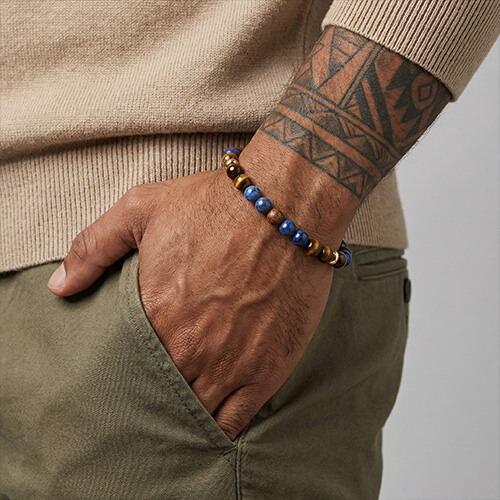
Elastic bracelets are well-suited to stacking because they sit flat and consistent on the wrist without a clasp creating a bump. For stacking, keep bead size consistent across all pieces. Mixing 8mm and 6mm beads in a stack creates an uneven silhouette where some bracelets dominate visually and others disappear. Two or three 8mm bracelets create a cleaner combined look than a mix of sizes. Elastic bracelets can be worn on the same wrist as a watch without catching or interfering, as long as the bracelet and watch strap are in a compatible size range. For stacking guidance, see the bracelet stacking guide.
How Do You Care for Elastic Bracelets?
The most important rule is to keep the cord dry and away from chemicals. Water doesn’t immediately damage elastic cord, but repeated soaking softens the fibers and accelerates degradation. Perfume, sunscreen and cleaning products are more damaging – the chemical content breaks down the elastic polymer over time. Put bracelets on after applying perfume, not before. For stone cleaning, wipe with a soft dry cloth after wearing to remove skin oils. Avoid soaking lava rock in water, as its porous surface absorbs liquid and soap residue can be difficult to remove completely.
When Should You Restring a Bracelet?
With daily wear, most high-quality elastic cord bracelets last one to three years before the cord begins to show signs of fatigue. The signs are visible: the cord looks stretched and uneven between beads, the bracelet no longer returns fully to its original size after stretching, or the knot areas look frayed. Restringing is a simple repair that any jewelry shop can do quickly and inexpensively. The beads themselves – being natural stone – don’t wear out. Only the cord needs replacing. When restringing, ask the jeweler to use 0.8mm to 1mm elastic cord – this is the appropriate diameter for 8mm stone beads.

Gambia – Hematite and Zebrawood Elastic Beaded Bracelet 6mm
From the Collection
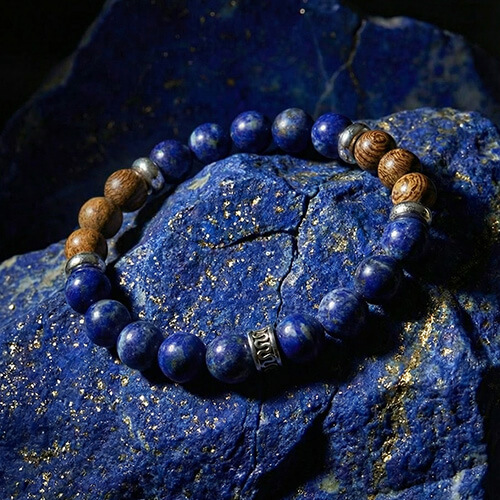
Mars (red tiger eye + lava stone) and Gambia (hematite + zebrawood, 6mm) – two of the collection’s strongest stone combinations for showing what elastic bracelets can look like in practice.
Browse the full men’s bracelet collection – all pieces strung on quality elastic cord with double-knot finishing at every bead.
Mr. Woodini was founded in 2018. We design eco-accessories built from materials with a story – recycled wood temples, natural stone beads, handcrafted construction. Our guides are written from direct experience: sourcing stones, testing daily wear, and building pieces by hand. Learn more about us.
Questions About Elastic Bead Bracelets
With regular wear and basic care, quality elastic cord lasts 1-3 years before showing stretch fatigue. The more frequently you wear it and the more it gets wet, the shorter the lifespan. The stone beads themselves don’t wear out – only the cord needs replacing.
When the bracelet stays stretched after you put it on – not snapping back to its original shape – or when you notice thinning or white stress marks in the cord at bead holes. Restringing by a local jeweler is quick and inexpensive.
Measure your wrist circumference and add 1.5-2cm. That’s your target bracelet size. An elastic bracelet should go on with a stretch but sit comfortably without stretching during wear. If between sizes, go larger rather than smaller – too tight accelerates cord degradation.
Yes – they’re one of the most comfortable bracelet types because they flex with wrist movement. No clasp to fiddle with, no rigid structure. Just make sure the size is right so it sits properly without pulling tight or sliding around.