




Reading time: approximately 7 minutes
Tiger eye is the stone that looks different every time you move your wrist. That optical effect – the shimmer that shifts with the light – is called chatoyancy, and it’s built into the mineral structure itself.
What Is Tiger Eye Stone?
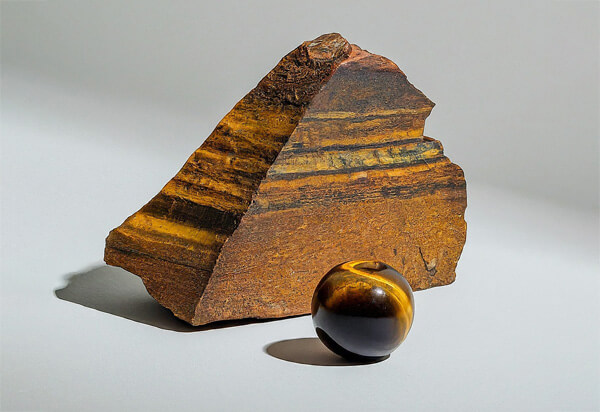
Tiger eye is a chatoyant gemstone in the quartz family. Its chemical composition is silicon dioxide (SiO2), the same base mineral as quartz, agate, and amethyst. What distinguishes tiger eye from other quartz varieties is not its chemistry but its internal structure: parallel fibrous inclusions that create a moving band of reflected light on the stone’s surface.
The name comes from this visual effect, which resembles the vertical slit pupil of a cat’s eye when the stone is moved under light. The scientific term for this phenomenon is chatoyancy, from the French “chatoyer” meaning “to shine like a cat’s eye.” Tiger eye is one of the most pronounced natural examples of chatoyancy in the gemstone world. According to the GIA Gem Encyclopedia, chatoyancy in tiger eye results from silicified fibrous mineral inclusions oriented in parallel planes within the host quartz.
What Creates the Shimmer?
Chatoyancy occurs when light reflects off closely packed parallel fibers or tubes within a stone. In tiger eye, these are the silicified remains of crocidolite fibers oriented in the same direction. When light strikes the surface at an angle, it reflects off these aligned fibers in a concentrated band. As the stone or the light source moves, the band of light appears to travel across the surface.
The intensity of chatoyancy varies between specimens. Higher-quality tiger eye has tight, well-defined fiber bundles that create a sharp, single moving band. Lower quality material has diffuse or irregular fiber distribution that creates a less defined shimmer rather than a clean band of light.
How Does Tiger Eye Form?
Tiger eye forms through a geological process called pseudomorphism – the replacement of one mineral by another while the original structure is preserved. The process begins with crocidolite, a blue fibrous amphibole mineral, deposited in parallel veins within host rock. Over geological time, silica-rich groundwater permeates the crocidolite deposit and gradually replaces the crocidolite molecules with quartz while leaving the fibrous arrangement intact. The iron content of the original crocidolite oxidizes during this process and creates the characteristic golden-brown color. Where the iron oxidizes more completely, the stone turns deep reddish-brown. Where the crocidolite is preserved before full silicification, the blue-grey form known as hawk’s eye results.
What Color Varieties Are Available?
The standard color is warm golden-brown with alternating lighter and darker bands – the most common form in jewelry. Red tiger eye (bull’s eye) is deep red-brown, caused by more complete iron oxidation or heat treatment. Blue tiger eye (hawk’s eye) is grey-blue, with the unoxidized crocidolite preserved in quartz – more subtle in its visual effect. Pietersite is a rare brecciated form with mixed blue, gold and red fibers from multiple directions, found mainly in Namibia and China.
Where Does Tiger Eye Come From?
The world’s dominant source is the Northern Cape province of South Africa, specifically the area around Griquatown. South Africa supplies the majority of global tiger eye used in jewelry. Secondary deposits exist in Western Australia, Rajasthan in India, Namibia, and smaller deposits in California and Arizona. Tiger eye from different origins is not significantly differentiated in the jewelry market – it’s assessed primarily on color saturation, chatoyancy quality and the clarity of its banding.
What Is the Historical Use of Tiger Eye?
Ancient Roman soldiers carried tiger eye as a protective talisman in battle, described in Roman texts as conferring clarity and focused courage. In ancient Egypt, tiger eye was used in the eyes of deity statues to represent divine vision – the stone’s visual depth and light-shifting quality made it a natural choice for representations of watchful supernatural beings. In Chinese culture, tiger eye has been valued for centuries, associated with the tiger’s courage. Contemporary Chinese demand remains one of the significant drivers of the global tiger eye market.
How Durable Is Tiger Eye for Daily Wear?
Tiger eye has a Mohs hardness of 7, placing it in the same category as quartz and making it one of the harder stones commonly used in bead bracelets. At hardness 7, it resists scratching from most everyday surfaces. The stone is also relatively tough in terms of fracture resistance, with no cleavage planes that would make it prone to splitting. This combination of hardness and toughness makes tiger eye an excellent practical choice for daily wear bracelets – it holds its polish well and doesn’t require the careful handling that softer stones like malachite or lapis lazuli demand.
| Stone | Hardness (Mohs) | Key Visual Feature | Best Worn With |
|---|---|---|---|
| Tiger Eye | 7 | Chatoyant golden-brown bands | Earth tones, wood, onyx |
| Black Onyx | 6.5-7 | Opaque deep black | Any palette – neutral anchor |
| Lapis Lazuli | 5-6 | Deep blue with gold pyrite flecks | Gold accents, navy, dark tones |
| Malachite | 3.5-4 | Banded green | Neutrals, wood, gold accents |
Tiger Eye in the Collection
Black Onyx, Tiger Eye and Wood – the classic combination that demonstrates how tiger eye’s warm amber reads against a dark neutral anchor. Voodoo (tiger eye and wood) for the pure earth-tone approach. Browse the full tiger eye collection and the men’s bracelet collection.
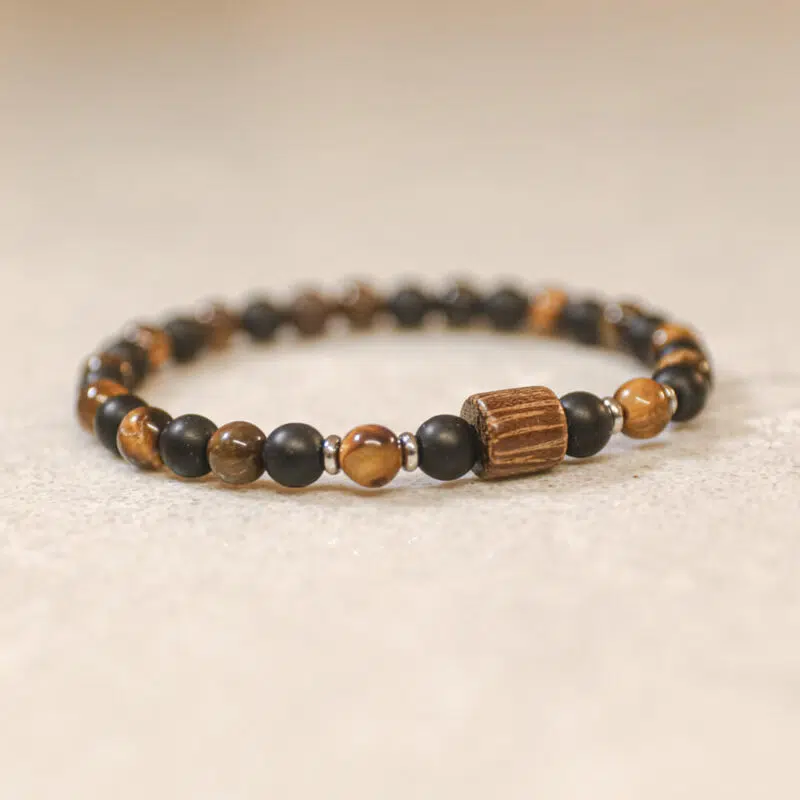
Black Onyx, Tiger Eye and Zebrawood Bracelet
Mr. Woodini was founded in 2018. We design eco-accessories built from materials with a story – recycled wood temples, natural stone beads, handcrafted construction. Our guides are written from direct experience: sourcing stones, testing daily wear, and building pieces by hand. Learn more about us.
Questions About Tiger Eye Stone
It’s called chatoyancy – an optical effect caused by parallel fibrous structures inside the stone that reflect light in a moving band as the stone moves. The fibers are the silicified remains of crocidolite preserved within quartz. It’s entirely natural and impossible to fake convincingly.
Yes. Tiger eye ranks 7 on the Mohs scale – one of the harder stones commonly used in bead bracelets. It handles daily wear well, holds its polish without special care, and has no cleavage planes that would make it prone to splitting.
The classic version is golden-brown with black banding. Blue tiger eye (hawk’s eye) is more grey-blue. Red tiger eye has a reddish-brown tone from more complete iron oxidation. All three are natural, not dyed.
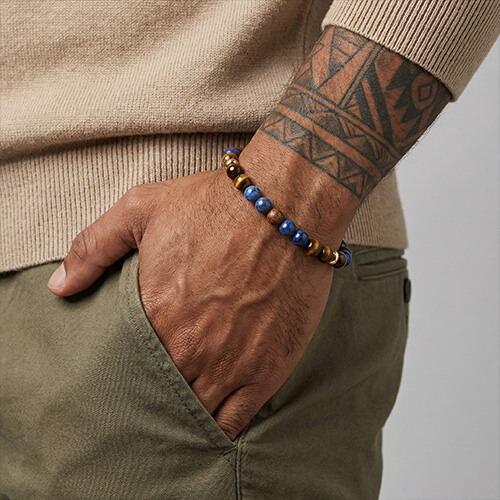
Tiger eye’s earth tones – brown, gold, black – work best with neutral clothing: white, beige, olive, grey and navy. It’s one of the most versatile stones for men’s bracelets precisely because the warm neutral color doesn’t create outfit conflicts.